


Views: 237 Author: Holin Knife Publish Time: 2026-10-21 Origin: Site


Content Menu
● Understanding Knife Opening Mechanisms: Three Separate Decisions
>> Manual vs. Assisted vs. Automatic Opening
● Common Pocket Knife Opening Mechanisms
>> 1. Thumb Stud: Familiar One-Handed Access
>> 2. Flipper Tab: Accessible Deployment from Behind the Pivot
>> 3. Front Flipper: A Different Interaction, Not an Automatic Upgrade
>> 4. Thumb Hole: Blade Access Without an Attached Stud
>> 5. Nail Nick: Traditional Two-Handed Opening
>> 6. Automatic Button: Release-Controlled Deployment
>> 7. OTF Slider: Single-Action and Double-Action Differences
>> 8. Hidden Release and Butterfly Designs
● How to Choose a Knife Opening Mechanism for Real Tasks
● Why Smooth Opening Does Not Prove Manufacturing Quality
● An OEM Buyer's Checklist for Custom Folding Knives
>> Step 1: Define the Intended User
>> Step 2: Describe the Complete Mechanism
>> Step 3: Agree on Sample Evaluation
>> Step 4: Check Repeated Operation and Maintenance
>> Step 5: Confirm Production and Market Requirements
● Maintaining Reliable Folding Knife Operation
● Develop a Custom Knife with Holin
>> What is the difference between a knife opener and a knife lock?
>> Is a flipper knife always spring-assisted?
>> Is a button-lock knife an automatic knife?
>> Which opening mechanism works best with gloves?
>> Can one-handed opening guarantee one-handed closing?
>> Are assisted-opening and automatic knives legally equivalent?
Knife opening mechanisms influence how a folding knife feels, how easily it fits everyday tasks, and what buyers should evaluate before ordering. Thumb studs, flippers, nail nicks, and automatic switches may look like competing options, but they do not describe the same thing.
At Yangjiang Holin Industrial Co., Ltd., we approach knife selection from a manufacturing perspective: the opening feature must work with the handle, pivot, locking system, and intended user. An impressive demonstration is not enough. The design also needs to make sense in repeated use and production.
This guide explains common pocket knife opening mechanisms, their practical trade-offs, and the questions worth asking when developing a custom folding knife.

Before comparing designs, separate operation into three questions.
1. What does the user touch? A thumb stud, blade hole, flipper tab, nail nick, button, or slider.
2. What moves the blade? The user, a spring-assisted system, or an automatic mechanism.
3. What holds it open? A separate locking system, where fitted.
A flipper is an opening feature, not a lock. A button lock is not necessarily automatic. Likewise, a crossbar-style lock can appear on knives with different opening actions.
These distinctions help consumers compare products accurately. They also prevent expensive misunderstandings between buyers, designers, and factories.
| Opening action | How deployment begins | What completes deployment | Main consideration |
|---|---|---|---|
| Manual | User moves the blade or its opening feature | User-applied force | Access, control, and pivot setup |
| Assisted | User starts moving the blade | An internal spring assists the remaining movement | Initiation force and closing resistance |
| Automatic | User activates a release | Stored spring energy drives deployment | Activation control and legal restrictions |
A thumb stud or flipper can appear on either a manual or assisted-opening knife. Describe the complete action rather than judging it from appearance.
A thumb stud is a small projection attached to the blade. Pressing against it applies leverage to rotate the blade outward.
Dual studs can support access from either side, but true left-handed usability also depends on the lock, clip position, and handle shape.
For product development, examine stud height, texture, and clearance. A stud that looks attractive may become difficult to reach when thick handle scales surround it. Its position may also affect sharpening access.
Thumb studs suit buyers seeking a familiar opening method without a large flipper tab.
A conventional flipper projects through the handle when the knife is closed. Finger pressure on the tab starts blade rotation.
Its performance depends on more than whether the pivot uses bearings or washers. Tab geometry, blade mass, pivot adjustment, and closed-blade retention all influence the result.
A flipper should not require an exaggerated wrist movement to compensate for poor setup. During sampling, evaluate whether the intended finger movement produces consistent opening.
Also check the closed profile. A prominent tab may catch on pocket edges or occupy more space than expected.
A front flipper uses an exposed section near the front of the closed blade's tang. The user rolls or pushes that section to initiate opening.
This arrangement can create a relatively clean handle profile, but it may take more practice than a conventional flipper.
For a broad customer base, avoid selecting it solely for appearance. Test reach, surface traction, and usability across different hand sizes. A compact design that works for an experienced enthusiast may frustrate a first-time user.
A thumb hole gives the user an opening surface within the blade itself. Appropriately designed holes can allow access from either side without separate protruding hardware.
However, the surrounding handle must leave enough room to engage the hole. Hole size alone does not guarantee comfortable operation.
For custom projects, evaluate the relationship between the opening, blade profile, and remaining material. Do not copy distinctive branded designs without checking relevant intellectual property requirements.
A nail nick is a recess that helps the user grip and lift the blade, normally with a fingernail.
It suits traditional pocket knives and products intended for deliberate two-handed opening. Its usability depends on recess access and the resistance encountered while lifting the blade.
A nail nick does not tell you whether the knife locks open. Many traditional folders use slip-joint construction, while other configurations differ.
Do not describe two-handed opening as universally safer. Safe handling still requires appropriate technique and attention to the blade path.
On a push-button automatic knife, pressing the release allows a spring to deploy the blade.
This differs from a manual button-lock knife, where the button primarily controls locking and unlocking rather than powering deployment.
Product descriptions should clearly distinguish the two. "Button operated" is too vague for purchasing specifications.
Evaluate release placement, resistance to unintended activation, and any fitted safety. Closing procedures vary by model; buyers should not assume that automatic opening also means automatic closing.
An out-the-front, or OTF, knife moves its blade through an opening at the handle's front rather than rotating it sideways.
Automatic OTF knives commonly use two action types:
- Single-action: the blade deploys automatically but requires manual retraction or resetting.
- Double-action: the control operates both powered extension and retraction.
This distinction matters more than simply calling the product a "slider knife."
For evaluation, consider slider effort, finger clearance, blade movement, and maintenance instructions. Never test deployment against a hand or assume an interrupted deployment makes the mechanism harmless.
Hidden-release automatics conceal the activation control, sometimes within a movable bolster. Their unusual interaction can appeal to collectors, but clear instructions remain essential.
Butterfly knives, or balisongs, use two pivoting handle sections that rotate around the blade. They are a separate construction category rather than another thumb-operated folder.
Neither design should be selected for novelty alone. Consider user familiarity, handling requirements, and destination-market restrictions before including either in a product range.

The most useful opening mechanism is the one that fits the complete task, including closing and storage.
| Application | Options worth evaluating | Questions to ask |
|---|---|---|
| Everyday pocket carry | Thumb stud, thumb hole, manual flipper | Is it comfortable to access and carry? |
| Traditional pocket use | Nail nick | Is two-handed opening acceptable? |
| Outdoor work | Accessible stud, hole, or flipper | Can intended users operate it with their actual gloves? |
| Frequent packaging work | Suitable folder or utility knife | Are blade replacement and controlled exposure more important? |
| Specialist automatic applications | Button automatic or OTF | Are ownership, sale, transport, and carry permitted? |
For packaging operations, a folding knife is not automatically the best answer. A utility knife may better match replaceable-blade requirements and workplace procedures.
Our recommendation is to start with the task, then choose the mechanism—not the reverse.
A smooth action can make a strong first impression. It does not establish that a knife is correctly assembled or durable.
For sample evaluation, distinguish several characteristics:
- Opening consistency: does the blade respond predictably?
- Closed retention: does it remain securely closed during intended handling?
- Blade alignment: is there unintended contact with the handle?
- Lock engagement: does the fitted lock function correctly?
- Open-blade movement: is movement within agreed limits?
- Closing control: can the user close it according to instructions?
Do not loosen a pivot simply to create a more dramatic action. That may introduce blade movement or change alignment.
Likewise, "bearing pivot" and "washer pivot" are construction descriptions, not complete quality grades. Evaluate the finished mechanism rather than treating one component as proof of performance.
A clear purchasing brief should describe measurable expectations, not only appearance.
Specify right-handed, left-handed, or ambidextrous requirements. Include expected hand sizes, glove types, and typical tasks.
"One-handed opening" should describe an achievable interaction, not merely a marketing claim.
Specify the opening feature, action type, locking system, and pocket-clip arrangement separately.
For example, "manual flipper with a liner lock" communicates more than "quick-opening knife."
Set acceptance criteria before approving production. Depending on the project, these may cover opening effort, blade alignment, lock function, cosmetic finish, and hardware security.
Where measurements are required, agree on the method, equipment, conditions, and acceptance limits.
Ask how cycling will be evaluated and what conditions will be recorded. Do not accept an unexplained cycle-count claim as proof of durability.
Review cleaning instructions, lubrication guidance, replacement parts, and warranty responsibilities.
Align approved samples, inspection plans, packaging, instructions, and traceability expectations.
Check applicable rules before finalizing the design. Legal classification can depend on mechanism, blade characteristics, location, and intended activity.
Follow the manufacturer's instructions rather than applying the same maintenance routine to every knife.
For routine care:
1. Remove visible debris without placing fingers in the blade path.
2. Clean and dry the knife after appropriate exposure or use.
3. Apply only the recommended lubricant and quantity.
4. Inspect hardware using the correct tools.
5. Stop using the knife if deployment, retention, or locking becomes unreliable.
Do not assume that stiffness always requires loosening the pivot. Contamination, adjustment, component condition, or assembly issues may need investigation.
Avoid unauthorized disassembly where it could compromise function or warranty coverage.
Yangjiang Holin Industrial Co., Ltd. manufactures folding knives, pocket knives, utility knives, and outdoor tools. Our in-house development team and production factory support product design, development, and scalable manufacturing through one-stop OEM/ODM services.
For a productive project discussion, send your target market, intended application, preferred opening action, approximate order quantity, and customization requirements.
Ask our team to review the mechanism, handle layout, and sampling requirements together before confirming the production specification. The goal is a coordinated product—not a collection of attractive features that work poorly together.
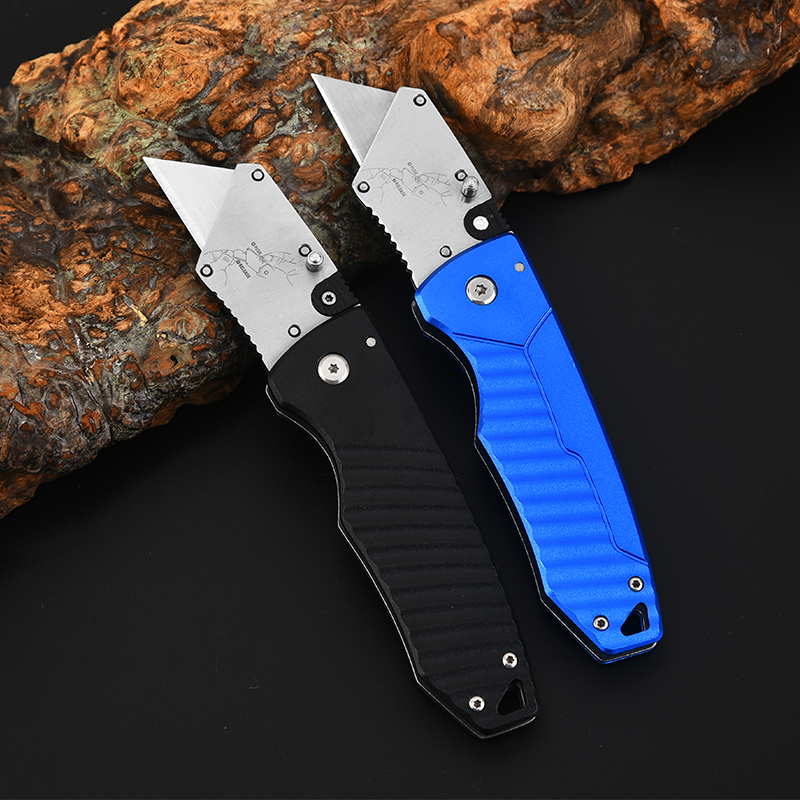
The opener helps deploy the blade. The lock, where fitted, holds it open. A thumb stud, for example, can work with several different locking systems.
No. A flipper can operate a manual or assisted-opening knife. Check the action description rather than assuming a spring is present.
Not necessarily. Manual button-lock knives exist. Determine whether pressing the button releases a spring-powered blade or primarily disengages the lock.
There is no universal winner. Evaluate accessible studs, holes, tabs, or controls using the actual gloves and intended hand positions.
No. Closing depends on the lock, mechanism, and instructions. Evaluate opening and closing as separate operations.
Not necessarily. Definitions and restrictions vary by jurisdiction. Check current rules for the specific product, destination, and activity rather than relying on a general category label.
1. [Blade HQ — "Knife Opening Mechanisms"]. Source for the original article's eight opening categories and introductory mechanism descriptions. [bladehq]
2. [Benchmade — "Knife Mechanisms Explained: Features, Uses, and Tips"]. Technical reference for the distinction between manual opening, assisted opening, automatic deployment, and locking systems. [benchmade]
3. [Benchmade Support — "Knife Opening Actions"]. Supporting reference for opening-action terminology and automatic controls. [support.benchmade]
4. [Kershaw — "Important Information On Your New Kershaw Knife"]. Manufacturer guidance on assisted-opening operation, blade-path precautions, maintenance, and appropriate adjustment tools. [kershaw.kaiusa]
5. [Blade HQ — "OTF Knife Guide: Legality, How They Work, Best Brands, & More!"]. Reference for OTF construction and single-action versus double-action operation. [bladehq]
6. [American Knife and Tool Institute — "State Knife Laws"]. U.S. legal-reference starting point covering restrictions associated with knife types, possession, sale, and carry. It is not a substitute for checking applicable law. [akti]


