


Views: 288 Author: Holin Knife Publish Time: 2026-10-29 Origin: Site


Content Menu
● Mini EDC Knife vs Full-Size EDC Knife: Quick Comparison
● What Defines a Mini EDC Knife?
>> Where a Mini Pocket Knife Works Best
● What Defines a Full-Size EDC Knife?
>> Where a Full-Size Pocket Knife Makes Sense
● Blade Length vs Cutting Geometry: What Actually Determines Performance?
>> Why a Smaller Blade Can Cut More Easily
>> Match Edge Design to the Intended Material
● Ergonomics: Handle Fit Matters More Than the "Mini" Label
>> Check These Four Contact Points
● Pocket Carry: Weight Is Only Part of the Story
>> Real Product Example: Mini Bugout vs Bugout
● Blade Steel, Heat Treatment, and Maintenance
>> Understand the Main Trade-Offs
>> Maintenance Should Match the User
● Safety and Carry Laws: A Mini Knife Is Not Automatically Legal
● A Practical Five-Step Knife Comparison Test
>> Step 1: Define the Real Workload
>> Step 2: Compare Representative Samples
>> Step 3: Repeat Ordinary Cutting Tasks
>> Step 4: Evaluate Carry Separately
>> Step 5: Record the Trade-Offs
● OEM/ODM Insight: Design a Product Family, Not Just a Smaller Copy
>> What Should Be Reviewed Independently?
>> Build the Procurement Brief Around Acceptance Criteria
● Develop an EDC Knife Around Your Customer's Tasks
>> Is a Mini EDC Knife Enough for Everyday Use?
>> Is a Full-Size EDC Knife Always Stronger?
>> Which Size Is Better for Large Hands?
>> Is a Mini Pocket Knife Better for Travel?
>> Can a Mini Knife Use the Same Steel as a Full-Size Knife?
>> Should a Knife Brand Offer Both Sizes?
Choosing a mini EDC knife vs full-size EDC knife comes down to one practical question: how much cutting capability will you actually use? A compact pocket knife prioritizes easy carry and quick everyday tasks. A full-size folding knife typically provides more usable edge and a roomier grip for sustained work.
My recommendation is to choose the smallest knife that handles your regular tasks comfortably—not simply the shortest blade available. Handle fit, cutting geometry, maintenance, and local regulations matter as much as size.
For buyers developing a private-label range, the same principle applies. Start with the customer's working environment, then build the product specification around it.

EDC means "everyday carry." Neither "mini" nor "full-size" has a universal dimensional standard. The ranges below are working categories for this comparison, not legal definitions or industry specifications.
| Comparison factor | Mini EDC knife | Full-size EDC knife |
|---|---|---|
| Illustrative blade length | Approximately 2–3 inches | Approximately 3–4 inches |
| Main advantage | Compact, unobtrusive carry | More cutting length and grip space |
| Typical applications | Parcels, tags, light cord | Larger packaging, repeated utility cuts |
| Handle fit | May limit finger placement | More room for a full-hand grip |
| Pocket comfort | Often easier in shallow pockets | Depends heavily on thickness and clip |
| Glove compatibility | Small controls may be harder to operate | Larger controls may be easier to access |
| Cutting performance | Strongly dependent on geometry | Strongly dependent on geometry |
| Legal status | Not automatically lawful | Requires the same jurisdiction-specific checks |
These categories overlap. A lightweight full-size knife can carry more comfortably than a thick, metal-handled mini.
A mini EDC knife is a compact everyday carry knife designed to reduce pocket footprint while retaining useful cutting capability.
Its appeal is straightforward: a knife that fits comfortably into daily clothing is easier to carry consistently.
Typical applications include:
- Opening parcels and envelopes.
- Cutting packaging tape.
- Removing clothing tags.
- Trimming light cord.
- Handling occasional small utility cuts.
For these tasks, additional blade length may provide little practical benefit. A short, well-ground edge can be entirely adequate.
However, "mini" does not guarantee comfortable handling. Some designs provide a secure four-finger grip through careful handle shaping. Others leave the little finger unsupported.
That difference matters more during repeated cuts than during a single package opening.
A full-size EDC knife generally offers a longer blade and a larger handle than its compact counterpart.
The benefit is not simply "more power." It is additional working space: more edge to complete a slicing motion and more handle surface to support the hand.
A larger folding knife may suit:
- Frequent packaging breakdown.
- Cutting thicker cordage.
- General campsite utility.
- Tasks performed while wearing gloves.
- Users who find compact handles cramped.
Nevertheless, full-size does not mean suitable for every demanding task. A folding knife should not replace a pry bar, screwdriver, or purpose-built chopping tool.
For repetitive packaging work, a replaceable-blade utility knife may also be a better choice than either EDC format.
Blade length determines available reach and slicing distance. It does not independently determine cutting efficiency.
A useful comparison must also examine blade stock thickness, grind, thickness behind the edge, and sharpening angle.
A thin mini blade may pass through cardboard more easily than a thicker full-size blade.
The reason is geometry: after the edge initiates the cut, the material must move around the blade. A thicker cross-section can create greater wedging resistance.
Conversely, a longer blade can complete some slicing tasks with fewer repositioning movements.
The practical conclusion is simple: compare knives on the same material before deciding that larger means better.
For general packaging, prioritize controlled cutting and efficient slicing. For cordage, consider how the edge engages flexible material.
Do not select blade thickness solely because it looks durable in product photographs. Excess thickness can undermine everyday cutting performance without improving the customer's actual experience.
When evaluating an everyday carry knife, I would examine handle fit before debating small differences in blade length.
A knife that feels secure during a brief demonstration may become uncomfortable after repeated cuts.
1. Grip length: Can the intended user hold the handle securely?
2. Handle edges: Do sharp transitions create pressure points?
3. Pocket clip: Does it press into the palm?
4. Controls: Can the user operate the mechanism without an awkward grip change?
A full-size handle often gives larger hands more room. A well-designed mini may still work effectively if its contours suit the user.
For gloved applications, test the actual glove type. Thin assembly gloves and insulated outdoor gloves create very different handling requirements.
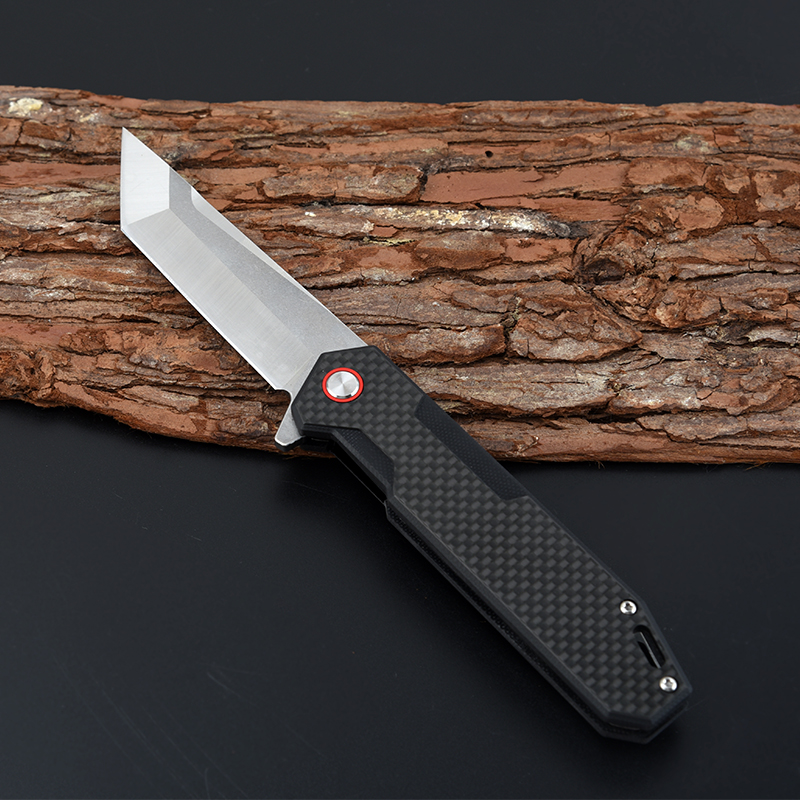
A lightweight EDC knife can still feel bulky if its handle is thick or its clip catches on clothing.
Evaluate the closed knife as a complete object:
- Closed length.
- Maximum width.
- Handle thickness.
- Clip position and tension.
- Exposed edges.
- Compatibility with normal pocket contents.
A mini pocket knife may be preferable for shallow pockets or lightweight clothing. A slim full-size knife may remain comfortable in deeper workwear pockets.
Benchmade's published specifications provide a useful size comparison:
| Specification | Mini Bugout 533BK-1 | Full-size Bugout comparison |
|---|---|---|
| Blade length | 2.82 inches | 3.24 inches |
| Closed length | 3.70 inches | 4.22 inches |
| Open length | 6.49 inches | 7.46 inches |
These figures show why size categories require context. The blade-length difference is 0.42 inches, but the handle and overall dimensions also change.
This example illustrates dimensional trade-offs, not a claim that all mini and full-size knives follow the same proportions. Materials and specifications also vary between individual versions.
Knife size does not determine steel quality.
Both mini and full-size EDC knives can use steels selected for different balances of wear resistance, toughness, and corrosion resistance.
- Edge retention describes how well an edge maintains cutting ability under a defined workload.
- Toughness concerns resistance to fracture and chipping.
- Corrosion resistance concerns resistance to rusting and related attack.
- Sharpening requirements depend on steel properties, edge condition, geometry, and abrasive selection.
Metallurgical research shows that hardness and carbide characteristics influence these properties. A steel name alone does not describe the complete finished blade.
For purchasing decisions, evaluate the steel grade together with the specified heat treatment and intended use.
A premium steel cannot compensate for an uncomfortable handle or unsuitable geometry.
For occasional household tasks, manageable upkeep may matter more than maximum wear resistance.
For humid working environments, corrosion resistance deserves greater attention. Regardless of size, follow the manufacturer's cleaning, drying, lubrication, and sharpening instructions.
Avoid assuming that stainless steel means maintenance-free.
Blade length is only one part of legal compliance. Rules may also address locking mechanisms, opening methods, location, and the reason for carrying.
For example, UK government guidance describes an exception for folding pocketknives with a cutting edge no longer than three inches that are not lock knives. That is not equivalent to saying every knife marketed as "mini" qualifies.
Check the rules applicable to the destination and intended use. Workplace and venue policies may impose additional restrictions.
From a handling perspective, neither size is inherently safe. Maintain control of the workpiece, keep fingers away from the cutting path, and follow the mechanism's operating instructions.
A locking mechanism does not make a folding knife immune to misuse or mechanical failure.
The following is a proposed evaluation method, not a report of completed laboratory testing.
It helps consumers and purchasing teams move beyond specification sheets.
List the materials, cutting frequency, normal clothing, glove requirements, and operating environment.
"Outdoor use" is too broad. Opening meal packaging and repeatedly cutting rope demand different design priorities.
Use knives with comparable edge condition. Record blade dimensions, handle dimensions, weight, and materials.
Otherwise, differences in sharpness may be mistaken for differences caused by size.
Use consistent materials and comparable cutting lengths. Record cut completion, repositioning, perceived effort, and grip discomfort.
Do not introduce twisting, prying, or improvised destructive tests.
Carry each closed knife in normal clothing where permitted.
Check whether the clip interferes with pocket access and whether the handle creates pressure when sitting.
Use the same scoring sheet for every sample:
| Evaluation area | Suggested observation |
|---|---|
| Cutting | Clean completion and required repositioning |
| Ergonomics | Secure grip and pressure points |
| Carry | Pocket interference and sitting comfort |
| Operation | Controlled opening and closing |
| Maintenance | Cleaning access and sharpening requirements |
This process produces a defensible comparison without pretending that one size wins every category.
For brands comparing mini EDC knife vs full-size EDC knife opportunities, simple proportional scaling is an incomplete development strategy.
Shrinking every component can make controls harder to access, reduce grip space, or leave an awkward clip-to-handle relationship.
A compact version should receive its own assessment of:
- Handle contour and usable grip length.
- Opening-control accessibility.
- Lock engagement and release access.
- Clip placement.
- Blade-to-handle clearance.
- Assembly tolerances and inspection criteria.
Visual consistency can connect two products. Their ergonomics still need independent validation.
An OEM/ODM brief should identify target dimensions, steel, handle material, mechanism, finish, destination market, and intended application.
It should also define sample approval and production inspection requirements. Discuss dimensional tolerances, blade centering, opening consistency, edge condition, and mechanism function with the manufacturer.
These are proposed purchasing considerations—not claims that a particular factory already uses a specified testing protocol.
Yangjiang Holin Industrial Co., Ltd. has an in-house R&D team, its own production factory, stable scaled manufacturing capability, and one-stop OEM/ODM support covering design, development, and batch production.
Those capabilities provide a starting point for discussing a coordinated mini and full-size product range.
Choose a mini EDC knife when compact carry supports the workload. Choose a full-size EDC knife when additional handle space and cutting length deliver a clear practical benefit.
For a custom product line, send Yangjiang Holin Industrial Co., Ltd. your target market, intended applications, preferred dimensions, materials, and estimated order quantity. Request a design review and sampling proposal that evaluates mini and full-size options against the same purchasing requirements.
Often, yes—for parcels, tags, tape, and occasional light cutting. Choose by actual workload and handle comfort rather than blade length alone.
No. Strength and durability depend on materials, geometry, mechanism design, heat treatment, assembly, and loading conditions. Size alone cannot establish a reliable ranking.
A full-size handle often provides more grip space. However, some compact designs accommodate larger hands effectively. Compare usable handle length and contour rather than overall length alone.
It may take less space, but compact dimensions do not establish transport or carry permission. Check destination rules and the policies of the relevant transport operator before packing.
Yes. Blade size does not require a particular steel grade. The appropriate specification depends on the intended balance of cutting performance, toughness, corrosion resistance, maintenance, and cost.
Consider both when customer requirements genuinely differ. A compact model can address carry comfort, while a larger version can serve users needing more grip and edge length. Validate demand before expanding the range.
- [Benchmade — Mini Bugout 533BK-1]. Manufacturer specifications supporting the compact model's dimensions. [benchmade]
- [Benchmade — Custom Mini Bugout]. Manufacturer comparison supporting the Mini Bugout and full-size Bugout blade and closed lengths. [benchmade]
- [Pro Tool Reviews — Benchmade Mini Bugout Pocket Knife Review]. Additional dimensional comparison, including open lengths; its aluminum-handle weight figures are not applied to other versions here. [protoolreviews]
- [Knife Steel Nerds — Knife Steels Rated by a Metallurgist: Toughness, Edge Retention, and Corrosion Resistance]. Metallurgical basis for steel-property definitions and performance trade-offs. [knifesteelnerds]
- [GOV.UK — Selling, Buying and Carrying Knives and Weapons]. Official guidance supporting the UK legal example. [gov]
- Company background: supplied by Yangjiang Holin Industrial Co., Ltd. in the article brief; not independently audited.


