


Views: 238 Author: Holin Knife Publish Time: 2026-09-24 Origin: Site


Content Menu
● Pocket Knife vs Folding Outdoor Knife: Core Definitions
● Which Category Is Growing Faster?
>> Why Pocket Knives Have Wider Volume Potential
>> Why Folding Outdoor Knives Are Gaining Value Faster
● Market Growth Drivers Behind Both Categories
>> Everyday Utility Is Supporting Pocket Knife Demand
>> Outdoor Lifestyles Are Raising Expectations
>> Safety and Compliance Affect Category Design
● Product Comparison: What Buyers Really Evaluate
● The Best Growth Strategy Is a Two-Tier Portfolio
>> Tier One: Everyday Pocket Knife Collection
>> Tier Two: Folding Outdoor Knife Collection
● How to Select the Right Category for Your Brand
>> 1. Define Your Primary Sales Channel
>> 2. Identify the User's Main Task
>> 3. Build Specifications Before Choosing Materials
● Manufacturing Insight: Performance Comes From Details
● A Practical Development Checklist for Buyers
● Final Verdict: Which Category Is Growing Faster?
>> What is the main difference between a pocket knife and a folding outdoor knife?
>> Are folding outdoor knives more expensive than pocket knives?
>> Which product is better for a private-label brand?
>> Can a folding knife be designed for both everyday carry and outdoor use?
>> What materials are commonly used for folding outdoor knife handles?
>> How can buyers evaluate a folding knife manufacturer?
>> What should be tested before confirming a bulk folding knife order?
Pocket knives are currently growing through broader everyday utility demand, while folding outdoor knives are gaining stronger value momentum through premiumization, outdoor participation, and specialized use cases. For brands and buyers, the best opportunity is not to treat them as competing products alone, but to build a portfolio that serves both daily carry and outdoor-focused consumers.
A pocket knife and a folding outdoor knife may share the same basic folding structure, but they answer different purchasing motivations. One is designed around compact daily convenience. The other is designed around confidence in more demanding environments. Understanding that difference is essential for importers, private-label brands, wholesalers, and retailers planning a long-term knife assortment.
From a manufacturing perspective, the question is not simply, "Which knife sells more?" It is also, "Which category offers better repeat orders, stronger product differentiation, higher perceived value, and more room for customization?"
At Yangjiang Holin Industrial Co., Ltd., we see this distinction clearly during product development discussions with global buyers. Some customers want slim, practical folding pocket knives for broad retail programs. Others need robust folding outdoor knives with stronger locks, corrosion-resistant blades, textured handles, and purpose-built features for camping, hiking, fishing, and emergency use.
Both categories are expanding. However, they are growing for different reasons.
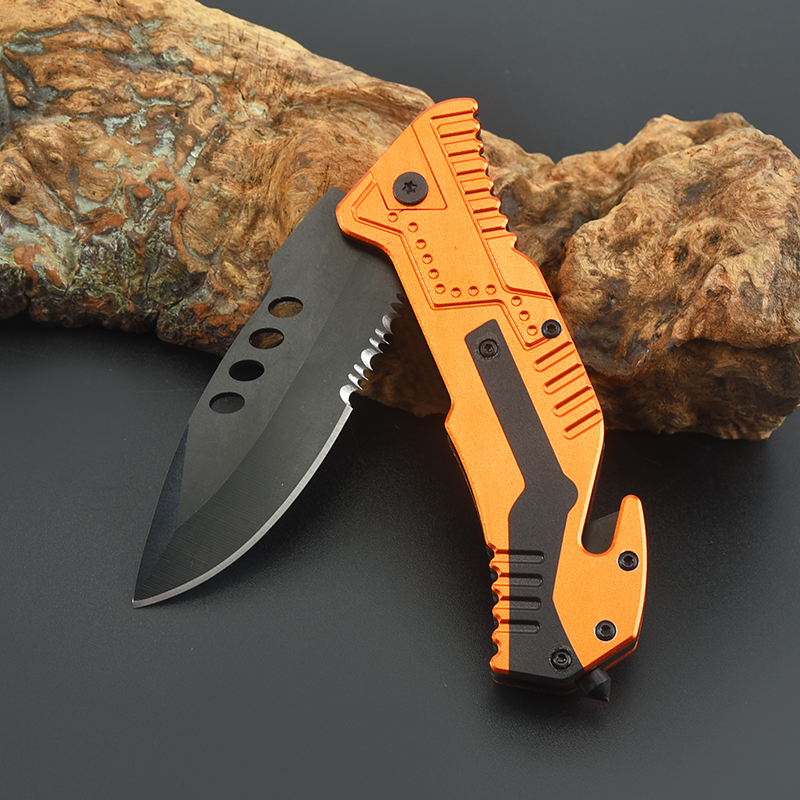
A pocket knife is a compact folding knife intended for daily convenience. It is often carried in a pocket, small bag, glove compartment, toolbox, or key everyday kit. The product typically prioritizes portability, low weight, easy opening, and routine cutting tasks.
Typical pocket knife applications include:
- Opening cartons and parcels
- Cutting rope, tape, cable ties, and wrapping
- Light food preparation during travel
- Small household tasks
- Everyday carry use
- Promotional, gift, or private-label retail programs
A folding outdoor knife is a more purpose-driven folding tool developed for outdoor activities. It generally requires greater blade strength, more secure lock performance, improved grip, weather resistance, and higher user confidence under changing field conditions.
Typical folding outdoor knife applications include:
- Camping and hiking
- Fishing and hunting-related outdoor tasks
- Rope cutting and gear repair
- Food preparation at campsites
- Wood processing and light carving
- Emergency preparedness kits
- Adventure, survival, and outdoor equipment collections
The categories overlap. A consumer may carry the same folding knife at work and on a weekend hike. Yet their product expectations are different.
| Comparison Factor | Pocket Knife | Folding Outdoor Knife |
|---|---|---|
| Primary purpose | Everyday convenience | Outdoor reliability and task performance |
| Typical size | Small to medium | Medium to large |
| Weight priority | High | Moderate |
| Blade design | Simple, versatile, compact | Stronger, thicker, task-specific |
| Handle design | Slim and pocket-friendly | Textured, ergonomic, weather-resistant |
| Lock expectation | Basic to mid-level security | Strong locking performance is often essential |
| Price sensitivity | Usually higher | Often lower when performance is clear |
| Customization potential | Branding, colors, packaging | Materials, locks, blades, grips, accessories |
| Buyer type | Retailers, gift buyers, distributors | Outdoor brands, specialty retailers, equipment suppliers |
The most accurate answer is that pocket knives are expanding faster in unit-volume opportunities, while folding outdoor knives are often growing faster in product value and premium positioning.
The wider knife market is projected to grow from USD 5.14 billion in 2026 to USD 8.52 billion by 2034, representing a projected compound annual growth rate of 6.51%. Folding knives are estimated to account for about 29% of the overall knife market, supported by portability, daily usefulness, light utility work, and outdoor recreation demand.
This creates a favorable environment for both categories. However, the drivers are not identical.
Pocket knives benefit from a larger addressable user base. A buyer does not need to be a camper, hiker, hunter, or outdoor specialist to purchase one. The product can appeal to office workers, drivers, home users, warehouse staff, hobbyists, travelers, and gift buyers.
This broad usefulness gives pocket knives several commercial advantages:
- Lower entry barriers for first-time buyers
- More compact packaging and shipping efficiency
- Easier inclusion in mass retail programs
- Strong potential for logo customization and promotional orders
- Wider price-point coverage, from budget to premium
- Frequent demand for seasonal gifts, tools, and everyday accessories
For a private-label customer, a simple folding pocket knife can be developed quickly around a proven platform. The buyer may choose blade finish, handle color, clip design, logo position, packaging, and retail presentation without requiring a fully new mechanical structure.
This makes the category attractive for volume-focused programs.
Folding outdoor knives serve consumers who are more likely to compare technical details. They care about blade steel, thickness, edge retention, corrosion resistance, lock type, handle traction, opening method, carry clip, sheath options, and overall field reliability.
These buyers may purchase fewer products, but they are often willing to pay more for a knife that feels dependable.
The outdoor audience is also expanding. The Outdoor Industry Association reports that outdoor recreation participation in the United States reached a record 183.2 million people in 2025. Its research also highlights hiking as a major activity, with 63.4 million participants recorded in 2024, while camping continues to show broad and growing consumer appeal.
This does not mean every outdoor participant will buy a folding knife. It does mean that the lifestyle ecosystem supporting outdoor equipment, camping accessories, compact tools, and durable gear remains substantial.
For brands, the opportunity lies in creating a folding outdoor knife that feels specific rather than generic.
A product can become more compelling through features such as:
- High-carbon stainless-steel blades
- Secure liner lock, frame lock, back lock, or crossbar-style lock systems
- G10, aluminum, wood, micarta, or reinforced polymer handles
- Non-slip grip textures
- Corrosion-resistant coatings
- Deep-carry pocket clips
- Lanyard holes
- Glass-breaker or rescue-oriented functions where appropriate
- Outdoor-ready packaging and accessory bundles
The strongest manufacturers do not rely on one trend. They watch several demand signals at the same time.
Consumers continue to value compact tools that solve simple daily problems. Cutting packaging, opening deliveries, trimming cord, preparing snacks, and handling small repairs are ordinary tasks. A practical folding pocket knife meets these needs without taking up much space.
The growth of parcel delivery and home-based purchasing has also increased visibility for compact cutting tools. Consumers regularly encounter boxes, tape, plastic wraps, and shipping materials.
For commercial buyers, this creates demand for products that are:
- Easy to carry
- Simple to operate
- Cost-effective
- Suitable for broad consumer groups
- Available in multiple colors and styles
- Easy to package for retail shelves or online sales
Outdoor consumers are not only looking for a cutting edge. They are looking for trust in use.
A folding outdoor knife may be used in wet conditions, low temperatures, remote locations, or situations where a failed lock, slippery handle, or poor corrosion resistance creates frustration. This raises the importance of material selection, tolerance control, assembly consistency, and functional testing.
Outdoor products also benefit from storytelling. A basic pocket knife may be sold as a useful tool. A folding outdoor knife can be positioned as part of a wider experience involving camping, fishing, hiking, trail meals, gear maintenance, and self-reliant travel.
That emotional connection supports stronger brand differentiation.
Knife products must be developed with destination-market regulations, age restrictions, carry rules, blade limitations, labeling requirements, and online marketplace policies in mind. These requirements differ significantly by country, state, region, and sales platform.
For products sold in the European Union, the General Product Safety Regulation requires economic operators to place only safe products on the market and requires a responsible economic operator in the EU for covered products.
For importers and brand owners, this means product development should include more than visual design. It should include:
- Intended-use assessment
- Lock and opening mechanism evaluation
- Sharp-edge and pinch-point review
- Packaging warnings where required
- Traceability and supplier documentation
- Market-specific labeling review
- Clear user instructions
- Responsible product presentation
A reliable manufacturing partner should support these preparation stages with consistent specifications, inspection records, samples, and production controls.

The fastest-growing category for a specific buyer depends heavily on what they value most.
| Buyer Priority | Better Fit | Reason |
|---|---|---|
| Broad consumer reach | Pocket knife | Daily-use appeal reaches more customer types |
| Low-cost private label | Pocket knife | Existing platforms can reduce development complexity |
| Premium outdoor positioning | Folding outdoor knife | More room for materials, functions, and performance claims |
| Gift and promotional sales | Pocket knife | Compact size and logo-friendly surfaces |
| Specialty outdoor retail | Folding outdoor knife | Matches camping, hiking, fishing, and gear categories |
| High repeat-order volume | Pocket knife | Broad price points and year-round utility demand |
| Higher average selling price | Folding outdoor knife | Technical features can justify stronger retail value |
| Strong brand differentiation | Folding outdoor knife | Design details and user scenarios create distinction |
| Fast product launch | Pocket knife | Standardized platforms are easier to adapt |
| Long-term product family development | Folding outdoor knife | Supports multiple blade, handle, and accessory variants |
For many brands, choosing only one category creates unnecessary limitations. The more practical approach is to build a two-tier folding knife range.
This collection should focus on portable, accessible, and commercially flexible products.
Recommended product directions:
- Slim stainless-steel folding knives
- Compact EDC pocket knives
- Small multi-blade pocket knives
- Lightweight aluminum-handle folders
- Wooden-handle gift pocket knives
- Budget-friendly private-label knife series
- Branded promotional folding tools
- Small utility folding knives for daily tasks
The objective is to create steady volume, approachable retail pricing, and broad consumer appeal.
This collection should focus on performance, user confidence, and outdoor identity.
Recommended product directions:
- Locking folding camping knives
- Corrosion-resistant fishing folding knives
- Ergonomic hiking knives
- Outdoor rescue-style tools
- Heavy-duty folding utility knives
- Outdoor knife and multitool bundles
- Premium G10 or micarta-handle folders
- Folding knives with pouch, clip, or lanyard options
The objective is to increase perceived value, improve margins, and give the brand a stronger technical identity.
Before requesting samples, use the following decision process.
A mass retailer, discount store, gift distributor, online marketplace seller, outdoor specialty store, and professional tool supplier do not need the same product.
Choose pocket knives when your channel emphasizes:
- High assortment turnover
- Lower retail prices
- Giftability
- Compact display programs
- Broad customer demographics
- Logo customization
Choose folding outdoor knives when your channel emphasizes:
- Outdoor expertise
- Product storytelling
- Material performance
- Higher perceived value
- Technical product comparison
- Brand loyalty
A knife becomes more competitive when it is designed around a clear use case.
For example:
- A commuter needs a compact, unobtrusive everyday tool.
- A warehouse customer needs a safer cutting tool for packaging materials.
- A camper needs a reliable knife for food preparation, cordage, and gear tasks.
- A fishing customer needs corrosion resistance and easy cleaning.
- A hiking customer needs low weight without sacrificing lock security.
Avoid designing a product that tries to satisfy every person equally. The result is often a knife with no clear advantage.
Buyers often start with a material request, such as "We need a G10 handle" or "We need a stainless-steel blade." A stronger development process starts with the task.
Ask:
1. What materials will the knife cut most often?
2. Will it be used in wet, humid, or salty conditions?
3. How important is weight?
4. What level of lock security is expected?
5. Is one-handed opening necessary?
6. What target retail price must the product support?
7. What packaging format will be used?
8. Which market will receive the product?
Only then should the buyer finalize blade steel, blade thickness, handle material, lock structure, finish, and accessories.
In knife production, visual similarity does not guarantee equal quality. Two folding knives may look nearly identical in photos but perform very differently after repeated use.
The important differences often appear in:
- Blade centering
- Opening and closing smoothness
- Lock engagement
- Lock release consistency
- Pivot tolerance
- Screw retention
- Handle fit
- Blade edge consistency
- Surface finishing
- Corrosion resistance
- Packaging protection during shipment
For a folding outdoor knife, these factors are especially important because users may apply more force and expect dependable performance in less controlled environments.
For a pocket knife, precision still matters. A compact knife with rough action, off-center blade alignment, or inconsistent finishing can quickly damage consumer trust.
A capable OEM/ODM manufacturer should therefore combine product engineering with structured production control. At Yangjiang Holin Industrial Co., Ltd., this means supporting buyers from concept discussion and design refinement through sample confirmation, material selection, production planning, inspection, packaging, and bulk delivery.
Use this checklist before placing an order for pocket knives or folding outdoor knives.
- Define the intended user and main task
- Confirm target-country product requirements
- Select a suitable blade profile and blade length
- Choose the right lock mechanism
- Define blade steel, hardness target, and finish
- Select handle material based on cost and user environment
- Confirm opening method and carry configuration
- Request samples before bulk approval
- Test blade centering, lock engagement, and opening action
- Approve logo artwork and packaging layout
- Confirm inspection standards and acceptable quality limits
- Review carton strength and export packing details
- Plan repeat-order lead times and safety stock
Pocket knives are likely to generate faster broad-market volume growth because they serve more everyday users, fit more retail channels, and support accessible price points.
Folding outdoor knives are likely to grow faster in premium value because outdoor participation, technical product expectations, and specialized use cases support stronger differentiation and higher average selling prices.
For brands that want resilient long-term growth, the strongest answer is not "pocket knife or folding outdoor knife." It is a balanced collection that offers:
- Compact everyday knives for broad customer acquisition
- Performance outdoor folders for stronger margins and brand identity
- Custom designs that fit the needs of a specific market
- Consistent manufacturing quality that supports repeat orders
If you are developing a private-label knife range, Yangjiang Holin Industrial Co., Ltd. can help turn your concept into a production-ready pocket knife or folding outdoor knife program. Our team supports product design, material selection, prototype development, logo customization, packaging, quality inspection, and scalable OEM/ODM manufacturing for global buyers.

A pocket knife is usually designed for compact daily use, light cutting tasks, and convenient carry. A folding outdoor knife is generally built for more demanding use, with stronger locking systems, more durable materials, improved grip, and outdoor-focused functions.
Usually, yes. Folding outdoor knives often use thicker blades, stronger locks, premium handle materials, protective coatings, and more complex construction. However, pricing depends on the material, design, order quantity, packaging, and customization requirements.
It depends on your target market. Pocket knives are often better for mass retail, gifts, and general everyday carry. Folding outdoor knives are more suitable for outdoor brands, camping retailers, fishing suppliers, and customers seeking a higher-value product.
Yes. Many successful products sit between the two categories. A medium-size folding knife with a secure lock, corrosion-resistant blade, lightweight handle, and pocket clip can work for daily tasks as well as hiking, camping, and travel.
Common materials include G10, micarta, aluminum, stainless steel, reinforced nylon, wood, and rubberized polymers. The best choice depends on desired grip, weight, weather resistance, cost, appearance, and target user.
Buyers should assess development capability, sample quality, lock performance, blade centering, tolerance control, material consistency, inspection procedures, packaging support, communication speed, and experience with OEM/ODM projects.
Important checks include sharpness, blade alignment, lock engagement, opening smoothness, closing action, handle fit, logo accuracy, coating quality, corrosion resistance where applicable, packaging strength, and shipment carton protection.
1. [Outdoor Industry Association — Reports Library and Annual Participation Trends] [outdoorindustry]
2. [Fortune Business Insights — Knife Market Size, Share and Industry Analysis] [fortunebusinessinsights]
3. [EUR-Lex — General Product Safety Regulation (EU) 2023/988] [eur-lex.europa]


