


Views: 264 Author: Holin Knife Publish Time: 2026-11-21 Origin: Site


Content Menu
● Industrial Utility Knife vs Consumer Utility Knife: Key Differences
● What Is an Industrial Utility Knife?
● What Is a Consumer Utility Knife?
● Construction and Durability: Look Beyond the Housing
>> Blade Support and Retention
● Blade Performance: Match the Edge to the Material
>> Blade Format and Cutting Depth
>> Sharpness Is Only Part of Performance
● Safety Features: Industrial Does Not Automatically Mean Safer
● Ergonomics and Productivity During Repeated Cutting
● Total Cost: Compare More Than Purchase Price
● A Practical Five-Step Utility Knife Evaluation
>> 2. Set Non-Negotiable Requirements
>> 4. Record Performance and Problems
>> 5. Approve a Reference Sample
● Two Application Scenarios That Change the Decision
>> Occasional Household Projects
● OEM/ODM Utility Knife Development for B2B Buyers
● Which Utility Knife Should You Choose?
● Start Your Utility Knife Development Project
>> Is an industrial utility knife always better than a consumer utility knife?
>> Are all industrial utility knives safety knives?
>> Can a consumer utility knife be used in a workplace?
>> Does a metal handle guarantee greater durability?
>> How often should utility knife blades be replaced?
>> What should buyers provide for an OEM/ODM quotation?
An industrial utility knife vs consumer utility knife comparison should begin with the cutting task—not the appearance of the handle. Both tools may open cartons, trim materials, and use replaceable blades. The meaningful differences are how they perform during repeated use, how they control blade exposure, and how easily buyers can maintain consistent performance.
At Yangjiang Holin Industrial Co., Ltd., our product-development perspective starts with a simple question: what must this knife do reliably in the customer's hands? For occasional household use, simplicity and affordability may be enough. For professional procurement, blade retention, ergonomics, maintenance, and repeatable manufacturing deserve closer attention.
This guide explains those differences and provides a practical framework for selecting or developing the right utility knife.
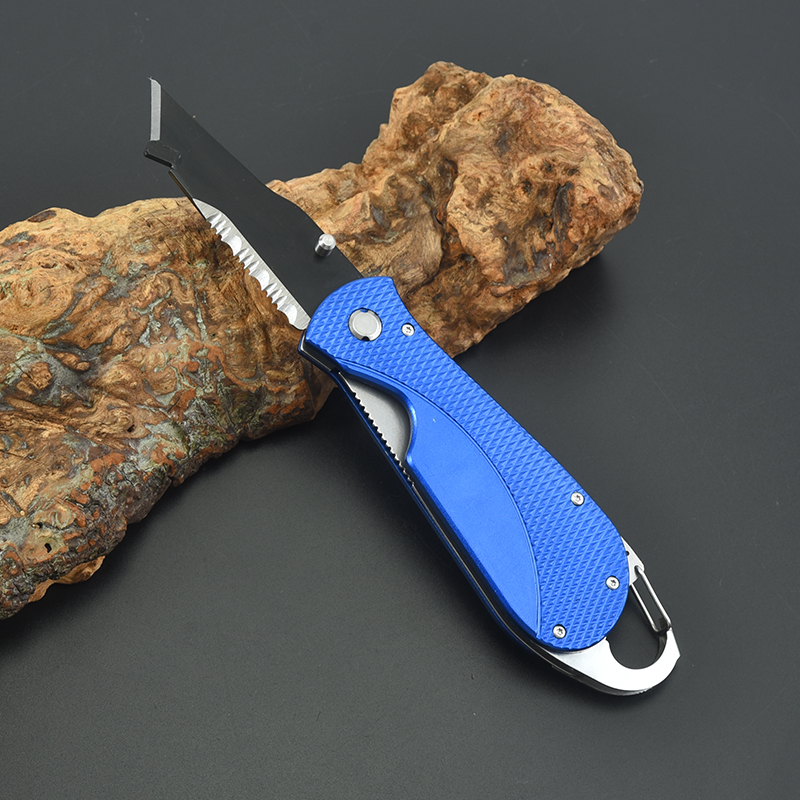
"Industrial" and "consumer" describe market positioning and intended use. Buyers should not treat either label as proof of tested performance or a particular safety mechanism.
| Comparison factor | Industrial utility knife | Consumer utility knife |
|---|---|---|
| Typical use | Repeated cutting in professional workflows | Occasional household and DIY tasks |
| Purchasing priority | Task suitability, durability, maintenance | Convenience, price, straightforward operation |
| Blade control | May include controlled exposure or safety retraction | Often manual extension and retraction |
| Handle design | Selected for repeated handling and working conditions | Often compact and easy to store |
| Blade replacement | Evaluated for frequent, controlled changes | Usually needed less frequently |
| Procurement approach | Samples, specifications, trials, quality checks | Individual purchase and basic feature comparison |
| Cost evaluation | Total operating cost | Primarily purchase price |
These are purchasing tendencies, not universal rules. A well-designed consumer knife may outperform a poorly specified industrial model.
An industrial utility knife is a replaceable-blade cutting tool selected for professional tasks such as packaging removal, material preparation, and production support.
The important distinction is not that every industrial model cuts thicker material. Some prioritize shallow, controlled cuts and product protection. Others provide greater cutting depth for suitable materials.
From a manufacturing standpoint, I would assess an industrial knife as a complete system:
- Blade specification and compatibility.
- Blade carrier and guide construction.
- Retention, locking, or retraction mechanism.
- Handle shape and surface.
- Blade-changing procedure.
- Inspection and replacement requirements.
A strong handle alone cannot compensate for unreliable blade retention or an unsuitable cutting mechanism.
A consumer utility knife is generally marketed for household maintenance, hobbies, unpacking, and occasional DIY projects.
Its appeal is practical: accessible pricing, manageable size, and simple operation. Depending on the model, it may use a segmented snap-off blade or a replaceable trapezoid blade.
Consumer positioning does not automatically mean poor quality. A lightweight knife can be appropriate when someone occasionally opens deliveries or trims thin materials.
The limitation appears when buyers select it for conditions they have not evaluated—for example, repeated cutting with gloves, frequent blade changes, or contamination from packaging adhesive.
Metal housings can provide a solid feel, but material alone does not determine professional suitability. Industrial safety knives are available with aluminum, recycled-plastic, and glass-fiber-reinforced plastic handles.
The better question is whether the complete construction suits the application.
Check for:
- Excessive blade movement.
- Loose fasteners or separating housing sections.
- Uncomfortable seams.
- Unreliable slider movement.
- Difficulty cleaning accessible areas.
A polymer knife with sound internal support may be more suitable than a heavier metal model with an imprecise mechanism.
Inspect the knife at its intended working extension. Excessive projection leaves more blade exposed and can make controlled cutting harder.
Do not confuse blade security with permission to apply side loads. Utility knives are cutting tools, not substitutes for pry bars, screwdrivers, or dedicated strapping cutters.
For bulk orders, specify the required blade position and retention behavior rather than relying on descriptions such as "extra strong."
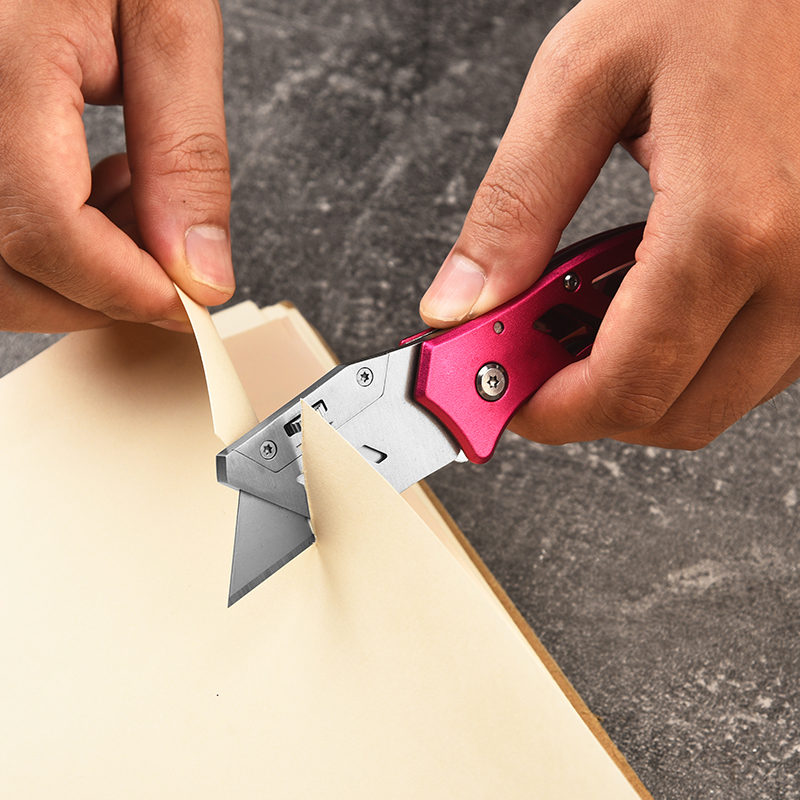
Blade format affects access, replacement procedures, and the cuts a tool can perform.
Common choices include:
- Segmented blades for applications that benefit from renewing the cutting tip.
- Trapezoid blades for compatible general-purpose utility knives.
- Proprietary safety blades designed around a particular guarded or retracting mechanism.
Never assume blades are interchangeable because they look similar. Confirm dimensions, thickness, locating features, and manufacturer compatibility.
Also distinguish blade dimensions from usable cutting depth. A blade may be substantially longer than the portion exposed during operation.
A useful blade evaluation includes cutting force, edge deterioration, material snagging, and cut quality.
Changing the handle will not solve every cutting problem. If performance deteriorates, investigate the blade condition, material, working angle, and tool suitability.
Our development approach would be to confirm the blade-and-task combination before investing in cosmetic customization. That sequence helps prevent a visually attractive product from becoming a poor working tool.
Safety mechanism is a more useful purchasing term than "industrial grade."
The user extends and retracts the blade. A lock may hold it at a selected position.
This can support certain cutting tasks, but safe storage depends on the user retracting or covering the edge as instructed.
In an automatic-retraction design, the blade generally retracts when the user releases the operating control.
Confirm the exact mechanism. Keeping a thumb on a slider may prevent retraction on some designs.
Fully automatic systems can retract the blade after it leaves the material even if the user continues operating the trigger.
Buyers should verify this behavior on the actual model rather than treating "retractable" as an equivalent claim.
Concealed-blade cutters restrict access to the cutting edge. They can suit compatible packaging tasks and help protect packaged contents.
However, the guarded opening limits the materials and thicknesses the tool can accept. Select the most protective mechanism that still performs the required cut reliably.
No mechanism eliminates the need for training, inspection, and appropriate working methods.
A knife that feels comfortable for one cut may feel different after repeated use.
For professional selection, assess:
- Grip security with required gloves.
- Trigger or slider effort.
- Left- and right-handed operation.
- Wrist position.
- Handle pressure points.
- Ease of reaching the blade-change control.
Do not assume heavier means better. Weight, balance, and handle geometry should be evaluated together.
Likewise, do not claim that a handle reduces fatigue or prevents injuries without appropriate evidence. User trials can identify preference and usability problems, but they do not establish medical benefits.
A consumer utility knife may cost less initially. An industrial model may justify a higher price if it performs the task reliably and reduces maintenance interruptions.
Neither result should be assumed.
Use total cost as a procurement framework:
> Total operating cost = knife purchases + replacement blades + blade-changing labor + maintenance and replacement costs.
Track product damage separately when it is relevant. Record incidents and near misses through the organization's safety process rather than inventing a financial value for them.
Useful comparison measures include:
- Blade expenditure per defined quantity of cuts.
- Time required for a blade change.
- Number of tools removed from service.
- Frequency of failed cuts or rework.
- Packaging contents damaged during opening.
Avoid unsupported promises such as "lasts three times longer." Establish performance through comparable testing.
This proposed evaluation process is a purchasing framework, not a certification standard.
Record the material, thickness, cutting direction, working surface, and required depth.
"Warehouse use" is too broad. Opening taped cartons differs from cutting stretch film or processing thick packaging.
Specify acceptable blade exposure, required mechanism, glove compatibility, and replacement-blade availability.
Include relevant site rules and destination-market requirements.
Use the same material batches and a documented procedure. Keep operators and working conditions as consistent as practical.
Do not conduct improvised overload or blade-breakage tests.
Measure cut completion, blade changes, operating difficulties, and visible wear.
Collect operator feedback alongside observations. A popular handle is not sufficient if its blade control fails the requirement.
Before ordering, approve the product specification and a physical reference sample.
Document blade compatibility, mechanism behavior, finish, packaging, and agreed inspection criteria. This connects the purchasing decision to repeatable production.
Consider a distribution operation opening cartons containing damage-sensitive goods.
The decision should prioritize controlled cutting depth, suitable guarding or retraction, and compatibility with the packaging.
A large exposed blade may add little value. A concealed-blade cutter could be preferable if it accepts the material and completes the required cuts.
Now consider someone opening deliveries and trimming thin craft materials several times a month.
A straightforward consumer utility knife may be sufficient. Paying for a specialized industrial mechanism is unnecessary if it does not improve the actual task.
These scenarios illustrate selection logic; they are not customer case studies or measured performance claims.
For importers, distributors, and private-label brands, the decision also concerns product positioning.
At Yangjiang Holin Industrial Co., Ltd., our in-house research and development team and manufacturing operation support product design, development, and volume production through OEM/ODM cooperation.
A useful development brief should cover:
1. Target users and applications.
2. Materials and required cutting depth.
3. Blade format and supply strategy.
4. Handle dimensions and operating preferences.
5. Required blade-control mechanism.
6. Branding, packaging, and instructions.
7. Testing, inspection, and market documentation.
Discuss feasibility before promising a feature. A requested mechanism, coating, or material needs engineering review and validation.
Customization should improve the product's fit for its intended market—not simply add a logo.
Choose a consumer utility knife when the work is occasional, the materials are suitable, and straightforward operation meets the requirement.
Choose an industrial utility knife when repeated use, controlled blade behavior, maintainability, or procurement consistency requires more detailed evaluation.
For professional buyers, my recommendation is to define the cut first, evaluate the mechanism second, and compare operating cost third. Appearance and branding should follow.
Send Yangjiang Holin Industrial Co., Ltd. your cutting application, target market, expected order volume, and customization requirements. Our team can review the brief and discuss a suitable OEM/ODM development path—from product design through bulk production.
No. It is better only when its features match the application. An unnecessarily specialized tool can be less convenient for occasional household work.
No. Some have manually controlled exposed blades. Confirm whether the actual model uses manual, automatic, fully automatic, or concealed-blade technology.
Potentially, if it suits the task and meets workplace requirements. Selection should follow the employer's assessment, instructions, training, and inspection procedures.
No. Evaluate the complete assembly, including blade support, retention, moving components, and handle integrity. Professional products can also use engineered polymer housings.
Follow the manufacturer's instructions and inspect performance. Replace damaged or ineffective blades, and stop using a retracting knife if its mechanism does not function reliably.
Provide the intended application, material samples where practical, blade requirements, mechanism preferences, quantity expectations, branding, packaging, and destination-market documentation needs.
- Canadian Centre for Occupational Health and Safety, "Working Safely with Sharp Blades or Edges." Supports the discussion of blade hazards, safer tool selection, retraction, and handling precautions. [ccohs]
- Canadian Centre for Occupational Health and Safety, "General Hand Tool Operation." Supports task-appropriate selection, training, maintenance, and removal of defective tools. [ccohs]
- MARTOR, "Safety Technology." Explains concealed blades, automatic retraction, and fully automatic retraction. Manufacturer descriptions explain mechanisms; they are not universal guarantees. [martor]
- MARTOR, "Logistics." Supports application-based selection, goods protection, and the limitations of concealed versus exposed retracting blades. [martor]
- MARTOR, "Production." Supports matching safety technology to material and cutting requirements, including reliable retraction during continued use. [martor]
- MARTOR, SECUPRO MARTEGO, SECUPRO 425, and SECUPRO MAXISAFE product specifications. Provide examples of aluminum, recycled-plastic, and glass-fiber-reinforced plastic professional knife housings. [martor]


