


Views: 298 Author: Holin Knife Publish Time: 2026-11-19 Origin: Site


Content Menu
● Metal vs Plastic Utility Knives: Quick Comparison
● What "Metal" and "Plastic" Actually Describe
>> Metal utility knife: Look beyond the housing
>> Plastic utility knife: A molded handle can still have a steel guide
● How Body Material Affects Durability, Comfort, and Cutting
>> Durability: Compare where each design can fail
>> Comfort: Evaluate the knife with the gloves operators wear
>> Cutting quality: Separate blade performance from handle performance
● Which Utility Knife Fits Your Application?
>> A retractable blade is not necessarily self-retracting
● A Five-Step Sample Trial for Bulk Utility Knife Orders
● Bulk Buying: Compare Replacement Costs Before Unit Prices
● Specify the Utility Knife Before Requesting an OEM/ODM Quote
>> Is a metal utility knife always more durable than a plastic one?
>> Is a plastic utility knife suitable for daily warehouse use?
>> Does a metal handle make a utility knife cut better?
>> Can metal and plastic utility knives use the same replacement blades?
>> Is a utility knife labeled "auto-lock" also auto-retracting?
>> Which utility knife should a distributor stock first?
A metal utility knife is a good starting point when you need a rigid housing for repeated workshop use. A plastic utility knife may be a better fit when low weight, grip comfort, or color coding matters more. But the handle material alone won't tell you which knife cuts cleaner, holds up longer, or is safer for your team. Blade support, cutting depth, and retraction matter more than the material label for many everyday jobs.
From a manufacturer's perspective, the first question I'd ask a buyer isn't "Metal or plastic?" It's "What are your operators cutting, and what must the blade avoid touching?" Opening cartons over finished goods is a different job from trimming material on a workbench. This guide compares both constructions, shows how to evaluate samples, and explains what to specify when placing a bulk or OEM/ODM order.

| Buying factor | Metal-body utility knife | Plastic-body utility knife |
|---|---|---|
| Body construction | May use die-cast metal with a separate blade carrier or guide | May use molded plastic with a steel blade channel or internal reinforcement |
| Weight and handling | Consider when operators prefer a more substantial feel | Consider when lower tool weight is a priority; confirm actual sample weight |
| Blade stability | Depends on the nose, carrier, guide, and lock—not the shell alone | A reinforced guide can provide firm support; check movement at the working extension |
| Grip design | Can use textured surfaces or soft-grip inserts | Can incorporate molded contours, color, texture, or soft-grip inserts |
| Common buying priority | Reusable workshop tools and rigid housings | Lightweight cutters, color-coded tools, and reinforced professional designs |
| Main thing to verify | Retention, housing condition, and whether the weight suits the task | Guide security, housing condition, and how the body holds up in normal use |
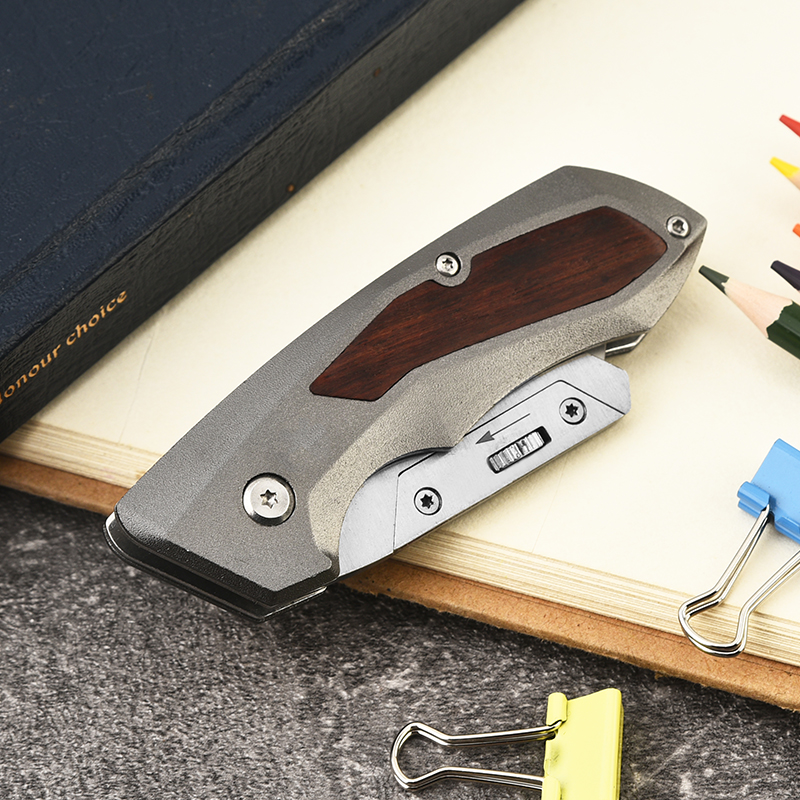
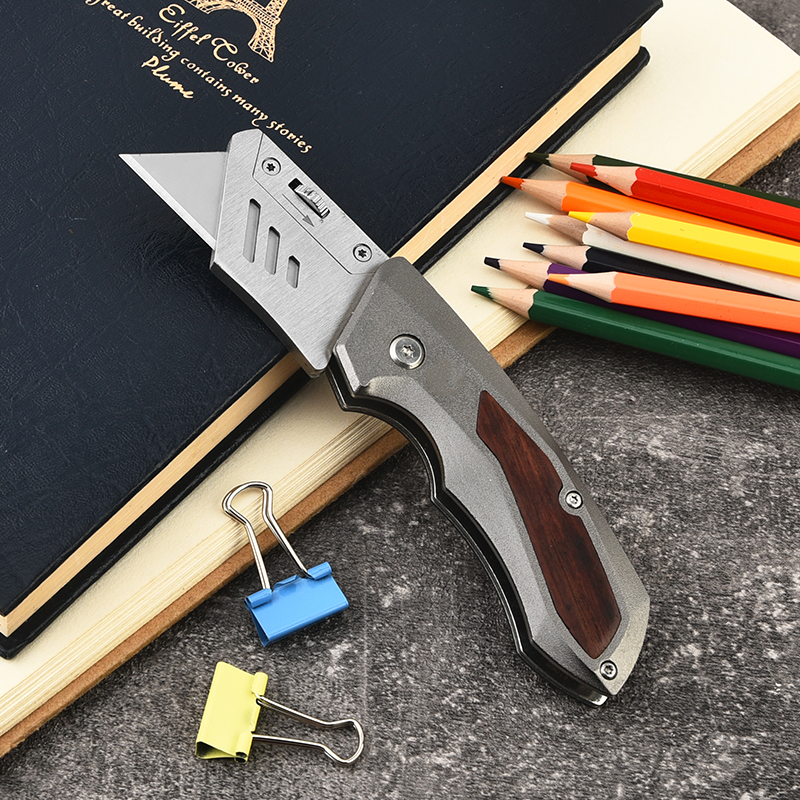
"Metal utility knife" usually describes the body, not every component. A model may combine a die-cast zinc housing, a steel blade, a slider, and separate internal parts. The STANLEY 99E, for example, pairs a die-cast zinc body with a retractable steel blade and an interlocking nose that helps secure the blade.
A metal shell can be useful when you want a rigid body and a substantial grip. But it cannot compensate for a loose carrier or a worn lock. If two knives feel equally solid in your hand, check which one keeps the blade more stable at the extension your team will actually use.
"Plastic" does not necessarily mean disposable. The OLFA L-2, for example, combines an ABS plastic handle with a rubber grip insert, a stainless-steel support channel, and an adjustable lock. Its construction illustrates why buyers should ask which component supports the blade rather than judging the entire knife by its exterior.
I'd ask suppliers to identify the housing, blade guide, carrier, and locking mechanism separately on the specification sheet. That makes a lightweight disposable carton cutter easier to distinguish from a reusable, steel-reinforced utility knife—even when both are advertised as plastic models.
Inspect metal samples for housing deformation, loose fasteners, or joints that no longer close evenly. On molded plastic samples, look for cracks at the nose, around fasteners, or where the guide is held in place. On both, check whether the slider still moves smoothly and the blade seats correctly after representative use.
Don't use cosmetic wear as your only acceptance criterion. A scuffed handle can still function properly, but a knife with unreliable retraction, a loose blade, or a cracked housing should be removed from service. If a supplier calls a model "heavy-duty," ask what was tested, how many samples were used, and what counted as failure.
A lighter body may appeal to workers who carry a cutter throughout a shift. A heavier model may feel more settled to someone who mainly uses it at a bench. Neither preference tells you which knife is easier to control with gloves or which slider is easier to reach.
Have operators with different hand sizes assess the same samples. Ask whether the grip creates pressure points, whether they can identify the slider position easily, and whether left- and right-handed users can operate the model as intended. Feedback such as "my glove catches on the slider" is more useful than a generic comfort score.
A sharper blade can make one sample feel better even if the handle offers no advantage. Where two knives accept the same blade, compare them with fresh blades of the same specification. Keep the test material and blade exposure consistent. If the models use different blade systems, compare them as complete tools and record that difference.
Check replacement blade availability too. A well-built knife can become impractical for a distributor or facilities team if refills are hard to identify, expensive to stock, or incompatible across similar-looking models.
| Application | What to prioritize first | What to verify on the sample |
|---|---|---|
| Warehouse carton opening | Restricted blade exposure or a recessed-blade cutter that fits the packaging | Opens the intended seam without marking contents; operates reliably with work gloves |
| Retail unpacking | Light, compact design with straightforward blade protection | Easy to put away safely; works on the tapes and cartons staff receive |
| Workshop or site trimming | Secure blade support and a format rated for the material | Blade stays seated, the grip remains controllable, and approved refills are easy to source |
| Mixed-use maintenance | A refillable model for approved tasks and a separate carton cutter where needed | Each tool has a clear purpose and can be identified easily in storage |
On a manual retractable utility knife, the operator must pull the blade back after use. A spring-return model can retract when the operator releases the control. Some contact-triggered designs retract after the blade leaves the material, even if the control is still held. Product names are not enough: ask the supplier to demonstrate exactly when the blade retracts.
For repetitive carton opening, also trial a recessed-blade cutter if the packaging can feed through its opening. This design limits access to the edge, but it may not suit every material or carton seam. No mechanism replaces training. Staff should inspect tools before use, cut away from the body, keep hands clear of the cutting path, fully retract exposed blades after use, and dispose of used blades in an appropriate puncture-resistant container.
The following is a proposed purchasing trial, not an industry certification test. Set pass criteria with your operations and safety teams before you compare samples.
1. Define the job. Record the actual materials, packaging types, gloves, and work surface. For carton opening, use representative packages with mock contents so you can spot unwanted blade contact.
2. Control the comparison. Use equivalent fresh blades where compatible and keep exposure consistent. If you're comparing different mechanisms, document the blade and settings for each.
3. Record usable results. Count clean openings, repeat passes, and marks on mock contents. Note grip problems and any difficulty with the slider or blade change.
4. Check condition after normal use. Inspect the housing, guide, blade seating, and retraction. Stop using any sample that cracks, releases the blade, or fails to retract as designed.
5. Approve the configuration in writing. Record the model, blade type, body material, guide, and retraction mechanism. Keep an approved sample so production units can be checked against what you actually tested.
Use total cost to compare purchase price, expected replacement bodies, refill blades, and any meaningful servicing or disposal costs over the same period. Don't assume a metal body lasts longer or a plastic model costs less. Use supplier quotes and sample-trial findings to estimate both.
For example, suppose you issue 100 knives. A plastic model costs $2 per unit and your budget allows for 40 replacement bodies, bringing body cost to $280. A metal model costs $3 per unit and you budget for 10 replacements, bringing body cost to $330. The plastic option is still $50 cheaper on bodies. But if its refills cost $60 more over the same period, the metal option becomes $10 cheaper on those combined costs. These figures are illustrative, not market prices or expected failure rates.
A useful request for quotation describes the work before it describes the finish. Include the following:
- Intended users, cutting tasks, materials, and any restrictions on blade exposure.
- Preferred housing, target weight, grip texture, and blade guide construction.
- Blade format, refill part number, change method, and required retraction behavior.
- Branding, color, packaging, instructions, destination markets, and initial order quantity.
- Sample approval criteria, production inspection requirements, and expected refill supply.
At Yangjiang Holin Industrial Co., Ltd., our in-house R&D team and production factory support one-stop OEM/ODM development, from product design and development through volume manufacturing. To compare a metal-body knife with a reinforced plastic alternative, send us your target application, estimated order quantity, and blade requirements. Request a quote with the proposed construction and sample plan for each option so you can evaluate both before committing to production.
No. Durability depends on the housing, guide, fasteners, and mechanism. A reinforced plastic design can be suitable for demanding work if it is rated for the task and passes your sample evaluation.
Yes, provided the design matches the packaging and workload. For frequent carton opening, evaluate blade exposure, retraction behavior, gloved handling, and damage to contents rather than comparing handle materials alone.
Not by itself. Blade sharpness, blade geometry, support, and exposure all affect the result. Use comparable blades and the same cutting material to judge whether the handle and mechanism make a meaningful difference.
Sometimes. Compatibility depends on the carrier and approved blade format, not the handle material. Verify the exact replacement part number instead of assuming that similarly sized blades will fit.
Not necessarily. Auto-lock describes how the blade holds its selected position. Auto-retraction describes how the blade returns to the housing. Ask what happens when the operator releases the slider and when the blade leaves the cut.
Start with the most common task in your customer base. A packaging supplier may prioritize a limited-exposure carton cutter, while a trade-tool distributor may prioritize a refillable utility knife with secure blade support. Stock the approved refills alongside reusable models.
- [Canadian Centre for Occupational Health and Safety — Working Safely with Sharp Blades or Edges]. Workplace guidance on tool selection, inspection, cutting direction, blade retraction, and disposal. [ccohs]
- [University of California Agriculture and Natural Resources — Safety Note #179: Retractable Utility Knives]. Utility-knife-specific guidance on material suitability, handling, and blade condition. [ucanr]
- [STANLEY — 99E Classic Retractable Blade Utility Knife]. Manufacturer specifications for the die-cast zinc housing, steel blade, and interlocking nose. [stanleytools]
- [OLFA — 18mm L-2 Classic Heavy-Duty Utility Knife with Rubber Inset]. Manufacturer specifications for the ABS handle, rubber grip insert, and stainless-steel support channel. [olfa]
- [OLFA — 18mm BN-AL Auto-Lock Basic Utility Knife]. Product example showing how an auto-lock mechanism holds the blade at preset positions. [olfa]
- [Slice — A Safety Utility Knife: Demand Safety From Every Angle]. Manufacturer explanation of recessed blades, spring-return sliders, and contact-triggered retraction. [sliceproducts]
- [New Zealand Government Procurement — Total Cost of Ownership: An Introduction to Whole-of-Life Costing]. Framework for comparing purchase, operating, maintenance, and replacement costs. [procurement.govt]


