


Views: 299 Author: Holin Knife Publish Time: 2026-11-17 Origin: Site


Content Menu
● Utility Knife vs Box Cutter: Quick Comparison
● What Is a Utility Knife Best Suited For?
>> Choose the blade system before the handle style
● What Is a Box Cutter Best Suited For?
>> Compare concealed, self-retracting, and manual-retractable designs
● Which Cutter Should Distributors Stock for Each Customer?
● A Sample Trial That Catches Problems Before a Bulk Order
● Compare Total Cost, Not Just the Cutter Price
● What to Include in an OEM/ODM Utility Knife or Box Cutter Brief
● Request OEM/ODM Samples for Your Distribution Program
>> Is a box cutter the same as a utility knife?
>> What is the best box cutter for opening cartons without damaging the contents?
>> Are utility knife blades interchangeable?
>> Is a self-retracting box cutter the same as a concealed-blade cutter?
>> Is a disposable or refillable box cutter better for warehouses?
>> Can a distributor use the same cutter for tape, film, and plastic strapping?
The main difference between a utility knife and a box cutter is what the product is designed to cut. A utility knife is a general-purpose tool for tasks such as scoring drywall, trimming sheet materials, or cutting corrugated board. A box cutter is generally sold for packaging work, such as opening taped cartons, cutting wrap, or breaking down boxes. The categories overlap: a retractable utility knife can serve as a box cutter, but a concealed-blade carton opener is not a substitute for a general-purpose utility knife.
For distributors, the distinction matters more on the purchase order than in the product name. Two tools labeled "box cutter" can differ in blade exposure, cut depth, replacement parts, and suitability for a customer's workplace. The best assortment starts with what the customer cuts, how often they cut it, and what the tool must do between cuts.

| Buying criterion | Utility knife | Box cutter |
|---|---|---|
| Primary purpose | General-purpose cutting, scoring, and trimming | Opening or breaking down packaging |
| Typical materials | Cardboard, drywall, and selected flooring or sheet materials, depending on the model | Carton tape, corrugated board, film, or plastic strapping, depending on the model |
| Common designs | Fixed-blade, manual-retractable, folding, and snap-off | Manual-retractable, self-retracting, and concealed-blade |
| Blade exposure | Varies by design; some models have multiple extension positions | Varies by design; guarded models limit access to the cutting edge |
| Replacement options | May use trapezoidal, hook, or segmented blades specified for the handle | May use a replaceable blade, a proprietary cartridge, or a disposable body |
| Typical buyers | Hardware wholesalers, trade suppliers, and industrial distributors | Packaging distributors, warehouse suppliers, and retail operations buyers |
| Key specification to verify | Blade retention, intended materials, and refill compatibility | Maximum cut depth, blade behavior between cuts, and packaging compatibility |
Treat these as buying categories, not rigid definitions. A catalog title should help customers find the tool. The specification should tell them whether it belongs at their workstation.
A utility knife makes sense when customers need one tool for several cutting tasks. A trade supplier might stock a retractable utility knife for crews that cut cardboard one day and score drywall the next. A hardware distributor might stock a folding utility knife for customers who value compact storage, alongside a heavier model for users who prioritize grip and blade stability.
The blade system determines which refills the distributor must carry and which applications the product can credibly serve. Three formats commonly encountered in trade assortments are:
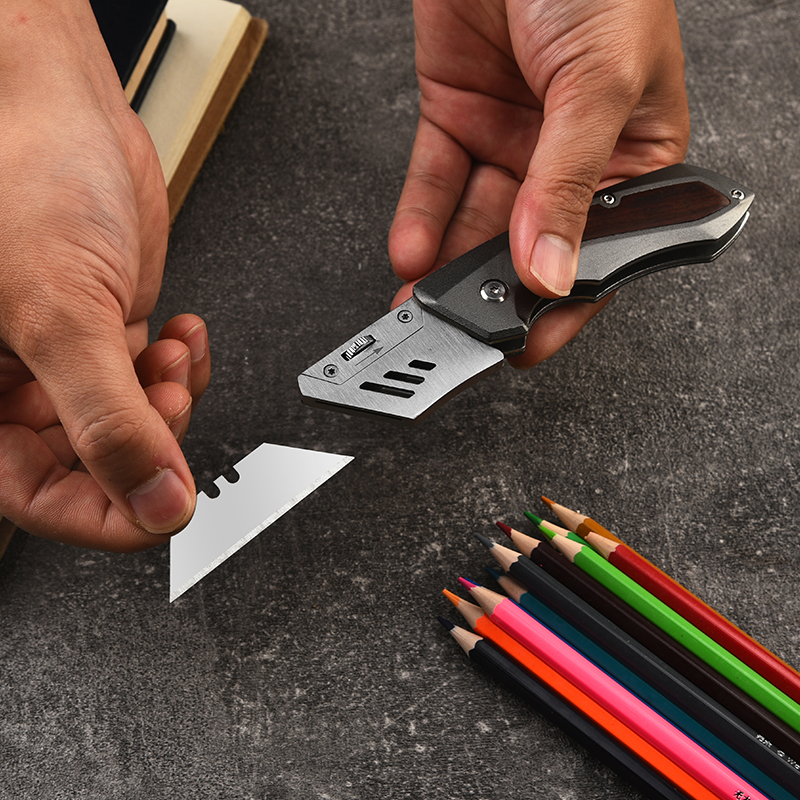
- Trapezoidal blades: A common format for general-purpose utility knives. Verify the blade dimensions and retention features before claiming interchangeability.
- Snap-off blades: Segmented blades sold in widths such as 9 mm and 18 mm. State the supported width and refill SKU rather than assuming any blade of the same nominal width will fit.
- Hook blades: An option for selected trimming tasks where the material and handle are suitable. Confirm compatibility before listing a hook refill as an accessory.
A folding design describes how the tool stores. A retractable design describes how the blade moves. A folding tool can also have a retractable blade, so these terms should not be presented as mutually exclusive categories.
A box cutter makes sense when packaging is the main task. But opening tape, cutting through a carton wall, and breaking down empty corrugated boxes are three different jobs. A short-reach carton opener may protect goods packed close to a seam but lack the reach needed to break down the box. A guarded cutter that works on stretch film may snag on a folded carton flap or fail to accept a wider strap.
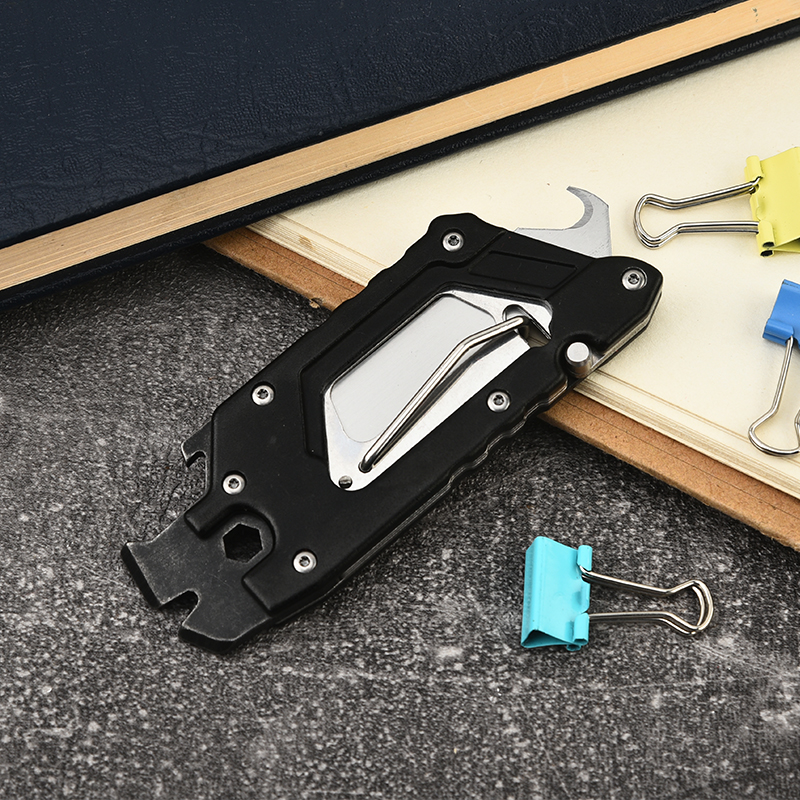
- Concealed-blade box cutter: The cutting edge sits behind a guard and the material enters a restricted opening. It is a practical first sample for repetitive packaging work when the material fits the opening.
- Self-retracting box cutter: The blade returns under conditions set by the mechanism. Some models retract when the user releases the actuator; others are designed to retract after the blade loses contact with the material, even if the actuator is still held. Verify the behavior on the actual sample.
- Manual-retractable box cutter: The operator extends and retracts the blade. This design may fit customers who need control over blade extension and whose site procedures permit it. It does not automatically return the blade after a cut.
"Safety box cutter" is a broad product label. For a useful listing, describe the feature that limits exposure and the conditions under which it works. Do not imply that a guard or return mechanism eliminates the need for site-specific controls.
| Customer segment | Product to sample first | What to verify with the customer |
|---|---|---|
| Fulfillment center opening taped cartons | Shallow-cut carton opener or concealed-blade box cutter | Tape types, package seams, and clearance above the goods |
| Receiving team opening and breaking down cartons | Separate carton opener and board-cutting tool, or a tested self-retracting model | Heaviest routine board, available cut depth, and site blade policy |
| Retail replenishment team | Compact guarded or self-retracting package opener | Glove use, left- and right-handed operation, storage, and refill access |
| Construction or maintenance supplier | Retractable or folding utility knife | Intended materials, grip, blade retention, and refill availability |
| Hardware retailer building a private label | General-purpose utility knife plus a dedicated packaging cutter | Clear shelf differentiation, compatible refills, and reorder quantities |
Start the sales conversation with one question: "Are your customers opening a seam, cutting through the board, or doing both?" That answer often tells you whether to quote one cutter or two. In a warehouse, the best tool for opening a tightly packed carton may not be the best tool for flattening it afterward. Separate SKUs can be easier to specify, train on, and replenish than one tool sold as suitable for everything.
A clean demo carton tells you whether the cutter can make one cut under favorable conditions. It does not tell you whether the tool runs reliably on cold tape, crushed seams, unusually thick board, or cartons with products packed against the lid. Ask the customer for representative packaging and include the hardest routine cut, not an unusual task the tool was never designed to handle.
1. Define the task. Record the material, carton construction, seam type, and acceptable cut depth. Distinguish "split the tape" from "cut through the board."
2. Compare production-intent samples. Use the proposed blade, handle, and return mechanism. If a prototype differs from the intended production model, record what still needs validation.
3. Record failures as well as successes. Note incomplete cuts, repeat passes, snagging, unintended marks on inner packaging, and any blade that fails to return as specified. Use the same tasks and scoring criteria for each candidate.
4. Evaluate the full work cycle. Check whether intended users can operate the tool with their normal gloves, tell when the blade is stored, and follow the approved procedure for changing or disposing of it.
5. Agree on acceptance criteria before ordering. Define what counts as a failed cut, unacceptable package damage, or a mechanism fault. Record the approved sample ID and verify that the production specification matches it.
Consider a distributor supplying a cosmetics fulfillment center. The buyer may initially request a single tool for carton opening and breakdown. If the trial shows that a shallow opener leaves retail cartons unmarked but cannot cut through the receiving team's heaviest empty boxes, that is a reason to separate the two tasks—not to reject the opener for failing a job it was not meant to do. This is an illustrative scenario, not a reported customer result.
A low unit price is easy to quote. Total cost is more useful to buyers who need to replenish an entire site. Compare handle purchases, refills or cartridges, replacement frequency, changeover time, and disposal over the same period. Use the customer's trial to estimate consumption rather than converting a supplier's demonstration into a blade-life claim.
For example, suppose a site uses 100 disposable cutters at US$1.20 each over a trial period. That is US$120 in product cost. An alternative uses 20 reusable handles at US$3 each and 100 cartridges at US$0.45 each, totaling US$105 before labor and disposal. The reusable option leads by US$15 on those assumptions. That lead could disappear if handles are frequently lost or if cartridges take longer to replace than expected. These are illustrative prices, not market quotes.
Ask the supplier to quote tool and refill pack sizes separately. A handle can be easy to source at launch but difficult to support later if its cartridge has a different minimum order quantity or lead time.
Yangjiang Holin Industrial Co., Ltd. has an in-house R&D team and its own production factory. It offers OEM/ODM support from product design and development through bulk manufacturing. To make a private-label project easier to quote and validate, give the manufacturing team the application and acceptance requirements alongside the branding brief.
- Application: What materials must the tool cut, and which materials or uses should the packaging explicitly exclude?
- Mechanism and blade: Specify blade format, permitted exposure, required return behavior, and whether the buyer needs a replaceable or disposable design.
- Replenishment: Assign separate item numbers to tools and refills. Define pack counts, compatibility markings, and the initial refill order.
- Packaging: State the sales channel, destination market, label languages, barcode placement, and any buyer-required warnings or instructions.
- Production approval: Agree on the reference sample, inspection checks, batch identification, and how changes to the blade, mechanism, or materials will be approved.
Put the application first in catalog copy. "Concealed-blade carton opener for taped parcels" communicates more than "professional safety cutter." Under the description, list supported materials, replacement part numbers, and exclusions so sales teams and buyers work from the same specification.
Send Yangjiang Holin your target materials, sales channel, estimated order volume, and packaging requirements. Request samples for each cutting task, along with the matching refill specifications and a bulk-order quote. Approve the cutter and its consumables together before committing to a launch.
Not always. "Box cutter" describes a packaging use, while "utility knife" commonly describes a broader tool category. A manual-retractable model may be sold under both names. Compare the mechanism and intended materials rather than treating the names as technical specifications.
Start by testing a shallow-cut carton opener or a concealed-blade model on fully packed samples. Check where the goods sit relative to the seam. Judge the result by whether it opens the carton cleanly without marking the inner packaging.
Some are, but the product name or nominal width does not prove compatibility. Confirm the dimensions, retention features, and exact refill SKU. Treat proprietary cartridges as model-specific unless the manufacturer documents otherwise.
No. A self-retracting model exposes the blade during the cut and withdraws it under specified conditions. A concealed-blade model keeps the edge behind a guard while the material passes through a restricted opening.
A disposable cutter avoids on-site blade changes. A refillable cutter lets the site retain the handle. Compare actual consumption, handle loss, refill availability, and the site's approved procedures for replacement and disposal.
Only if the model is specified and tested for all three. A guarded opening that accepts thin film may not accept a particular strap. List validated materials individually instead of calling every packaging cutter "all-purpose."
- STANLEY Tools, "Utility, Safety & Snap-Off Knives & Blades." Manufacturer catalog used to verify utility knife formats, folding and retractable configurations, and examples of replacement blades. [stanleytools]
- Pro Tool Reviews, "Stanley Safety Knife Overview," April 26, 2018. Product review used for examples of packaging cutter mechanisms, cut-depth settings, and guarded designs for different materials. [protoolreviews]
- Sollex, "Blades for Stanley Utility Knives & Snap-off Cutters," May 8, 2024. Technical supplier guide used for blade formats, nominal widths, and compatibility considerations. [sollex]
- Sollex, "6 Types of Safety Knives [Guide]," January 4, 2024. Technical supplier guide used to distinguish concealed blades, retraction designs, and disposable versus replaceable-blade options. [sollex]


