


Views: 228 Author: Holin Knife Publish Time: 2026-11-16 Origin: Site


Content Menu
● Introduction: What makes a rescue blade supplier worth qualifying?
>> Why Yangjiang, China belongs on the sourcing map
● Selection criteria: How to compare factories without relying on sales claims
● China supplier shortlist: Five companies worth screening
>> 1. Yangjiang Holin Industrial Co., Ltd. — OEM and ODM development candidate
>> 2. HEXON Tools — catalog reference for automotive emergency kits
>> 3. Ningbo Hi-Bin — concealed-edge reference for workplace applications
>> 4. Ningbo Chengyi Tools Co., Ltd. — adjacent OEM benchmark for utility cutters
>> 5. Xiamen Mascera Technology Co., Ltd. — component specialist, not a finished rescue tool supplier
>> Capacity, MOQ, and certification comparison
● Technical buyer's guide: What to specify, test, and verify
>> Specify the material and the performance separately
>> Separate ISO certification from EU market compliance
>> The overlooked factory-audit check: Trace one sealed carton backwards
>> Move from RFQ to shipment in four controlled stages
● Conclusion: Shortlist by evidence, then award a pilot
● FAQs
>> 1. How can I check whether a supplier's ISO certificate has expired or been suspended?
>> 2. What if a material certificate matches the grade, but the finished batch performs differently?
>> 3. Can I use the factory's existing report if I only change the logo or packaging?
>> 4. How do I compare two factories when one quotes a much lower MOQ?
>> 5. Should I buy the insert separately to reduce cost and supply risk?
The strongest supplier is not necessarily the one with the most machines or the lowest sample quote. It is the one that can show that the guarded cutter you approve is the same product it can make, test, trace, and deliver on repeat orders. Start with four checks: whether the factory and its certificates match the production site, whether its engineering team can manage drawing revisions, whether its quality controls connect finished units to incoming material lots, and whether it can reserve enough capacity to meet your delivery schedule.
This guide covers guarded rescue blades for emergency seat-belt cutting and adjacent concealed-edge safety cutters. It distinguishes finished-product suppliers from development candidates and component specialists. Although buyers often search for "Top 10 Rescue Blade Manufacturers in China," the public evidence reviewed here supports five candidates, not ten verified rescue blade factories. Some are useful benchmarks rather than direct substitutes. The order reflects sourcing relevance, not an audited performance ranking.

Yangjiang, Guangdong, is an established knives-and-scissors manufacturing cluster. For an importer, the practical advantage is access to manufacturers, materials distributors, and technical services in the same region. Steel producer Alleima reported in November 2026 that its authorized Yangjiang distributor provides local access to knife steel, cutting services, and heat-treatment technical support. That proximity can make it easier to coordinate a material review or investigate a process problem, but it does not prove that any individual factory has a qualified emergency cutter line.
The October 2026 Yangjiang industry fair drew 229 exhibitor enterprises and nearly 600 booths, according to reporting published by Guangdong's foreign affairs office. Xinhua separately reported that Yangjiang's knives-and-scissors exports reached RMB 1.33 billion in January–April 2025, up 8% year over year. These figures show the scale and export activity of the broader cluster; neither measures rescue blade production or market share. The sources reviewed did not establish a standalone 2025 or 2026 market figure for guarded rescue blades.
A public catalog gets a supplier onto a shortlist; it does not qualify the supplier for production. Use the same evidence requirements for every company, whether you are sourcing an existing model or developing a new guarded cutter.
| Selection criterion | Evidence to request | What should stop approval |
|---|---|---|
| Factory identity | Business license, production address, process map, and a list of subcontracted operations | The quoting company cannot identify who manufactures, assembles, or releases the product |
| Engineering capability | A redacted drawing revision, change record, and a named technical contact | Sales accepts specification changes, but engineering cannot document their effect on the finished model |
| Product safety | A report tied to the exact model, revision, and intended cutting material | The only evidence is a demonstration video, a test on a different model, or a report with no acceptance criteria |
| Material control | An approved bill of materials, incoming inspection records, and lot traceability | The supplier can produce a material certificate but cannot connect it to the shipment |
| Capacity and delivery | Available monthly output for the quoted model, bottleneck operation, and a dated production plan | The supplier gives a factory-wide figure but will not commit to a production slot |
| Commercial terms | Separate sample, pilot, production, and packaging minimums, plus tooling and reinspection terms | The advertised MOQ applies only to a stock model, while the custom configuration is priced or scheduled differently |
Define the product before requesting prices. A handheld emergency seat-belt cutter, a workplace film cutter, and a replacement insert may all appear under similar catalog terms. They are not interchangeable. Ask each bidder to identify exactly what it supplies, what application it can substantiate, and who is responsible for testing the finished assembly. For OEM projects, clarify which buyer-approved design the factory will build to. For ODM projects, establish which existing platform the supplier owns and which elements your company may customize or reuse.
Holin's public history lists 2010 as its company setup year. It reports a 2,000 m² factory, more than 60 machines, 80 workers, five designers, and 12 technical specialists. Its public profile describes design-to-production OEM and ODM support for folding knives, pocket knives, and outdoor tools. It also records an overseas export milestone, but it does not identify principal destination markets or provide export volumes by region. These disclosures provide a basis for a factory review, not independent confirmation of capacity or rescue cutter performance.
Holin is a candidate for small and midsize brands that want to compare the total cost of a custom program, not just the price of a stock unit. Its published emphasis on direct communication and design-to-production support is relevant when the buyer needs several review rounds before launch. Test that flexibility with a small paid development brief: request a written feasibility response, a controlled drawing revision, separate quotes for a pilot and repeat orders, and a schedule that names the person responsible for each approval. This makes responsiveness and cost competitiveness measurable.
For a guarded rescue blade project, ask Holin to confirm which processes it can handle in-house, which it would subcontract, and what evidence it can provide for the proposed finished model. The reviewed profile does not establish an off-the-shelf guarded seat-belt cutter, a model-specific MOQ, or audited output for that product. Treat Holin as a development candidate until it supplies that evidence.
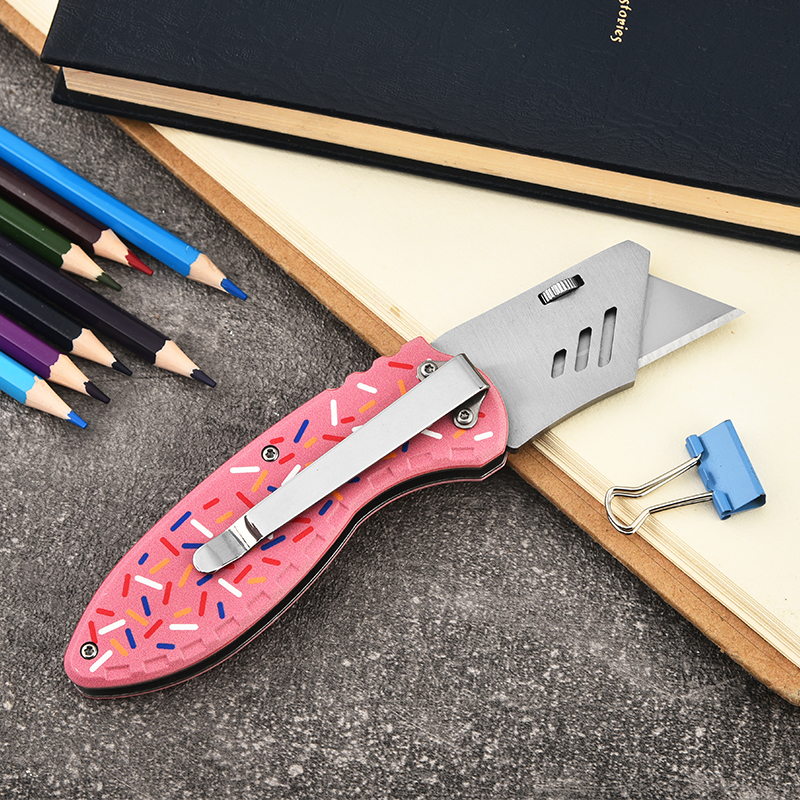
HEXON lists a finished automotive escape tool with a recessed stainless-steel seat-belt cutter, a molded body, and a holder. The listing makes it a direct product-category benchmark for buyers comparing an existing emergency kit format with a custom project. It does not establish a legal founding year, principal markets, model-specific production capacity, or the scope of customization for this item. It also does not independently verify the company's factory role for the model.
If evaluating the product, request the exact model number, current production-site details, traceable test samples, and an itemized list of permitted branding and packaging changes. For a combined escape tool, require separate evidence for each advertised function. A report covering the cutter cannot substantiate a claim about the other functions, and copy from a product page is not a substitute for model-specific test data.
Hi-Bin lists concealed-blade safety cutters, including model HB8109, and identifies applications in warehousing, retail, manufacturing, and other workplaces. This makes it useful for benchmarking guarded formats, packaging presentations, and the difference between an industrial safety cutter and a consumer emergency product. The reviewed catalog does not establish a founding year, principal export destinations, or dedicated seat-belt cutter production. Nor does it confirm that OEM options advertised elsewhere in the catalog apply to every concealed-edge model.
Include Hi-Bin when your project calls for a workplace safety cutter or when you need an adjacent catalog benchmark. For a seat-belt application, require evidence on the intended webbing and exact finished model rather than extrapolating from successful cuts on film, tape, or cartons. Ask whether changes to the molded body, packaging, or private label would trigger a different minimum order or require new validation.
Chengyi's marketplace profile describes OEM and ODM services for utility cutters and related hand tools. It reports exports to European, American, and Asian markets and lists a factory address in Ningbo, Zhejiang. These are supplier-reported claims. The profile describes years of operating experience without providing a reliable incorporation date, so procurement teams should confirm the legal founding year from the business license rather than infer it from the listing.
Chengyi is relevant as a benchmark for branded utility-tool programs and as a candidate to screen for a guarded design. Its public profile does not establish an existing rescue blade model or seat-belt performance. Before shortlisting it for development, request a sample from a comparable guarded product family, a list of in-house and outsourced processes, and an explanation of how the factory controls changes between pilot and bulk production.
Mascera publicly lists custom zirconia ceramic blades for film, textile, packaging, and equipment applications. Its catalog describes component customization rather than verified production of finished emergency seat-belt cutters. The reviewed page does not establish a founding year, principal export markets, or a finished rescue tool assembly line.
Use Mascera as a component benchmark when the project already has an assembly partner and the buyer needs a documented ceramic option. Ceramic's corrosion resistance and wear properties do not by themselves qualify it for an emergency application. If evaluating a ceramic insert, ask for the material specification and agree on how the finished assembly will be evaluated for damage and retained function after handling and storage. Keep final product acceptance with the company responsible for the complete assembly.
"Not verified" means the reviewed source does not establish the figure or document for the quoted product and site. It does not mean the supplier lacks the capability or certification. Factory area and headcount are not interchangeable with monthly output, and a component MOQ cannot be compared directly with a retail-ready kit MOQ.
| Supplier | Best fit | Public capacity evidence | MOQ for the relevant project | Certification or compliance status |
|---|---|---|---|---|
| Yangjiang Holin | Custom development and repeat OEM orders | Self-reported 2,000 m² site, 60+ machines, and 80 workers; guarded-model output not verified | Request separate pilot, production, and packaging minimums | Request current site certificate and exact-model documentation |
| HEXON Tools | Existing automotive escape-tool format | Product listing; line output and manufacturing site for the model not verified | Request stock, branded, and custom-pack quantities | Product listing does not establish current site certification or model conformity |
| Ningbo Hi-Bin | Concealed-edge workplace cutter comparison | Several catalog models; available capacity for the quoted model not verified | Request stock and private-label quantities separately | Verify current site documents and exact-model test scope |
| Ningbo Chengyi Tools | OEM utility cutter comparison | Factory address and production claims; model-level output not verified | Request sample, pilot, and repeat-order minimums | Verify the certificate holder, site, scope, and current status |
| Xiamen Mascera Technology | Custom ceramic insert sourcing | Published component offering; job-specific throughput not verified | Request prototype and production component quantities | Request component material and inspection records; these do not establish finished-product conformity |
"Stainless steel" is a material family, not a complete purchase specification. If a bidder proposes a grade such as 420J2, require it to identify the governing specification, the exact material designation, and the records it will provide for each lot. If another factory offers an "equivalent," make substitution subject to written approval and require the supplier to explain what has changed. Likewise, if a supplier proposes zirconia, verify the exact material offered and do not treat a generic ceramic data sheet as evidence for the assembled cutter.
Specify the finished product separately. Agree on the exact cutting material, test conditions, acceptance criteria, and sample selection before quotations are finalized. For a seat-belt cutter, carton tape is not an acceptable substitute for the specified webbing. The validation plan should address guard integrity, unintended access to the cutting edge, functional performance after the agreed storage conditioning, and the consistency of the production lot. Do not accept a proprietary factory method without a written procedure and a way to reproduce the result independently. The European Commission's product-safety guidance likewise treats risk assessment as central to evaluating consumer product safety.
ISO 9001 certification concerns a quality management system. It is not proof that a specific cutter passed performance testing or meets every requirement in its destination market. Similarly, CE marking is not a general quality badge or an environmental certification. It applies only where EU harmonisation legislation requires it; if no applicable legislation provides for CE marking, it must not be used. RoHS addresses restricted substances in electrical and electronic equipment within scope. A purely manual guarded cutter should not be assumed to need RoHS merely because a buyer requests a generic "CE/RoHS certificate." An electronic variant needs its own scope assessment.
For an EU consumer product, review the General Product Safety Regulation (GPSR) and any applicable product-specific rules. The European Commission identifies the GPSR as the general safety framework for non-food consumer products and notes that it has applied since December 13, 2024. Build a file for the exact model, with the product risk assessment, supporting test reports, traceability information, and reviewed instructions and claims. If a model is covered by legislation requiring an EU declaration of conformity, check that the declaration applies to the finished product, not merely to one supplied component.
Instead of asking the factory to display its best material certificate, ask it to select a sealed carton from a pilot lot and show the records behind that carton. Start with the carton or unit lot code, then ask for the assembly batch, inspection record, cutter component lot, and related incoming material record. If the cutting component lot combines several incoming batches, ask the factory to show how it recorded and controlled that merge. The point is not whether the documents exist; it is whether they establish which material went into the units being shipped.
Then run the test in reverse: select one incoming component lot and ask which finished cartons contain it. This tests whether a future material problem can be contained without treating an entire shipment as suspect. It also exposes a common weakness in sample approval: a hand-selected sample may be made from documented material while the factory cannot demonstrate that routine production follows the same controls. Make successful lot reconciliation a pilot release condition, not a request you raise only after discovering a defect.
1. Issue one comparable RFQ. Include the intended application, destination markets, projected annual volume, first purchase quantity, test requirements, packaging configuration, and requested delivery term. Ask for separate prices for tooling, validation, pilot units, production units, and packaging. Identify who owns any paid tooling and who can authorize changes.
2. Approve samples and production documents together. Keep a signed reference sample, but also freeze the drawing revision, bill of materials, artwork, test method, and acceptance criteria. Specify which characteristics cannot change without written approval. A reference sample alone does not tell an inspector which variation is acceptable.
3. Run a production-equivalent pilot. Ask the factory to use the intended production site, tooling, materials, and assembly process. Have the buyer or an independent inspector select test units from the lot. Agree in advance on which failures stop shipment and who pays for corrective work and reinspection. Do not treat a sample inspection as assurance that a critical defect cannot exist elsewhere in the lot.
4. Confirm export and shipment responsibilities before booking. Give the broker and carrier the exact product description and configuration rather than relying on a supplier's generic customs code. Confirm destination-market requirements, packing and labeling, who files the import entry, and who bears the cost of delay or reinspection. Request a shipping schedule that distinguishes factory completion from inspection, cargo handover, and arrival. For EU-bound goods, missing or questionable compliance documentation can delay release.
For a guarded rescue blade program, select suppliers by role first. A catalog supplier can help benchmark an existing emergency product; a concealed-edge specialist can benchmark workplace formats; a component maker can support an independently managed assembly program. If you need a custom development path, Holin is a reasonable company to include in the RFQ, provided it can document feasibility, traceability, and available capacity for the exact model.
To request a project review from Yangjiang Holin Industrial Co., Ltd., send your intended application, target markets, estimated order volumes, packaging requirements, and validation criteria. Ask for separate pilot and production quotations, a breakdown of in-house and subcontracted work, and a list of the documents the factory can deliver before shipment. That gives you a proposal you can compare against the other bids and a clear basis for deciding whether to proceed.
Request the full certificate, including its number, legal entity, site address, scope, dates, and certification body. Check the number and status through the issuer's official directory or an accredited certification database where available. A future expiry date printed on a PDF is not enough: if the directory has no matching entry, ask the issuer directly whether the certificate is active and covers the factory making your order. Do not accept a certificate for a sales office as evidence that a separate production site is covered.)
Hold the affected lot and compare the material records, component batch, assembly revision, and finished-product results with the approved pilot. A material certificate supports the identity of the documented material; it does not explain how the finished assembly will perform. If identity is disputed, commission a laboratory to select an appropriate method for distinguishing the grades in question. If the material matches, investigate assembly variation, component damage, storage exposure, and changes to the test method before authorizing release.
Possibly, but only after a documented review. Confirm that the tested model, materials, assembly, and production site are unchanged. Then assess whether the new packaging changes warnings, instructions, storage protection, or claims. A report for an unchanged physical unit may remain relevant; it will not cover broader performance claims added to a new package. If a declaration of conformity is required, make sure the finished product and responsible entity are correctly identified.
Ask each factory what its minimum actually buys. A low MOQ may apply to stock units with generic packaging, while another quote includes a custom component, printed retail packaging, and a dedicated production run. Compare first-order cash outlay, including tooling, validation, inspection, and packaging, then compare the repeat-order cost at the same forecast volume. For a small brand, a paid pilot with a clear reorder path can be a better deal than a low MOQ that does not apply to the approved configuration.
Only if you have a qualified assembly partner and a written method for controlling the interface between the insert and the guarded body. Split sourcing gives you another component option, but it also makes it easier for each supplier to blame the other when the finished unit fails. Name one party responsible for final inspection, lot traceability, and change approval. A component report, whether for steel or ceramic, does not qualify the assembled consumer product.
- Guangdong Foreign Affairs Office coverage of the October 2026 Yangjiang International Hardware Knives and Scissors Fair. [en.gdfao.gov]
- Xinhua's June 2025 report on Yangjiang's knives-and-scissors exports. [english.news]
- Alleima's November 2026 industry report on Yangjiang's steel supply and technical-service network. [alleima]
- European Commission guidance on the General Product Safety Regulation and the EU framework for consumer product safety. [ec.europa]
- Your Europe guidance on CE marking and the EU declaration of conformity, plus European Commission guidance on RoHS scope. [europa]


