


Views: 264 Author: Holin Knife Publish Time: 2026-10-24 Origin: Site


Content Menu
● Custom EDC Knife vs Off-the-Shelf Models: The Main Differences
● Blade Performance: Compare Geometry Before Steel Names
>> Steel Selection Involves Trade-Offs
>> Heat Treatment and Geometry Complete the Specification
● Ergonomics and Carry: Where Customization Can Matter Most
● Cost Comparison: Look Beyond the Unit Price
>> What Makes a Custom EDC Knife More Expensive?
>> Use a Total-Project Cost Model
● Lead Time, Minimum Orders, and Supply Continuity
● Quality Control: Custom Does Not Automatically Mean Better
>> Build a Written Inspection Plan
● Three Practical Tools for Better Purchasing Decisions
>> 1. Create a Weighted Decision Scorecard
>> 2. Compare Samples Under Consistent Conditions
>> 3. Approve a Reference Sample and Freeze Changes
● Branding, OEM, and ODM: Choose the Right Development Depth
● Warranty, Maintenance, and Market Requirements
● Which Option Should You Choose?
>> Turn Your Requirements into a Manufacturing Brief
>> Is a custom EDC knife better than an off-the-shelf knife?
>> Can I customize a pocket knife without developing a completely new design?
>> What is the minimum order quantity for custom EDC knives?
>> Which blade steel is best for everyday carry?
>> How should I compare custom knife samples?
>> Can one custom knife design be sold worldwide?
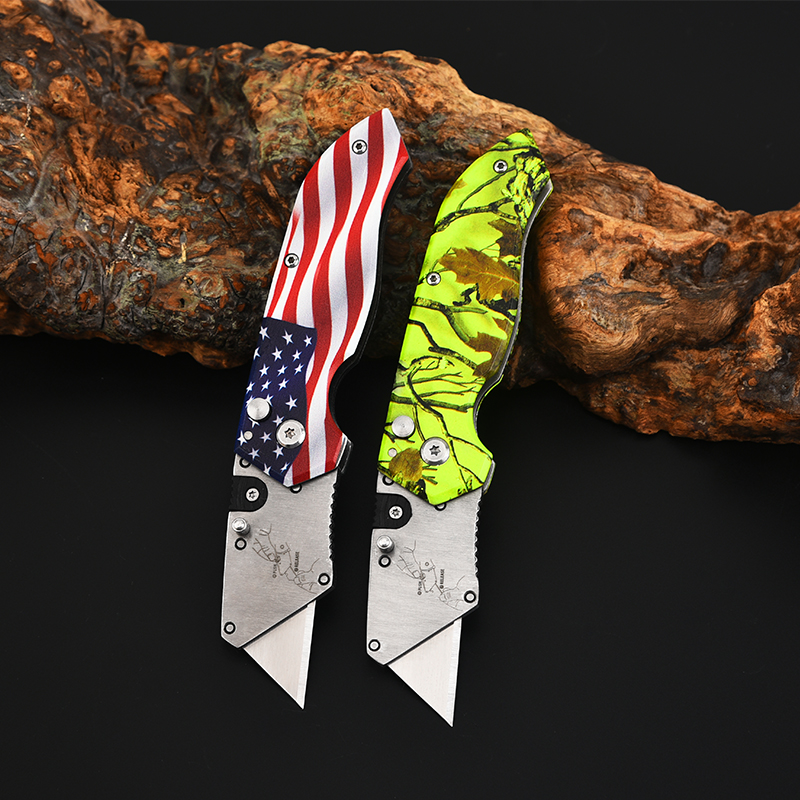
A custom EDC knife gives you control over the details that matter: blade geometry, handle comfort, materials, and branding. Off-the-shelf models offer a different advantage: an established specification without a new development project. The right choice depends on whether you need a reliable knife immediately or a differentiated product built around specific users.
At Yangjiang Holin Industrial Co., Ltd., our perspective starts with a practical question: what should the knife accomplish that an existing model cannot? With an in-house R&D team, our own factory, scalable production capabilities, and one-stop OEM/ODM services, we help buyers connect product requirements with manufacturing decisions.

EDC means everyday carry. Here, it refers to a compact knife intended for routine cutting tasks, such as opening packaging or cutting cord.
However, "custom" needs clarification. A handmade collector's knife, a configurable production model, and an OEM-developed pocket knife represent different purchasing experiences. This article focuses mainly on customized production knives for brands, distributors, and professional buyers.
| Comparison factor | Custom EDC knife | Off-the-shelf model |
|---|---|---|
| Design control | Configurable within engineering and manufacturing limits | Existing design |
| Initial expenditure | May include sampling, tooling, and development | Usually avoids new development costs |
| Availability | Requires approvals and production scheduling | Faster when suitable inventory exists |
| Materials | Selected against project requirements | Limited to available configurations |
| Branding | Can extend to product architecture and packaging | Usually limited without a separate agreement |
| Quality evidence | Requires prototype and production validation | Existing specifications and feedback may be available |
| Best fit | Differentiated product programs | Immediate purchases and market testing |
Neither category guarantees better performance. The decisive difference is how well the specification, execution, and support match your needs.
Buyers often begin with steel names. I would begin with the cutting task.
Knife-steel performance involves several competing properties: edge retention, toughness, and corrosion resistance. Metallurgist Larrin Thomas's published testing explains why no single steel dominates every category. Heat treatment and hardness also affect the resulting balance.
For a custom pocket knife, translate expectations into priorities:
- Frequent abrasive cutting: investigate edge retention and sharpening requirements.
- Humid working conditions: prioritize corrosion resistance and maintenance.
- Demanding utility work: consider toughness alongside appropriate blade geometry.
- General everyday use: seek a balanced specification rather than one exceptional rating.
An off-the-shelf knife can already provide the right combination. Customization becomes valuable when available combinations leave a meaningful requirement unmet.
A steel designation does not fully describe a finished blade. Heat treatment, edge angle, and thickness behind the edge influence performance.
Thomas's comparative research uses controlled geometry and sharpening to make steel comparisons more meaningful. Buyers should apply the same principle: compare equivalent configurations rather than attributing every difference to metallurgy.
For custom EDC knife manufacturing, request a defined hardness range, blade dimensions, and agreed inspection methods. For stock models, look for comparable technical information instead of relying exclusively on premium-material descriptions.
A knife can look excellent in photographs yet disappoint in daily use.
When evaluating a design, I would examine the complete interaction: retrieving it, opening it, gripping it, cutting with it, closing it, and returning it to a pocket.
A practical sample review should cover:
- Grip comfort during representative cutting tasks.
- Access to the opening mechanism.
- Clip pressure and interaction with pocket fabric.
- Handle edges that create pressure points.
- Suitability for intended left- or right-handed users.
These are proposed evaluation criteria, not claims that one handle material or mechanism always performs better.
Custom development allows buyers to address specific findings before production. Off-the-shelf models offer less design flexibility, but purchasing samples from several established designs can reveal an acceptable solution without development expenditure.
The key is validation: approve a knife because it works for its intended users, not because its specification sheet sounds impressive.
A custom program may require engineering, prototypes, tooling, packaging development, and inspection planning. The exact cost depends on how much changes.
Adding artwork to an existing platform is different from developing a new handle structure or blade configuration. Ask suppliers to separate one-time charges from recurring production costs.
Off-the-shelf purchasing generally avoids those development activities, but it may leave fewer opportunities to differentiate the product.
For commercial sourcing, compare:
> Total project cost = development + tooling + production + inspection + packaging + logistics + applicable duties + expected after-sales costs.
Then divide by the expected number of sellable units.
As a hypothetical example, $3,000 in development costs adds $3 per knife across 1,000 units, but $0.60 across 5,000 units. These figures illustrate cost allocation only; they are not Holin quotations.
Do not assume customization becomes economical at a universal order quantity. Obtain project-specific pricing and account for inventory risk, not merely a lower quoted unit price.
An available stock model is usually the more practical starting point when a deadline leaves no room for development. However, "off the shelf" does not necessarily mean inventory is available.
Custom projects require a schedule covering specification approval, samples, revisions, production, and shipment. Minimum order quantities should be confirmed for each configuration rather than assumed across an entire product range.
Before committing, ask:
1. Which materials and components are already available?
2. What requires new tooling or supplier coordination?
3. When does the production lead time officially begin?
4. What changes would trigger reapproval?
5. How will repeat orders maintain the approved specification?
For established brands, continuity can matter as much as launch speed. Discuss replacement components, material substitutions, and change notifications before placing an order.

A well-made production knife can outperform a poorly controlled custom project. Conversely, a properly validated custom design can resolve shortcomings that stock products leave unaddressed.
For procurement, separate design approval from production acceptance.
Agree on measurable characteristics such as:
- Blade and handle dimensions.
- Hardness requirements and verification methods.
- Blade centering and permissible movement.
- Opening, closing, and locking function where applicable.
- Cosmetic acceptance criteria.
- Marking, packaging, and accessory accuracy.
ISO 2859-1 provides acceptance-sampling procedures for inspection by attributes. A purchasing team can reference an agreed sampling framework, but sampling is not a substitute for defining defects or establishing appropriate safety-related controls.
Request actual inspection arrangements rather than treating the name of a standard as proof that a supplier follows it.
Before discussing finishes, rank your priorities.
A proposed scorecard might allocate 30% to cutting suitability, 25% to ergonomics, 20% to total cost, 15% to supply reliability, and 10% to branding.
These are illustrative weights, not industry benchmarks. Adjust them to your business.
Score both stock samples and custom prototypes against the same criteria. This reduces the risk of choosing customization for novelty or choosing stock solely because the initial purchase looks simpler.
Use the same representative cutting material, task sequence, and assessment form for each candidate.
Record observations such as:
- Cutting effort at the start and end of the assessment.
- Grip discomfort.
- Ease of cleaning.
- Pocket-carry feedback.
- Visible edge damage or functional changes.
Have qualified personnel assess mechanical safety. Avoid improvised destructive testing or unsafe lock-testing demonstrations.
This is a proposed internal comparison process, not a replacement for laboratory testing or regulatory assessment.
After approving the design, retain a documented reference sample.
Record its materials, dimensions, finish, artwork, packaging, and acceptance criteria. Require written approval before substitutions or specification changes.
This creates a clearer basis for evaluating subsequent shipments. It also helps distinguish a design issue from a production deviation when problems arise.
Not every business needs a fully original knife.
Three practical routes are worth discussing with a manufacturer:
- Existing platform with branding: appropriate when the main requirement is identity and packaging.
- Adapted design: useful when selected features need adjustment.
- New product development: suitable when existing architectures cannot meet the brief.
OEM and ODM terminology varies between suppliers, so define responsibilities contractually. Clarify who supplies the design, who develops engineering details, who owns tooling, and what exclusivity applies.
Holin's in-house R&D and manufacturing capabilities support discussions across design, development, and batch production. Specific materials, minimum quantities, testing, and delivery commitments should be confirmed for the individual project.
After-sales support belongs in the comparison from the beginning.
Benchmade's published policies illustrate why details matter: its warranty addresses manufacturing defects, while modified knives have additional service requirements. Buyers should not assume that aftermarket changes receive the same treatment as an original factory configuration.
For either purchasing route, clarify:
- Warranty scope and exclusions.
- Repair or replacement procedures.
- Spare-part availability.
- Authorized maintenance.
- Responsibility for return shipping and customer claims.
Legal review also deserves an early place in the brief. Carry, import, sale, and ownership requirements can differ by destination and knife design. Do not treat "EDC" as a legal classification or assume that one specification works globally.
Choose an off-the-shelf model when you need a small quantity, an available design already fits, or market testing matters more than product exclusivity.
Choose a custom EDC knife when a specific user requirement remains unmet, differentiation supports your commercial strategy, and you can commit resources to development and validation.
For many buyers, the strongest route is staged: evaluate existing models, identify measurable shortcomings, then customize only what creates meaningful value.
Contact Yangjiang Holin Industrial Co., Ltd. with your target market, intended tasks, preferred knife format, estimated quantity, target price, and required delivery window.
Request a project review covering feasible customization, sample development, production requirements, and quotation scope. A clear brief makes the next discussion more productive than a general request for "the best custom knife."
Not automatically. Customization provides control, but performance depends on design, materials, manufacturing, and validation. A suitable stock knife may offer better value when no changes are necessary.
Potentially. Ask about existing platforms, branding, packaging, and permitted component changes. Available options depend on the manufacturer and the selected design.
There is no universal minimum. It depends on the platform, materials, tooling, and customization scope. Request a written quotation for your exact configuration.
There is no single best choice. Match corrosion resistance, toughness, edge retention, and sharpening requirements to the intended task. Evaluate heat treatment and geometry alongside the steel name.
Use a shared assessment sheet, consistent tasks, and documented acceptance criteria. Include ergonomics, cutting performance, carry comfort, workmanship, and qualified mechanical-safety evaluation.
Do not assume so. Destination-specific rules may affect design, importation, sale, and carry. Obtain appropriate market-specific guidance before approving production.
- Larrin Thomas, Knife Steel Nerds. "[Knife Steels Rated by a Metallurgist—Toughness, Edge Retention, and Corrosion Resistance]." October 19, 2021. Technical basis for the discussion of steel-property trade-offs, hardness, and comparative testing. [knifesteelnerds]
- Larrin Thomas, Knife Steel Nerds. "[Testing the Edge Retention of 48 Knife Steels]." May 1, 2020. Background on controlled testing and the relationship between metallurgy and performance. [knifesteelnerds]
- International Organization for Standardization. "[ISO 2859-1:2026—Sampling Procedures for Inspection by Attributes]." Source for the acceptance-sampling framework discussed in the quality-control section. [iso]
- Benchmade Knife Company. "[Warranty]." Manufacturer example of published coverage for manufacturing defects; not a statement of Holin's warranty terms. [benchmade]
- Benchmade Knife Company. "[Can I Send in a Modified Knife for Warranty or LifeSharp Service?]." Manufacturer example of additional service requirements for modified products. [support.benchmade]
- Ask the Police. "[Q337: Is It Illegal to Carry a Knife Around in My Pocket?]." Jurisdiction-specific background supporting the need to review destination rules; not worldwide legal guidance. [askthe.police]


