


Views: 243 Author: Holin Knife Publish Time: 2026-10-25 Origin: Site


Content Menu
● Understanding Knife Steel: Four Properties That Matter
>> Edge Retention: How Long Does the Blade Keep Cutting?
>> Toughness: Resistance to Chipping and Breaking
>> Corrosion Resistance: Protection Beyond Appearance
>> Ease of Sharpening: The Cost of Restoring Performance
● Knife Steel Comparison: Matching Materials to Real Applications
● What Is the Best Steel for a Pocket Knife?
● Choosing Steel for Utility Knives and Outdoor Tools
>> Utility Knives: Separate Replaceable Blades from Permanent Blades
>> Outdoor Knives: Prioritize the Likely Failure Mode
● Why Heat Treatment and Blade Geometry Can Outweigh the Steel Name
>> Hardness Is a Specification, Not a Complete Quality Score
>> Thin Geometry Improves Cutting but Changes Durability
● What User Feedback Reveals—and What It Cannot Prove
● A Practical OEM/ODM Knife Steel Selection Process
>> Step 1: Write a Clear Use Profile
>> Step 2: Compare Two or Three Material Options
>> Step 3: Approve the Complete Blade Specification
>> Step 4: Validate Samples Under Repeatable Conditions
>> Step 5: Connect the Approved Sample to Production
● Developing Custom Knives with Yangjiang Holin Industrial Co., Ltd.
● Build Your Knife Specification Around the Customer
>> 1. What is the best knife steel for everyday carry?
>> 2. Is D2 better than 14C28N?
>> 3. Does higher HRC always mean a better knife?
>> 4. Are powder metallurgy steels always worth the extra cost?
>> 5. Can stainless knife steel rust?
>> 6. What should buyers provide for a custom knife quotation?
The best knife steel is not necessarily the most expensive alloy. It is the steel that delivers the right balance of cutting performance, durability, corrosion resistance, and maintenance for the intended task. This knife steel guide explains how to compare blade materials for pocket knives, folding knives, utility knives, and outdoor tools—and how buyers can turn those comparisons into practical manufacturing specifications.
My starting point is simple: define the job before choosing the steel. A warehouse worker opening cartons, an angler working around saltwater, and a brand developing an outdoor knife do not need identical blades.
For commercial buyers, another question matters just as much: can the selected material deliver consistent performance across production batches?

Steel names provide useful information, but they do not describe the complete knife. Four properties help explain the trade-offs.
Edge retention describes a blade's ability to remain useful as it cuts. However, edges become dull for different reasons, including abrasive wear, rolling, microchipping, and corrosion.
Many laboratory comparisons primarily measure resistance to abrasive wear. That makes them useful for comparing steels, but not a complete prediction of every cutting task.
A steel that performs well on abrasive materials may still disappoint if its edge chips under the intended workload.
Toughness measures resistance to fracture. It matters when an edge encounters impacts, knots, or unexpected hard materials.
Higher wear resistance often comes with reduced toughness, although the relationship depends on alloy design and heat treatment.
For outdoor tools, sufficient toughness may be more valuable than exceptionally long wear resistance. Nevertheless, no steel makes a folding knife suitable for unrestricted prying or striking.
Corrosion can cause staining, pitting, and deterioration at the cutting edge. Sweat, saltwater, food residue, and damp storage all influence the risk.
Stainless steel resists corrosion; it does not make maintenance unnecessary.
For coastal use, evaluate the complete knife. A corrosion-resistant blade does not automatically protect the pivot, screws, clip, or locking components.
Sharpening difficulty depends on wear resistance, carbide characteristics, edge thickness, damage, and abrasive selection.
A very wear-resistant blade may require more suitable sharpening equipment and longer repair sessions.
For many everyday users, straightforward maintenance provides more practical value than the longest possible interval between sharpenings.
The table below offers a starting point rather than a universal ranking. These are comparative material tendencies, not performance guarantees for finished knives or confirmation of Holin's available inventory.
| Steel | Useful characteristics | Main trade-off | Applications worth evaluating |
|---|---|---|---|
| 14C28N | High toughness, good corrosion resistance, straightforward sharpening | Lower wear resistance than many carbide-rich alloys | General-purpose pocket knives and outdoor cutting tools |
| D2 | Useful wear resistance at accessible price points | Lower corrosion resistance and toughness than some alternatives | Dry-environment utility folders |
| CPM-S35VN | Balanced stainless performance | Higher processing cost than many conventional steels | Upgraded everyday carry knives |
| M390 / CPM-20CV | High wear resistance with strong corrosion resistance | More demanding sharpening and limited tolerance for abusive loading | Premium slicing-focused folders |
| CPM-MagnaCut | Strong balance of toughness, corrosion resistance, and wear resistance | Performance still depends on processing and geometry | Premium pocket knives and outdoor blades |
| CPM-3V | High toughness with useful wear resistance | Not stainless | Outdoor blades prioritizing damage resistance |
| LC200N | Excellent corrosion resistance with good toughness | Lower wear resistance than highly wear-resistant alloys | Fishing and wet-environment knives |
The most important comparison is between finished blades with comparable geometry and suitable heat treatment—not steel names viewed in isolation.
For an everyday pocket knife, I would begin with three questions:
- What will the owner cut most often?
- How frequently will the knife encounter moisture?
- How willing is the owner to sharpen it?
For general use, 14C28N deserves consideration because it combines toughness, corrosion resistance, and manageable sharpening. Alleima recommends a hardness range of 55–62 HRC for this grade, demonstrating that even one steel can support different processing targets.
That range is not a recommendation to select the highest number automatically.
For buyers seeking increased abrasive wear resistance, steels such as S35VN or M390 may be appropriate. Their advantages become more meaningful when customers cut frequently and have suitable sharpening equipment.
For a budget-focused range, a well-executed conventional steel can be a more sensible choice than an expensive alloy paired with unsuitable geometry.
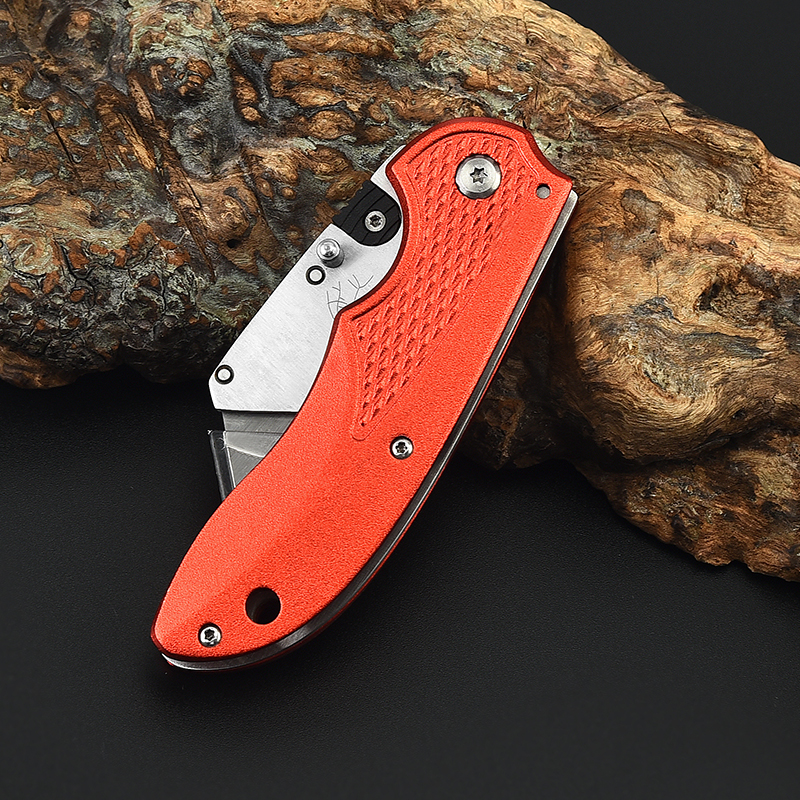
A replaceable-blade utility knife follows a different ownership model from a conventional folding knife.
Its value depends on blade compatibility, replacement availability, secure retention, and cost per usable cutting edge. Choosing a premium alloy may add little value if users routinely replace blades after demanding work.
For a permanent-blade utility folder, sharpening convenience and edge durability become more important.
Define the product format first. Then specify the material around actual cutting tasks and maintenance expectations.
Outdoor use includes very different activities. Rope cutting, food preparation, wood carving, and heavy chopping should not share one automatic steel recommendation.
Ask what would cause the greatest problem:
- Chipping during demanding cutting.
- Rust during prolonged moisture exposure.
- Wear during repeated abrasive cutting.
- Difficult sharpening away from a workshop.
A tough steel such as CPM-3V may suit some demanding outdoor blades, while LC200N merits consideration for highly corrosive environments. Blade dimensions and construction must still match the task.
HRC refers to hardness measured on the Rockwell C scale. Hardness influences blade behavior, but it does not directly measure toughness, corrosion resistance, or overall cutting quality.
Two blades carrying the same steel designation can perform differently because of their processing and geometry.
A useful purchasing specification therefore identifies:
1. The exact steel grade.
2. The agreed hardness range.
3. The blade dimensions and cutting geometry.
4. The verification method and acceptance criteria.
A hardness reading supports quality control. It does not prove that every aspect of heat treatment is optimal.
Blade thickness, thickness behind the edge, and sharpening angle all affect cutting performance.
A thinner blade can pass through material with less resistance. However, an edge that is too thin for its workload may chip or roll.
Conversely, a thick edge may feel durable yet cut poorly.
The useful target is balance: geometry thin enough for efficient cutting, with sufficient support for the expected task. Steel selection should support that geometry rather than substitute for it.
Public knife discussions highlight a recurring disagreement: some owners value easy-to-sharpen steels, while others prioritize longer wear resistance.
D2 discussions also include different experiences with rust and maintenance. Some owners report spotting; others describe satisfactory performance with ordinary care.
These comments help identify practical concerns:
- How much maintenance will customers accept?
- Do they own suitable sharpening tools?
- Will the knife encounter sweat, humidity, or food residue?
- Does the product description explain realistic limitations?
However, individual reports are not controlled comparisons. Blade finish, storage, geometry, workload, and sharpening technique differ between users.
I would use these comments to shape sample evaluations and care instructions—not to claim that one steel always outperforms another. They are also not testimonials from Holin customers.
For brands and distributors, the strongest specification connects customer needs with measurable acceptance criteria.
Avoid a brief that says only "premium outdoor knife."
Instead, describe the intended cutting materials, environment, maintenance expectations, product format, and target price.
For example:
"Develop a folding knife for carton opening, rope cutting, and occasional outdoor use. Prioritize corrosion resistance, convenient sharpening, and comfortable repeated handling."
This gives the development team a meaningful starting point.
Shortlist materials that fit the application rather than comparing every available alloy.
Ask the manufacturer to explain:
- Material sourcing and availability.
- Expected manufacturing implications.
- Proposed hardness range.
- Geometry recommendations.
- Maintenance requirements.
- Sample and production lead times.
Do not assume that every published steel grade is available for a particular project.
| Specification | What to establish |
|---|---|
| Steel identity | Exact grade and agreed documentation |
| Hardness | Target range and measurement procedure |
| Geometry | Blade thickness, edge angle, and relevant tolerances |
| Surface finish | Approved appearance and finish consistency |
| Cutting performance | Defined materials, procedure, and acceptance criteria |
| Corrosion evaluation | Agreed exposure conditions and assessment method |
| Production control | Sampling plan, records, and traceability requirements |
These requirements should be agreed before production, not reconstructed after a problem appears.
Compare prototypes using the same cutting material, starting sharpness, and evaluation method.
Record useful outcomes, such as cuts completed, visible edge damage, restoration effort, or corrosion observations.
Changing several variables at once makes results difficult to interpret. For an initial steel comparison, keep geometry as consistent as practical.
Do not convert an informal in-house trial into a universal performance claim.
An approved sample establishes a reference, but production needs its own controls.
Agree how material identity, hardness, dimensions, finish, and functional performance will be checked. Retain records that connect inspection results with the relevant batch.
Consistency matters because customers purchase the production knife—not the development sample.
Yangjiang Holin Industrial Co., Ltd. manufactures folding knives, pocket knives, utility knives, and outdoor tools.
With an in-house research and development team, its own production factory, and scalable manufacturing capabilities, Holin provides one-stop OEM/ODM support covering product design, development, and batch production.
For buyers, this creates an opportunity to discuss steel, geometry, handle design, product positioning, and manufacturing requirements together.
Specific steel availability, hardness targets, testing arrangements, quantities, and delivery schedules should be confirmed for each project.
Successful steel selection begins with the cutting task and ends with a validated production specification. Alloy choice, heat treatment, geometry, maintenance, and manufacturing consistency must work together.
Send Yangjiang Holin Industrial Co., Ltd. your product concept, intended application, estimated order quantity, and target price range. Request a project-specific OEM/ODM discussion covering material options, prototype development, and production requirements.
There is no universal winner. 14C28N offers an attractive combination of toughness, corrosion resistance, and sharpening convenience. Other steels may better suit buyers prioritizing abrasive wear resistance or particular premium features.
D2 generally offers greater abrasive wear resistance, while 14C28N generally provides better toughness and corrosion resistance. The better choice depends on the task, maintenance expectations, heat treatment, and blade geometry.
No. Higher hardness can improve resistance to deformation, but overall performance also depends on toughness, microstructure, and geometry. Select an appropriate hardness range for the steel and application rather than chasing the highest number.
Not always. Powder metallurgy supports useful carbide distributions and alloy designs, but its benefits must match the product's requirements. Many customers are well served by appropriately processed conventional steels.
Yes. Stainless steels differ in corrosion resistance, and unfavorable conditions can still cause corrosion. Clean and dry the blade after use, especially after contact with saltwater, sweat, or food residue.
Provide the intended use, target market, product dimensions, preferred materials, quantity, price positioning, branding, packaging, and performance requirements. If the steel is undecided, explain the priorities and request suitable alternatives.
1. Blade HQ — "Knife Steel Guide."
Original article used to establish the comparison framework, including edge retention, toughness, corrosion resistance, sharpening, heat treatment, and geometry. [bladehq]
2. Larrin Thomas, Knife Steel Nerds — "Knife Steels Rated by a Metallurgist—Toughness, Edge Retention, and Corrosion Resistance," October 19, 2021.
Technical basis for comparative steel tendencies and the trade-offs among toughness, abrasive wear resistance, and corrosion resistance. These comparisons do not constitute guarantees for individual finished knives. [knifesteelnerds]
3. Alleima — "Alleima® 14C28N Strip Steel," material datasheet, updated May 9, 2025.
Primary manufacturer information on the grade's intended applications, material characteristics, and processing considerations. [alleima]
4. Alleima — "Alleima® 14C28N Knife Steel."
Primary manufacturer guidance supporting the stated 55–62 HRC recommended hardness range and discussion of edge stability and sharpening. [alleima]
5. Reddit, r/knives — "Unpopular Opinion," September 8, 2024.
Qualitative user discussion illustrating differing preferences for sharpening convenience and higher wear resistance. Comments are anecdotal, not representative test data or Holin customer testimonials. [reddit]
6. Reddit, r/knives — "Does D2 Rust?" September 10, 2020.
Qualitative owner reports used to identify maintenance concerns and differing corrosion experiences, not to establish controlled material rankings. [reddit]


