


Views: 220 Author: Holin Knife Publish Time: 2026-09-15 Origin: Site


Content Menu
● What Does Folding Knife OEM Mean?
>> How OEM Folding Knife Production Works
● What Does Folding Knife ODM Mean?
>> Common ODM Folding Knife Customization Options
● Folding Knife OEM vs ODM at a Glance
● When OEM Is the Better Choice for a Knife Brand
>> Choose OEM Folding Knife Manufacturing If You Need:
● When ODM Is the Better Choice for a Knife Brand
>> Choose ODM Folding Knife Manufacturing If You Need:
>> ODM Does Not Have to Look Generic
● The Real Cost Difference Between OEM and ODM
● Development Time: Why Speed Changes the Decision
● Product Quality: What Buyers Should Evaluate
>> Essential Folding Knife Quality Checks
>> Expert Recommendation: Define "Acceptable" Before Production
● Safety, Traceability, and Market Readiness
>> Build Compliance Into the Product Brief
● How to Choose Between OEM and ODM
>> Choose OEM If Your Priority Is:
>> Choose ODM If Your Priority Is:
>> A Practical Hybrid Strategy
● Why Manufacturer Capability Matters
● Start With the Right Manufacturing Model
● FAQ
>> 1. What is the main difference between folding knife OEM and ODM?
>> 2. Is OEM always more expensive than ODM?
>> 3. Can I add my logo to an ODM folding knife?
>> 4. Can an ODM folding knife be exclusive to my brand?
>> 5. How long does a custom OEM folding knife take to develop?
>> 6. What should I send a folding knife manufacturer for an OEM quote?
>> 7. What quality issues should I check before ordering folding knives?
>> 8. Is ODM suitable for a new outdoor knife brand?
Choosing between folding knife OEM and folding knife ODM is not simply a purchasing decision. It determines how much control your brand has over product design, intellectual property, development time, tooling investment, quality management, and long-term product differentiation.
For buyers sourcing folding knives, pocket knives, utility knives, and outdoor tools, the right model depends on one central question: Are you building a unique product platform, or bringing a proven product to market faster? At Yangjiang Holin Industrial Co., Ltd., we see both approaches succeed—but they serve very different brand strategies.
A startup retailer testing a new outdoor category may benefit from ODM speed and lower development risk. A mature knife brand that needs a proprietary locking system, exclusive handle geometry, or a distinctive visual identity will usually gain more value from OEM development.
This guide explains the practical differences between OEM and ODM folding knife manufacturing, including ownership, cost structure, lead time, quality requirements, compliance planning, and the decision process that helps global buyers select the right route.

OEM, or Original Equipment Manufacturing, means that a manufacturer produces a knife according to the buyer's product specifications, drawings, design files, materials requirements, and branding instructions.
In an OEM folding knife project, the customer usually owns or controls the core product concept. The manufacturer translates that concept into an manufacturable product through engineering, sampling, tooling, testing, assembly, and mass production.
For example, a brand may provide:
- A blade profile and blade length
- A handle design and ergonomic requirements
- A preferred steel grade
- A locking mechanism specification
- A custom pocket clip design
- Surface-finishing requirements
- Packaging artwork
- Logo placement and marking instructions
- Target retail price and performance expectations
The manufacturer's role is not limited to producing parts. A capable folding knife OEM partner should help identify production risks before tooling begins, such as thin blade sections, difficult machining angles, tolerance conflicts, weak liner-lock engagement, unstable opening action, or material choices that do not match the intended customer segment.
A typical OEM project moves through several stages:
1. Product briefing and feasibility review
The buyer explains the target market, application, product positioning, technical requirements, and expected order volume.
2. Engineering development
The manufacturer reviews dimensions, mechanism layout, assembly structure, material compatibility, and manufacturability.
3. Prototype creation
Initial samples are produced for fit, function, ergonomics, opening action, lock engagement, blade centering, and visual review.
4. Design refinement
The product is adjusted based on sample feedback. This may include handle contour changes, blade thickness changes, spring adjustments, logo position revisions, or packaging upgrades.
5. Tooling and pre-production approval
Dedicated tooling may be developed for components such as handles, liners, clips, injection-molded parts, or packaging inserts.
6. Mass production and quality inspection
The factory produces the approved product under defined inspection standards and packaging requirements.
The key benefit is product ownership and differentiation. The trade-off is greater planning responsibility, more development work, and usually a higher initial investment.
ODM, or Original Design Manufacturing, means that the manufacturer offers an existing product design that can be adapted for the buyer's brand.
Instead of starting with a completely new folding knife, the buyer selects from an established model range. Customization may include a logo, color, handle material, coating, packaging, retail box, sheath, display format, or selected component upgrades.
For many importers, distributors, e-commerce sellers, promotional-product companies, and outdoor retailers, an ODM folding knife is a practical way to launch a private-label knife line quickly.
An ODM program can often support the following options without creating a completely new mechanical platform:
- Laser-etched, printed, or stamped logos
- Custom handle colors
- G10, aluminum, stainless-steel, wood, or composite handle options
- Black oxide, satin, stonewashed, titanium-coated, or painted blade finishes
- Different packaging designs
- Custom instruction cards
- Retail-ready gift boxes
- Private-label barcode labels
- Custom pouch, sheath, or display solutions
- Selected blade material or hardware upgrades
The most important distinction is that the base product architecture already exists. The manufacturer has usually tested its assembly process, component fit, production workflow, and cost structure. This reduces development time and lowers the buyer's risk during the first order.
However, an ODM design may not be fully exclusive unless the buyer negotiates an exclusive arrangement, pays for dedicated modifications, or develops a proprietary configuration beyond standard catalog options.
| Decision Factor | Folding Knife OEM | Folding Knife ODM |
|---|---|---|
| Product starting point | A buyer-led concept, drawing, or specification | A factory’s existing knife platform |
| Design freedom | Very high | Moderate |
| Brand differentiation | Stronger potential | Depends on customization depth |
| Development time | Longer | Shorter |
| Upfront investment | Usually higher | Usually lower |
| Tooling requirement | Often required | Often limited or unnecessary |
| Minimum order quantity | May be higher for custom components | Often more flexible |
| Product ownership | Usually buyer-controlled by agreement | Base design generally remains with manufacturer |
| Best for | Established brands and differentiated product lines | Fast launches, market tests, and private-label programs |
| Technical risk | Higher during early development | Lower because the design already exists |
| Time to market | Depends on development and tooling | Faster once artwork and specifications are approved |
The right choice is not about which model is "better." It is about which model matches your commercial objective.
OEM is usually the stronger option when the knife itself is central to your brand value.
If your company wants customers to recognize a distinct blade silhouette, signature handle shape, exclusive lock structure, purpose-built outdoor function, or premium material combination, OEM provides the room to build those elements into the product.
- A new blade shape or size
- A proprietary folding mechanism
- An exclusive handle profile
- A distinctive pocket clip or carry system
- Specific weight, balance, and ergonomic targets
- A knife designed for a defined use case
- Premium positioning that cannot rely on catalog models
- Long-term product exclusivity
- Better control over product evolution across multiple generations
- A custom outdoor tool set built around a consistent design language
For example, an outdoor brand may want a compact everyday-carry folding knife with a 3-inch drop-point blade, textured G10 scales, a deep-carry pocket clip, a reversible thumb stud, and a liner lock optimized for right- and left-handed use. If the desired combination does not exist in a factory's current range, an OEM project can turn that concept into a branded product platform.
The biggest OEM advantage is not simply customization. It is strategic differentiation.
A strong folding knife category can become difficult to defend when multiple retailers sell near-identical products with different logos. OEM development gives a brand the opportunity to create a product customers can recognize, compare, review, and repurchase.
It also enables a more coherent product family. One successful OEM knife can lead to matching fixed-blade knives, utility knives, rescue tools, camping tools, multi-tools, gift sets, and seasonal color variations.
ODM is often the smarter choice when speed, budget control, and market validation matter more than building a proprietary knife from the ground up.
For a buyer entering the folding knife category for the first time, the greatest risk is often not manufacturing. It is demand uncertainty. Will customers prefer a tactical look, a classic wood-handle style, an EDC pocket knife, a compact utility cutter, or an outdoor survival format?
An ODM program allows the buyer to test those questions with lower development cost and a shorter launch cycle.
- A faster product launch
- A lower-risk first order
- Private-label products for a retailer or distributor
- Promotional knives for corporate gifting
- A seasonal product collection
- A proven knife structure
- Limited customization without new tooling
- A way to test price points and consumer response
- A broader product range without building every model from scratch
- A reliable replenishment model for existing product designs
ODM is particularly useful for buyers that need multiple SKUs. Rather than spending the entire budget on one custom folding knife, a brand may select several existing styles: a compact pocket knife, a tactical folding knife, a utility knife, and an outdoor multi-tool—then unify them through packaging, color direction, logo application, and merchandising.
A common mistake is assuming that ODM automatically means a commodity product. It can—but it does not have to.
A well-managed ODM program can create meaningful differentiation through:
- A tightly defined color palette
- Premium packaging
- Brand-specific blade markings
- Custom instruction materials
- Carefully selected handle materials
- Exclusive combinations of components
- A consistent visual merchandising system
- Retail-ready display packaging
- Product bundles designed for specific users
The key is to treat ODM as a brand-building system, not just a logo-printing service.
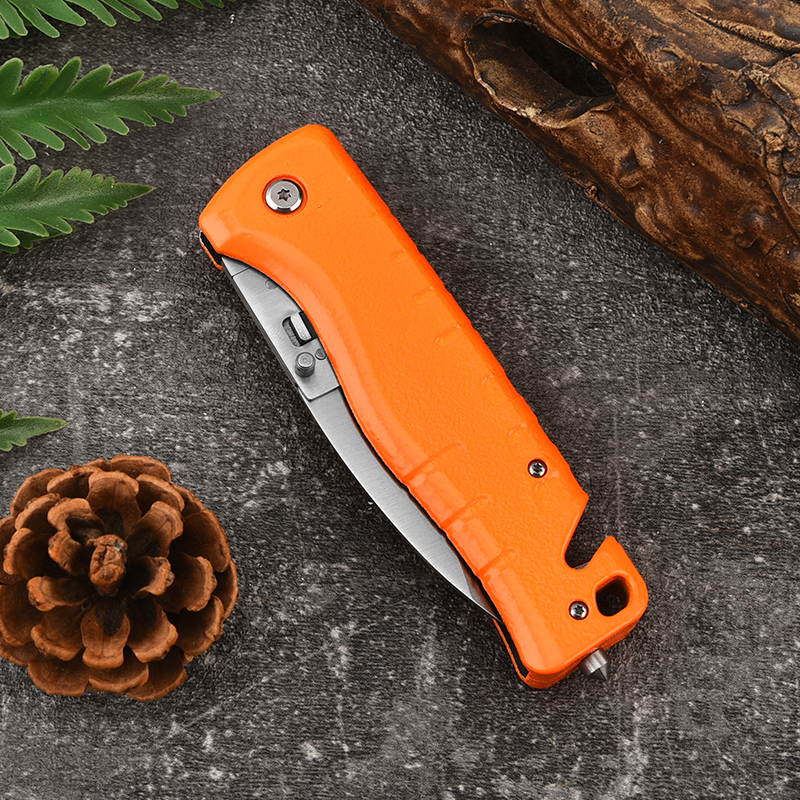
Many buyers compare OEM and ODM only by unit price. That approach is incomplete.
The true cost of a folding knife project includes development, tooling, sampling, revisions, production yield, quality control, packaging, logistics, inventory, and the commercial cost of launching a product that does not fit the market.
An OEM knife project may involve:
- Engineering review
- Prototype development
- Multiple sample rounds
- New molds or tooling
- Custom hardware
- Special materials
- Dedicated inspection fixtures
- Packaging development
- Higher initial minimum order quantities
- Longer cash-to-market cycle
These costs can be justified when the product creates lasting brand value or supports a premium selling price.
An ODM knife program typically reduces or removes many early-stage costs because the base product is already developed. Buyers may still pay for:
- Logo setup
- Custom packaging
- Handle-color changes
- Blade finish changes
- Artwork preparation
- Special labeling
- Optional upgraded materials
- Product testing or market-specific documentation
In short, ODM usually reduces upfront risk, while OEM can create greater long-term brand value.
A folding knife is a mechanical product. Small changes can affect blade centering, opening force, lock engagement, spring tension, gap consistency, and assembly efficiency.
That is why an OEM project needs enough time for engineering and validation. Rushing a custom knife into mass production can create problems that cost far more to solve after shipment.
| Project Stage | OEM Folding Knife | ODM Folding Knife |
|---|---|---|
| Product selection or concept review | 1–3 weeks | Several days to 2 weeks |
| Engineering and sample development | 3–8 weeks or longer | Usually limited to customization review |
| Tooling | 4–10 weeks where required | Often not required |
| Pre-production approval | 1–3 weeks | 1–2 weeks |
| Mass production | Depends on materials and order volume | Depends on materials and order volume |
These ranges are planning estimates, not fixed promises. Actual lead time depends on material availability, order quantity, complexity, surface treatment, packaging, testing requirements, shipping schedules, and the number of approval rounds.
The practical lesson is simple: Choose ODM when your sales calendar is fixed. Choose OEM when your product roadmap is more important than launch speed.
Whether you choose an OEM or ODM folding knife manufacturer, quality should never be treated as a final inspection issue only. Quality starts with product design and process control.
For folding knives, buyers should review both visible workmanship and mechanical performance.
- Blade centering in the closed position
- Consistent opening and closing action
- Secure lock engagement
- Reliable lock release
- Sharp-edge condition and blade grind consistency
- Gap consistency between handle components
- Pocket clip alignment and retention
- Fastener tightness
- Surface finish quality
- Logo clarity and placement
- Handle material consistency
- Packaging protection during transport
- Carton strength and shipping marks
- Batch identification and traceability
A knife can look attractive in a sample but still perform inconsistently in production. For this reason, a buyer should agree on an inspection checklist before mass production begins.
One of the most effective actions a buyer can take is to create a product approval sheet before the purchase order is released.
This document should define:
- Approved reference sample
- Blade material and finish
- Handle material and color
- Dimensions and weight tolerance
- Opening force expectations
- Lock-function requirements
- Cosmetic acceptance criteria
- Packaging configuration
- Quantity per inner box and master carton
- Labeling requirements
- Random inspection level
- Defect classification
This avoids the common problem of relying on subjective descriptions such as "good quality" or "premium finish." A clear approval standard makes communication faster and helps both buyer and manufacturer protect the final result.
Folding knives and utility knives are not ordinary promotional products. Their design, instructions, packaging, and traceability need careful attention.
For products placed on the European consumer market, Regulation (EU) 2023/988 applies from December 13, 2024 and establishes a general product-safety framework. It places importance on safe products, risk assessment, traceability, and responsible economic operators.
For a knife brand, this means that compliance planning should begin during product development—not after the products have been packed.
Your project brief should consider:
- The intended user and product application
- Foreseeable misuse
- Lock and closure performance
- Sharp-edge and handling risks
- Age restrictions or warnings where applicable
- User instructions
- Product identification
- Batch or lot tracking
- Manufacturer and importer information
- Market-specific labeling requirements
- Documentation retention
A folding knife with a failed locking mechanism can create a laceration risk. Recalls involving sharp tools have cited issues such as folding mechanisms that do not remain securely closed or locks that fail to stay engaged.
This is why product development should include more than aesthetics. Mechanical reliability is a brand-protection issue.
Use the following decision framework before you request a quotation.
- Building a proprietary product
- Creating clear market differentiation
- Protecting long-term brand value
- Achieving a precise technical specification
- Introducing a premium or specialized knife
- Developing an exclusive product family
- Controlling product evolution over time
- Entering the market quickly
- Reducing upfront development investment
- Testing a category before committing to tooling
- Offering multiple product styles
- Launching a private-label knife range
- Creating seasonal or promotional collections
- Using established and production-ready designs
For many brands, the best answer is not strictly OEM or ODM. It is a staged strategy.
1. Launch selected ODM folding knives to test target customers, pricing, materials, and packaging direction.
2. Track sell-through, customer reviews, return reasons, and repeat orders.
3. Identify the strongest product category.
4. Develop an OEM successor with improved features, exclusive styling, and stronger margins.
5. Use the OEM product as the hero item while maintaining ODM products for assortment breadth.
This approach reduces early risk while still creating a path toward long-term product ownership.
The quality of your OEM or ODM experience depends heavily on the manufacturer's development and production capabilities.
A supplier that only assembles existing products may be suitable for basic private-label orders. However, a brand that requires product innovation needs a partner with in-house engineering knowledge, materials understanding, manufacturing coordination, sampling capability, and consistent production control.
Yangjiang Holin Industrial Co., Ltd. supports folding knife, pocket knife, utility knife, and outdoor-tool projects with an internal development team and production facilities. This enables buyers to move from initial concept through product development, sampling, customization, and scaled manufacturing within one coordinated process.
For OEM projects, this means closer communication between design and production. For ODM projects, it means buyers can select from established product platforms while still receiving practical customization support for branding, materials, finishes, and packaging.
The goal is not merely to make a knife. It is to help customers create a product that fits their target market, price level, sales channel, and long-term brand plan.
OEM is best for brands that want to own the product story. ODM is best for brands that need to validate the market quickly.
Before choosing, define your target user, expected retail price, required differentiation, first-order budget, sales timeline, and forecast volume. Then ask a potential folding knife manufacturer to recommend the development route that best fits those realities—not simply the route with the lowest opening quotation.
If you are planning a folding knife, pocket knife, utility knife, or outdoor-tool program, contact Yangjiang Holin Industrial Co., Ltd. with your product idea, target market, reference images, expected quantity, and packaging requirements. Our team can help you assess whether an OEM or ODM solution is the better foundation for your next product line.
Folding knife OEM involves manufacturing a knife based on the buyer's own design or technical requirements. ODM involves selecting an existing manufacturer design and customizing it for the buyer's brand.
OEM generally requires a larger upfront investment because it may involve engineering, sampling, tooling, and custom parts. However, OEM may provide stronger long-term value when the design supports premium pricing, customer loyalty, and product exclusivity.
Yes. ODM customization commonly includes logo application, packaging, blade finishes, handle colors, labels, and selected material options. The available options depend on the specific product platform and order quantity.
It can be, but exclusivity must be clearly agreed in writing. A standard ODM model is often available to multiple buyers. Greater exclusivity may require a dedicated configuration, custom components, committed order volumes, or separate development investment.
Timing depends on the design complexity, required tooling, sample revisions, materials, packaging, and production schedule. An OEM project normally takes longer than an ODM launch because the product must be engineered and validated before bulk production.
Send product drawings or reference images, target dimensions, blade and handle materials, desired locking mechanism, finish requirements, logo artwork, packaging preferences, target quantity, target market, and expected delivery date.
Review blade centering, lock engagement, opening action, sharpness, fastener security, handle fit, surface finish, pocket clip performance, packaging protection, labeling, and batch traceability.
Yes. ODM can be an effective starting point for a new brand because it reduces product-development risk and allows faster testing of consumer demand. After identifying successful products, the brand can invest in OEM designs for greater differentiation.
1. [Regulation (EU) 2023/988 on General Product Safety — EUR-Lex]
2. [General Product Safety: European Standards and Official Publications — European Commission]
3. [EU General Product Safety Regulation Summary — EUR-Lex]
4. [Commission Implementing Regulation (EU) 2024/1435: Product Recall Notice Template — EUR-Lex]
5. [Laceration and Sharp-Edge Hazard Recall Examples — 411 Press]


