


Views: 299 Author: Holin Knife Publish Time: 2026-11-03 Origin: Site


Content Menu
● What Is OEM EDC Knife Manufacturing?
● What Is White Label Knife Purchasing?
● OEM EDC Knife Manufacturing vs White Label Purchasing: Comparison
● Customization: What Will Customers Actually Notice?
>> OEM Allows Functional Product Development
>> White Label Prioritizes Selection Over Redesign
● Cost Comparison: Look Beyond the Factory Price
>> A Practical Break-Even Example
● Quality Control: Verify the Knife, Not the Label
>> Steel Names Do Not Describe Complete Performance
>> Folding Mechanisms Need Separate Acceptance Checks
● Lead Times, Minimum Orders, and Inventory Exposure
● Design Rights, Exclusivity, and Supplier Continuity
● Product Safety and Market Access Apply to Both Routes
● A Five-Step Method for Choosing the Right Sourcing Route
>> 1. Define the Customer and Cutting Task
>> 2. Identify Non-Negotiable Requirements
>> 3. Evaluate Existing Models First
>> 4. Approve a Documented Reference Sample
>> 5. Release Production Through Clear Approval Gates
● A Hybrid Strategy: Validate Demand, Then Develop
● Build the Right Knife Program With Yangjiang Holin
>> 1. Is OEM EDC knife manufacturing always more expensive?
>> 2. Can white label knives deliver reliable quality?
>> 3. Does OEM manufacturing guarantee an exclusive knife?
>> 4. What information should I include in a custom knife inquiry?
>> 5. Can I move from white label purchasing to OEM production?
OEM EDC knife manufacturing and white label purchasing offer two different ways to build an everyday carry knife brand. OEM manufacturing gives buyers greater influence over product specifications and development. White label purchasing starts with an existing knife that can be branded and sold with fewer development steps. The better choice depends on your budget, launch schedule, technical requirements, and long-term positioning.
My recommendation is to evaluate differentiation before comparing quotations. Are you selling an available product under a new name, or developing a knife that solves a specific customer problem? That distinction should guide the sourcing decision.
For brands, importers, and distributors, this comparison explains the commercial trade-offs, technical checkpoints, and purchasing steps that matter.

OEM stands for original equipment manufacturer. In this article, OEM EDC knife manufacturing means producing an everyday carry knife against buyer-defined specifications or an approved custom design.
A custom EDC knife project may cover:
- Blade profile, dimensions, and cutting geometry.
- Steel selection and target hardness.
- Handle shape, materials, and surface texture.
- Opening mechanism and locking system.
- Pocket clip placement and hardware.
- Branding, packaging, and instructions.
The buyer does not necessarily need finished engineering drawings. A capable manufacturing partner can help translate a product brief into a manufacturable design.
However, commissioning development does not automatically establish ownership. Design rights, tooling ownership, exclusivity, and permitted reuse must be addressed in the agreement.
ODM means original design manufacturer. Typically, the supplier provides the underlying design, which the buyer selects or adapts.
An ODM pocket knife can sit between a fully custom project and a standard white label purchase. It may reduce development work while allowing selected changes.
Terminology varies between suppliers. Ask what can actually change, which development work is included, and who controls the resulting design.
White label purchasing means selecting an existing product and selling it under your own brand. The same underlying knife may also be available to other buyers.
Customization commonly focuses on logos, packaging, and available finish options. Structural changes may require a separate development project.
For a new distributor, a white label pocket knife can provide a practical way to test customer interest before committing to custom tooling.
However, "existing product" does not necessarily mean "ready to ship." Branding, packaging, production scheduling, and inspection can still affect delivery.
White label also does not mean low quality. An established design can perform well when its materials, manufacturing controls, and acceptance requirements are appropriate.
| Purchasing factor | OEM EDC knife manufacturing | White label purchasing |
|---|---|---|
| Starting point | Buyer brief or custom specification | Existing supplier model |
| Design flexibility | Broader, subject to feasibility | Usually limited to available options |
| Development spending | May include engineering, prototypes, and tooling | Usually less product-development spending |
| Launch preparation | Requires development and approval stages | Can involve fewer development stages |
| Minimum order quantity | Depends on materials, tooling, and processes | Depends on stock and branding requirements |
| Product exclusivity | Must be negotiated | Usually absent unless agreed |
| Technical workload | Greater specification and validation work | Greater emphasis on verifying an existing design |
| Main commercial risk | Investing before demand is established | Selling a product competitors can also source |
| Strongest application | Distinctive, long-term product programs | Market testing and straightforward range expansion |
Neither route guarantees a particular minimum order quantity, unit price, or lead time. Compare written quotations for equivalent requirements.
The strongest reason to choose custom pocket knife manufacturing is not simply to create an unusual appearance. It is to improve a meaningful user experience.
For example, a buyer may want:
- A slimmer handle for comfortable pocket carry.
- A clip position that reduces exposed handle length.
- A grip shape suitable for larger hands.
- Cutting geometry suited to frequent packaging tasks.
- Easier access for routine cleaning and maintenance.
These requirements should become measurable specifications or repeatable evaluation tasks.
"Premium feel" is difficult to inspect. Defined dimensions, finish samples, and documented operating checks are more useful.
With white label purchasing, the central skill is choosing the right existing platform.
Compare several samples against the same customer use case. Evaluate comfort, cutting behavior, opening and closing, clip retention, and visible assembly quality.
If an available model already meets the brief, extensive redesign may add cost without improving customer value.
My purchasing preference would be to customize only where the change solves a recognizable problem or supports a credible positioning advantage.
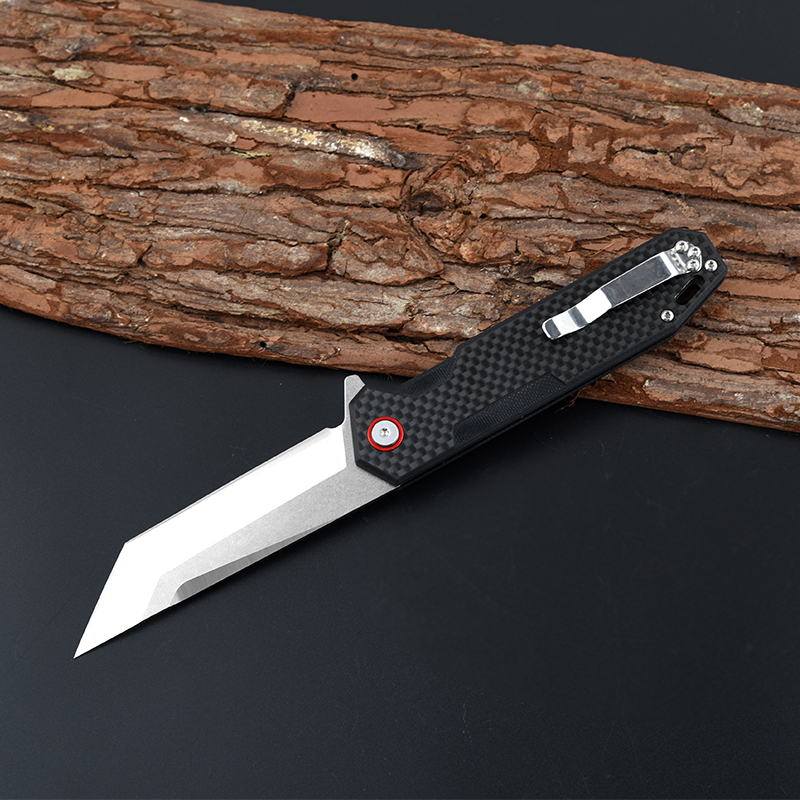
OEM knife manufacturing can involve engineering, prototypes, tooling, and additional validation. White label purchasing can reduce those initial development commitments.
However, a lower starting investment does not automatically produce a better commercial result.
Evaluate the complete cost structure:
1. Development, samples, and tooling.
2. Production and branded packaging.
3. Inspection and required testing.
4. Freight, insurance, duties, and import charges.
5. Inventory financing and storage.
6. Expected warranty, returns, and replacement handling.
Allocate one-time costs separately from recurring costs. Also distinguish recoverable taxes from genuine expenses where applicable.
Consider a hypothetical custom project requiring $6,000 in additional development spending. If it generates $3 more contribution per sold knife than the white label alternative, it needs 2,000 sales to recover that investment.
This is an illustrative calculation, not a supplier quotation or market benchmark.
The comparison assumes all relevant variable costs are already included in contribution. If custom packaging, warranty costs, or selling expenses increase, the recovery point changes.
This approach turns "OEM costs more" into a decision about investment, margin, and realistic sales volume.
Neither OEM nor white label is a quality grade. Both require appropriate specifications and production controls.
Knife performance depends on more than the steel designation. Hardness, carbide structure, heat treatment, and blade geometry influence cutting behavior and durability.
Metallurgical research also shows trade-offs between wear resistance and toughness. A steel selected for extended abrasive cutting may not provide the same resistance to chipping as another configuration.
For procurement, request a coherent specification rather than a fashionable steel name alone:
- Steel designation and material documentation.
- Target hardness and verification method.
- Blade thickness and edge geometry.
- Finish and corrosion-related requirements.
- Agreed cutting and durability evaluations.
Hardness readings are useful, but they do not independently verify every aspect of heat-treatment quality.
A folding knife combines a cutting blade with moving parts. Its evaluation should therefore extend beyond sharpness.
Agree on checks for blade centering, retention when closed, opening consistency, lock engagement, unwanted movement, and fastener security.
Safety-related evaluations need controlled procedures and competent personnel. Avoid improvised force demonstrations as substitutes for documented testing.
For white label products, ask whether production samples match the approved sample. For OEM projects, verify that engineering changes have been incorporated into the final production specification.
OEM development generally introduces more stages: design review, prototypes, revisions, production preparation, and approval.
White label purchasing may bypass some of those stages, but stock availability and packaging requirements still matter.
Ask suppliers to separate their schedule into:
- Sampling and sample approval.
- Material procurement.
- Tooling or production preparation.
- Manufacturing and assembly.
- Inspection and corrective action.
- Shipment readiness.
Minimum orders should also be broken down. A total project quantity may hide separate minimums for handle colors, blade finishes, packaging, or special components.
An apparently attractive assortment can create slow-moving inventory if every variation requires a substantial commitment.
A logo on a blade protects neither the underlying design nor your access to future supply.
For OEM and customized ODM projects, discuss:
- Ownership of drawings and custom tooling.
- Rights to manufacture or sell the design.
- Exclusivity by territory, channel, or period.
- Approval requirements for material substitutions.
- Access to replacement components.
- Tooling maintenance and transfer arrangements.
For white label knives, assume competing brands may buy the same platform unless the contract states otherwise.
Supplier continuity deserves equal attention. Record approved materials, finishes, dimensions, and packaging revisions so repeat orders do not depend solely on a photograph or product code.
An established catalog product is not automatically suitable for every destination market.
Knife-related import, sale, and carry restrictions require destination-specific review. Product features and intended sales channels should be checked before committing to production.
For consumer products within its scope, the European Union's General Product Safety Regulation has applied since December 13, 2024. Relevant requirements include risk assessment, technical documentation, traceability, and an EU-based responsible economic operator.
Neither sourcing model removes these obligations. Buyers should establish who prepares documentation, maintains records, supplies warnings, and supports corrective action.
This is a procurement planning issue, not a substitute for legal advice.
The following framework is an editorial purchasing recommendation, not a validated industry scoring system.
Specify who will use the knife, what they will cut, where they will carry it, and which market will receive it.
Separate essential features from preferences. This prevents decorative changes from driving unnecessary development.
If a white label model meets the essential requirements, compare its total cost and limitations against a custom proposal.
Record the sample revision, specification, appearance standards, and inspection criteria. Retain matching reference samples with both parties.
Confirm specifications before tooling, approve development before mass production, and resolve inspection findings before shipment release.
These steps reduce ambiguity regardless of the purchasing route.
A staged approach can suit buyers who want eventual differentiation without committing immediately to a full custom range.
Start with an appropriate existing model. Gather structured feedback on grip comfort, clip preference, cutting tasks, maintenance, and reasons for returns.
Then use that evidence to define an OEM or ODM development brief.
Treat early feedback carefully. A small group of enthusiastic customers is not proof of broad demand.
The goal is to identify repeated, commercially relevant problems—not to redesign a knife around every individual request.
Choose OEM when meaningful product differentiation justifies development. Choose white label when an existing platform meets the brief and limits initial exposure.
Yangjiang Holin Industrial Co., Ltd. manufactures folding knives, pocket knives, utility knives, and outdoor tools. With its own research and development team and production factory, the company supports product design, development, and scalable batch production through one-stop OEM/ODM services.
Send Holin your target market, estimated order quantity, product requirements, branding concept, and launch schedule. Request a feasibility review and a proposal separating development costs, production pricing, sampling stages, and inspection requirements.
Not necessarily. Development spending may be higher, but recurring costs depend on design complexity, materials, order volume, and manufacturing processes. Compare equivalent specifications and total program costs.
Yes. Reliability depends on the product design, materials, production controls, and verification. White label describes the sourcing arrangement, not a performance standard.
No. Exclusivity and design ownership require written agreement. Specify the protected design, permitted uses, duration, territory, and any exceptions.
Provide the target market, intended tasks, estimated quantity, target price, preferred dimensions, materials, mechanism, branding, packaging, and desired delivery schedule. Identify which requirements are flexible.
Yes, but customer demand does not grant rights to copy the supplier's design. Agree on development permissions and create a documented specification for the new project.
1. Ted Scott Designs — "Private Label, White Label, OEM—Knowing the Difference," October 25, 2020. Manufacturer perspective supporting the distinction between existing-product branding and production against buyer specifications. Terminology is not universally standardized. [tedscottdesign]
2. Larrin Thomas, Knife Steel Nerds — "Knife Steels Rated by a Metallurgist—Toughness, Edge Retention, and Corrosion Resistance," October 19, 2021. Technical basis for the discussion of hardness, carbide structure, wear resistance, and toughness trade-offs. [knifesteelnerds]
3. Larrin Thomas, Knife Steel Nerds — "What Is Edge Stability?", August 27, 2018. Explains the relationship between edge geometry, cutting ability, rolling, and chipping. [knifesteelnerds]
4. European Commission, Access2Markets — "EU's General Product Safety Regulation (GPSR): A New Era of Consumer Protection," January 6, 2025. Official overview of applicability, risk assessment, and responsible economic operator requirements. [trade.ec.europa]
5. U.S. Department of Commerce, International Trade Administration — "EU Consumer Goods General Product Safety Regulation (GPSR)," September 30, 2024. Supports the discussion of technical documentation, warnings, traceability, and market-access preparation. [trade]


