


Views: 277 Author: Holin Knife Publish Time: 2026-09-30 Origin: Site


Content Menu
● Are Aluminum Knife Handles Durable?
● 6061-T6 vs. 7075-T6 for Knife Handles
● Why Grip Design Matters More Than a Material Claim
>> Design for the hand and the pocket
>> Treat cold-touch and scratches honestly
● Anodized Aluminum Knife Handles: Type II vs. Type III
>> Account for finish thickness before machining approval
● Aluminum vs. G-10, Titanium, and Stainless Steel
● How to Specify an Aluminum Handle for OEM/ODM Production
>> Add a quality checklist before the first batch
● How to Clean and Maintain an Aluminum Knife Handle
● Build the Handle Around the Product
>> Are aluminum knife handles strong enough for everyday carry?
>> Is 7075 aluminum always better than 6061 for knife handles?
>> Are anodized aluminum handles scratch-proof?
>> Will an aluminum handle be slippery when wet?
>> Which anodizing type should I choose for a colored handle?
>> What should I send a custom knife manufacturer first?
An aluminum knife handle can make a folding knife feel light, precise, and comfortable to carry. But "aluminum" alone tells a buyer surprisingly little. Alloy, handle geometry, surface texture, finish, and construction all affect how the knife feels after months of pocket carry or outdoor use.
For brands developing folding knives, pocket knives, utility knives, and outdoor tools, the better question is not "Is aluminum durable?" It is: Which aluminum handle specification fits the intended user and application? This guide explains the trade-offs and shows how to turn them into a practical product brief.

Yes—when the alloy, design, and finish suit the job. Aluminum offers a useful balance of low weight, machinability, and corrosion resistance. That does not mean every aluminum handle resists dents, scratches, or slippery conditions equally well.
A knife handle is also a system, not just a pair of scales. Its apparent durability depends on the thickness of the scales, the support provided by liners or an integral frame, fastener placement, pivot design, edge radii, and the way the user grips the knife. A strong alloy will not compensate for poor geometry around a heavily loaded screw hole.
What aluminum does well:
- Keeps everyday-carry knives comfortable in a pocket.
- Allows precise machining of contours, grooves, and hardware seats.
- Supports a broad choice of anodized colors and finishes.
- Offers good general corrosion resistance when properly specified.
What it does not guarantee:
- A secure grip on a smooth, wet handle.
- Freedom from cosmetic scratches or dents.
- Comfortable bare-hand contact in extreme cold or heat.
- Identical colors across different alloys or production batches.
The practical takeaway is simple: evaluate the finished handle, not the material name on a product listing.
For many folding-knife designs, 6061-T6 aluminum is a sensible starting point. The 6061 designation identifies the alloy; T6 identifies its heat-treated condition. It combines useful strength with good machinability and corrosion resistance. 7075-T6 offers substantially higher strength, but that advantage should address a real design requirement rather than serve as a premium-sounding label.
Typical reference values for the two tempers illustrate the difference. They describe material specimens—not the strength, safety, or service life of a complete knife.
| Selection factor | 6061-T6 aluminum | 7075-T6 aluminum |
|---|---|---|
| Typical tensile strength | About 310 MPa | About 572 MPa |
| Typical yield strength | About 276 MPa | About 503 MPa |
| General design priority | Balanced strength and manufacturability | Higher strength where the design needs it |
| Buyer’s decision | Start here for many machined handle concepts | Request only when loads and geometry justify it |
A higher yield strength does not automatically produce a better pocket knife. If a handle is already adequately supported, grip shape and finish may make a greater difference to the user. Conversely, a thin or highly machined component may call for a closer structural review.
Procurement tip: Ask a supplier to state both the alloy and temper. "Aircraft-grade aluminum" is less useful on a drawing than "6061-T6," followed by the required dimensions, finish, and inspection criteria. Avoid treating a metal's tensile-strength figure as a direct measure of a knife's overall durability.
A smooth aluminum handle may feel refined in a showroom and uncertain in a wet hand. Knife-owner discussions reflect both reactions: some people value the low weight and solid feel, while others dislike the cold touch, visible wear, or lack of traction. Those comments are useful design prompts, but they are not controlled test results.
Grip features should work together:
- Contouring: A comfortable palm swell and carefully shaped edges reduce pressure points.
- Texture: Machined grooves or patterned areas can improve purchase without covering the whole handle.
- Control zones: Texture near the thumb and finger contact points may matter more than decorative machining elsewhere.
- Pocket interaction: Aggressive texture can catch on clothing or feel abrasive during frequent carry.
- Cleaning access: Deep patterns can hold dirt, so an outdoor-tool design should remain easy to clean.
For a compact everyday-carry knife, the best answer may be modest texture and rounded edges. For an outdoor tool expected to meet rain, mud, or gloves, a more assertive pattern may be appropriate. Neither choice should rely on a photograph alone: handle samples need hands-on evaluation in the conditions the product is meant to face.
Metal quickly feels cold when handled in low temperatures and can become uncomfortable after prolonged exposure to heat. Anodizing improves the surface, but it does not make the underlying aluminum immune to impact marks. If appearance over time is central to the product promise, test the proposed color and texture after ordinary carry rather than approving only a pristine sample.
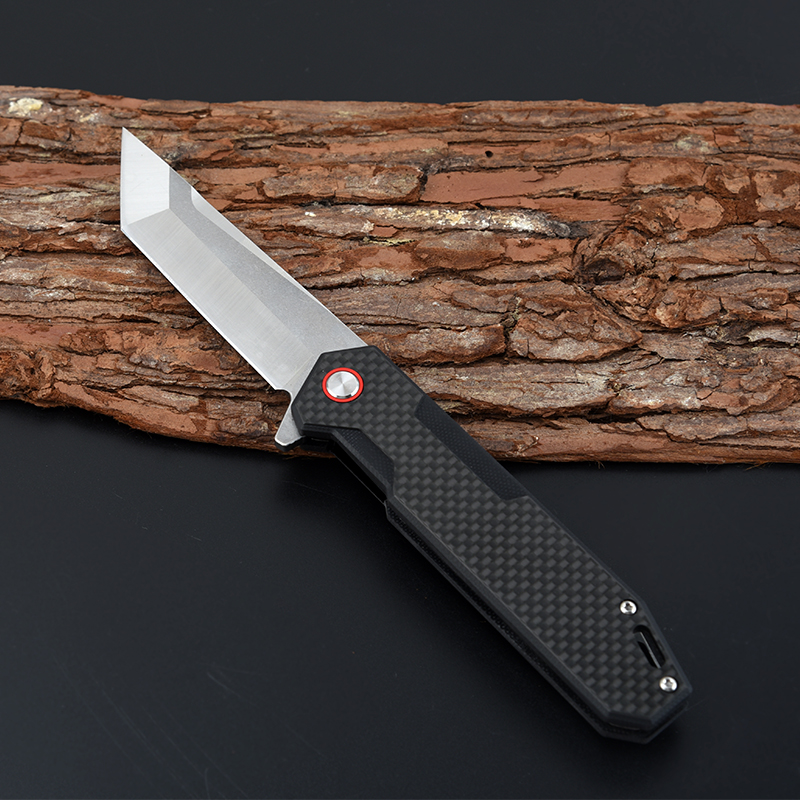
Anodizing converts the outer surface of aluminum into an oxide layer. The coating can improve surface protection and create color options, but its performance depends on the alloy, process, thickness, sealing, and final design.
| Finish choice | Useful priority | Design consideration |
|---|---|---|
| Type II anodizing | Decorative color and general surface protection | Agree on color samples and acceptable variation |
| Type III hardcoat anodizing | Greater resistance to abrasive wear | Check coating thickness, darker color expectations, and fitted dimensions |
Type III is not simply "Type II, but better." A hardcoat specification can be valuable where wear is a concern, while Type II may better serve a range of decorative colors. Neither finish should be sold as scratch-proof. Color can also vary with alloy, pretreatment, coating thickness, and processing conditions.
This is an easy issue to miss when developing a folding knife. Anodizing changes dimensions: part of the coating grows outward while part forms within the original metal surface. On a hole, outward growth occurs from both sides. That can affect a tight-fitting pivot, hardware seat, or assembled clearance.
Before approving production drawings, identify critical fit surfaces and ask how they will be measured after finishing. Discuss any areas that need masking with the finishing supplier. A sample that fits perfectly before anodizing is not, by itself, proof that the finished production assembly will fit correctly.
For colored handles, request physical limit samples that show the acceptable light and dark range. If color matching is particularly important, confirm which parts and material lots the approval samples represent.
No handle material wins every use case. The decision should reflect weight targets, preferred feel, appearance, grip geometry, construction, and budget—not a claim that one material is universally "best."
| Handle material | Potential advantage | Trade-off to evaluate |
|---|---|---|
| Aluminum | Lightweight metal feel and broad finishing options | Cold touch, dents, and finish wear |
| G-10 | Nonmetal feel and varied surface textures | Different visual and tactile character |
| Titanium | Premium metal appearance and design possibilities | Higher material and machining costs may affect the project |
| Stainless steel | Robust feel and familiar metal construction | Added carry weight can work against a lightweight brief |
These are design tendencies, not performance rankings. A textured aluminum handle may offer better purchase than a smooth handle made from another material. Likewise, the total weight of a knife depends on its blade, liners, frame, hardware, and overall geometry—not just its handle scales.
A successful custom knife project starts with a brief that a design and manufacturing team can actually test. "Lightweight black aluminum handle" leaves too many decisions unresolved. The following sequence helps turn an idea into a repeatable production specification.
1. Define the user and task. Is the product a pocket knife for daily carry, a utility knife used with gloves, or an outdoor tool expected to get wet? State the likely conditions.
2. Set measurable design targets. Provide preferred overall dimensions, target assembled weight, grip length, and any critical interface dimensions.
3. Select the proposed alloy and temper. Start with the performance need. Ask what would justify moving from 6061-T6 to a higher-strength option.
4. Specify the gripping surfaces. Mark the exact areas for milling or texture. Describe how the handle should feel, not merely how it should look.
5. Choose the finish. State the anodizing type, color target, appearance limits, and any coating-thickness or inspection requirements agreed with the finisher.
6. Review the prototype as a complete knife. Check assembled fit, edge comfort, opening and closing feel, pocket interaction, and grip with dry and wet hands.
7. Approve production references. Keep an accepted physical sample, final drawings, and written appearance criteria before bulk production begins.
A useful inspection plan separates cosmetic acceptance from functional acceptance. For example, an anodized scale may meet a color target yet still need a fit check around the pivot. Conversely, a small visual variation might fall within an agreed range without affecting use.
Ask the manufacturing team to confirm:
- Which dimensions are checked before and after anodizing.
- How assembled fit and operation will be assessed.
- Where inspection will look for burrs, sharp edges, and surface defects.
- What counts as an acceptable color variation or visible contact mark.
- How an approved prototype will be compared with production units.
These points do not replace model-specific engineering tests. They make design intent clearer and give buyers and suppliers a common basis for reviewing samples.
For ordinary grime, wipe the handle with a soft cloth and a mild soap solution, then rinse and dry it thoroughly. Pay attention to textured areas and crevices where moisture and dirt can remain.
Avoid aggressive acidic or alkaline cleaners and coarse abrasives on anodized surfaces. Do not promise that polishing will restore a damaged anodized finish: a scratch that reaches the underlying metal is different from removable surface dirt. Follow the finished knife's own care instructions for its blade, pivot, and other components.
An aluminum handle is most convincing when its material specification supports a clear user experience. A balanced alloy choice, deliberate grip pattern, suitable finish, and post-finish fit checks do more for a product than an impressive material label alone.
Planning a custom folding knife, pocket knife, utility knife, or outdoor tool? Send Yangjiang Holin Industrial Co., Ltd. your target use, reference drawings or concept images, expected order quantity, and preferred handle finish. Its in-house R&D team and production factory can work with you on product design, development, OEM/ODM customization, and bulk manufacturing. Request a prototype review plan before finalizing your production specification.
They can be. The answer depends on alloy, handle geometry, support structure, hardware, and intended use. Check the complete knife design rather than relying on a material-strength figure alone.
No. 7075-T6 offers higher typical strength, but 6061-T6 may be the more balanced choice for a design that does not need that additional strength. Compare the requirements of the actual handle.
No. Anodizing changes the surface and can improve wear resistance, but visible marks and impact damage can still occur. Approve finish expectations using physical samples.
It may be, particularly if the handle is smooth or poorly shaped for the hand. Evaluate the proposed contour and texture with wet-hand and glove-use checks that match the product's intended use.
Type II is a common starting point when decorative color matters. Type III hardcoat is worth considering when abrasion is a higher priority. Confirm the achievable color and coating specification with the finishing supplier.
Send the intended application, target dimensions and weight, concept drawings or images, preferred alloy and finish, grip requirements, and expected order quantity. Clearly mark any dimensions or appearance features that must not change.
1. Blade HQ, ["For a Durable Handle, Look No Further Than Aluminum!"].
2. The Aluminum Association, ["Industry Standards"].
3. Thomas, ["All About 6061 Aluminum (Properties, Strength and Uses)"].
4. FabDigit, ["Aluminum 7075: Properties, Tempers (T6, O, T651) & Uses"].
5. Aluminum Anodizers Council, ["Anodizing Reference Guide"].
6. Aluminum Anodizers Council, ["Anodized Aluminum FAQ"].
7. r/knifeclub, ["How do you feel about aluminium as a handle material?"].


