


Views: 224 Author: Holin Knife Publish Time: 2026-09-26 Origin: Site


Content Menu
● Budget Pocket Knife vs Premium Pocket Knife: The Core Difference
● Which Pocket Knife Has the Better Profit Margin?
>> A Worked Budget vs Premium Knife Example
● How Product Specifications Change Profit
>> Blade Steel and Heat Treatment
>> Packaging and Customization
● A Deeper Cost Check: The Margin Leakage Map
● When Budget Pocket Knives Maximize Profit
● When Premium Pocket Knives Maximize Profit
● A Practical OEM/ODM Test Before Scaling
● Which Strategy Should You Choose?
>> Is a premium pocket knife always more profitable than a budget pocket knife?
>> What matters more: profit margin percentage or profit per unit?
>> Can a budget pocket knife still offer good quality?
>> Does premium blade steel guarantee a premium knife?
>> Should a new brand launch both tiers at once?
>> How can OEM/ODM development improve profitability?
For a knife brand or wholesale buyer, the budget pocket knife vs premium pocket knife decision is not simply about which model costs less to manufacture or sells for more. The better question is which product delivers more profit after manufacturing, freight, selling fees, marketing, returns, and unsold inventory. A budget knife can win through repeatable volume. A premium knife can win through higher profit per sale. Neither wins automatically.
This guide compares the two from a product-development and procurement perspective. It also shows how to test profitability before committing to a large OEM/ODM order.

A budget pocket knife is designed to meet a clear use case at an accessible retail price. Buyers still expect a usable edge, dependable opening and closing, a comfortable grip, and consistent quality. The cost savings usually come from simpler construction, readily available materials, standardized components, and fewer finishing operations—not from ignoring essential function.
A premium pocket knife asks customers to pay more for benefits they can recognize and trust. These may include a more carefully specified blade, tighter fit and finish, refined ergonomics, distinctive industrial design, upgraded handle materials, or stronger after-sales support. A costly material alone does not create a premium product.
The labels are relative to your market. One reviewer's "budget" knife may retail for close to $100, while another affordable model may cost under $50. Define your tiers against the alternatives your target customer actually sees, rather than relying on a universal price cutoff.
| Decision factor | Budget pocket knife | Premium pocket knife |
|---|---|---|
| Primary appeal | Practical value and accessible price | Distinctive performance, design, or ownership experience |
| Product strategy | Proven construction with disciplined cost control | Selective upgrades that customers will pay for |
| Typical sales challenge | Price competition and limited room for error | Proving that the higher price is justified |
| Inventory exposure | Lower cost per unit, often more units to manage | More capital tied up in each unit |
| Quality priority | Consistency across large runs | Consistency plus scrutiny of fine details |
| Best-fit channel | Broad retail, promotions, or value-focused wholesale | Specialist retail, branded collections, or enthusiast-focused sales |
These are strategic tendencies, not guaranteed outcomes. In independent side-by-side testing, some lower-priced knives performed well against more expensive models. That is a useful reminder: retail price and useful performance are not the same thing.
Premium knives often have a higher *potential* profit per unit because their selling prices leave more room above manufacturing cost. Budget knives can produce more total profit if they sell faster and efficiently enough. To compare them, calculate both contribution per unit and profit over a defined period.
Use this simplified model:
Contribution per unit = Net selling price − landed product cost − selling costs − expected return and warranty cost
Then calculate:
Period contribution = Contribution per unit × Units sold − allocated launch costs
Here, "net selling price" means the amount your business receives before the listed costs are deducted. Keep the accounting boundary consistent for both products. If a wholesale customer pays the freight, for example, do not include that freight in one model but omit it from the other.
The figures below are hypothetical planning assumptions, not market averages, supplier quotations, or forecasts for your business. The two models use the same accounting boundary so buyers can see how volume changes the result.
| Illustrative input | Budget model | Premium model |
|---|---|---|
| Net selling price per unit | $24.00 | $68.00 |
| Landed product cost per unit | $10.00 | $31.00 |
| Selling, fulfillment, and marketing per unit | $7.00 | $17.00 |
| Expected returns and warranty cost per unit | $1.00 | $3.00 |
| Contribution per unit | $6.00 | $17.00 |
| Units sold during the period | 2,000 | 600 |
| Period contribution before launch costs | $12,000 | $10,200 |
The premium model earns more per sale, but the budget model wins in this particular volume scenario. Change the sales forecast, advertising cost, or return rate, and the answer may reverse.
For an equal-unit comparison, the premium model leads by $11 per unit. To match $12,000 in contribution at $17 per unit, it would need to sell approximately 706 units, assuming the other inputs remain unchanged. This is why a credible demand estimate matters as much as an attractive factory quote.
Blade steel affects performance, but a steel name does not tell the whole story. Edge retention, toughness, and corrosion resistance involve trade-offs. Heat treatment and edge geometry also influence how a finished knife cuts and resists damage.
For a budget model, select a blade specification that reliably meets the intended task and can be manufactured consistently at the target cost. For a premium model, an upgraded steel is most valuable when its performance matches a buyer need that can be explained and demonstrated. Paying more for an alloy while overlooking inconsistent heat treatment may add cost without creating dependable customer value.
Ask your supplier for a documented steel designation, agreed hardness range, and inspection method. Test finished production samples rather than judging a knife solely by its material list.
Customers interact with a knife's handle and opening action every time they use it. Grip, pocket comfort, and predictable lock engagement can therefore matter more to satisfaction than a visually dramatic feature.
Budget designs can protect margin by limiting decorative machining, complex assemblies, and excessive finish options. Premium designs may justify more precise fitting, distinctive texture, or additional finishing—but each upgrade should support a clear retail claim.
Neither tier should treat basic function as optional. A poorly fitted premium knife can attract expensive returns, while an inconsistent budget knife can lose the repeat orders on which its volume strategy depends.
A custom box, logo, colorway, or accessory can help differentiate either tier. Yet customization also introduces artwork approvals, sampling, inventory complexity, and potential minimum-order constraints.
Start with the features that customers will notice. A restrained, well-presented budget knife may outperform a heavily decorated product that exceeds its target price. For premium knives, packaging should reinforce the product story without consuming so much cost that it erases the additional margin.
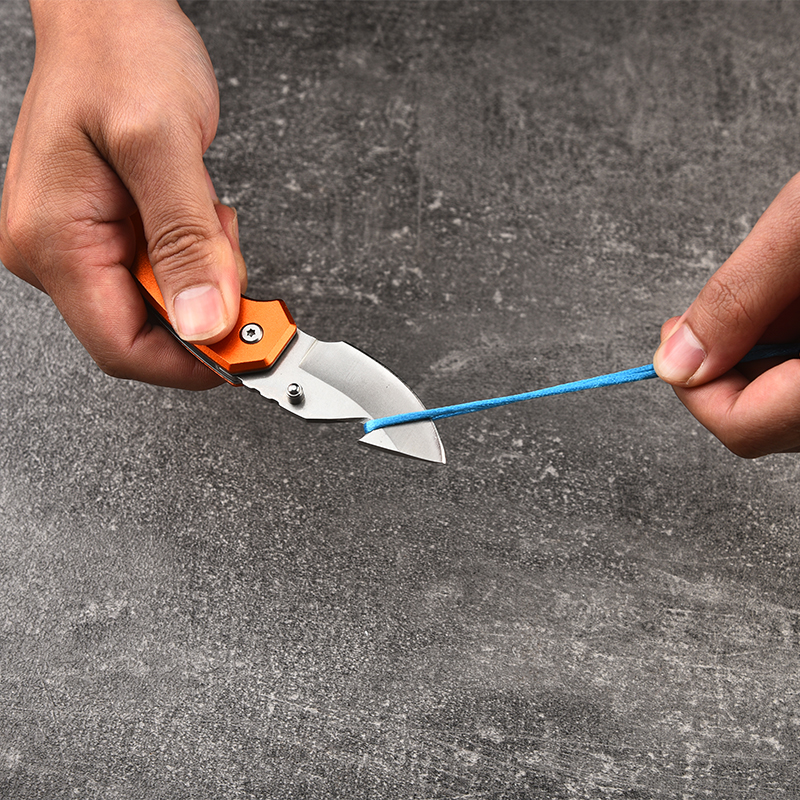
A quote is only the beginning of a knife's cost story. Before comparing budget and premium pocket knife profitability, build a margin leakage map for each SKU. This identifies expenses that arrive after the factory price is agreed.
- Development: Design work, prototypes, revisions, tooling, and sample shipments.
- Production: Materials, assembly, finishing, inspection, and replacement units for defects.
- Importation: Freight, insurance, duties, customs handling, and destination charges.
- Selling: Marketplace or retailer fees, payment processing, fulfillment, promotions, and advertising.
- After-sales: Returns, refunds, warranty handling, customer support, and replacement shipping.
- Inventory: Storage, financing, markdowns, and obsolete stock.
Allocate one-time development and tooling costs across a realistic order volume, not an optimistic lifetime sales target. For example, a $3,000 launch expense adds $3 per knife over 1,000 units sold, but $10 per knife if only 300 sell. That difference can overturn an otherwise appealing premium-margin calculation.
Channel costs deserve particular attention. Selling-platform fees can change, so use the fee schedule and fulfillment assumptions that apply to your actual listing, destination, size, and sales plan. A percentage borrowed from another seller's category is not a reliable input.
A budget strategy works best when the product meets a common need, the design can be produced consistently, and your channel can generate enough sales without expensive customer acquisition.
Consider a budget line when:
- You have a value-focused retailer or distributor with a credible volume commitment.
- A proven design can be differentiated through useful details rather than costly reinvention.
- You can forecast replenishment from actual orders or a controlled pilot.
- A small reduction in manufacturing cost will not increase defects or returns.
Its main danger is thin room for error. If competitors force discounts or advertising costs rise, a modest per-unit contribution can disappear quickly. Set a minimum acceptable contribution before approving the design, then test whether it survives a lower selling price or a slower sales month.
A premium strategy is stronger when your brand can show why the knife is worth more and can reach buyers who care about those differences. Material upgrades are one route, but they are not the only one. Design quality, controlled manufacturing, clear specifications, and responsive support can all help defend a higher price.
Consider a premium line when:
- You can define a specific customer and the feature that customer values.
- Product samples demonstrate a noticeable improvement over lower-priced alternatives.
- Your selling channel allows enough space to explain the knife's benefits.
- Expected sales justify development spending and inventory risk.
Its main danger is paying for features customers will not fund. A premium bill of materials can look impressive while leaving little contribution after promotion and after-sales expenses. Prototype against a target retail price, not just a target appearance.
From a manufacturing-planning perspective, the most useful question is not "Which tier is better?" It is "Which specification can we repeatedly produce at a cost the market will support?" A staged test answers that question with less inventory exposure.
1. Set two target customer briefs. Define the use case, expected retail price, intended channel, and essential features for one budget and one premium concept.
2. Request comparable quotations. Keep quantities, packaging assumptions, inspection requirements, delivery terms, and destination consistent wherever possible.
3. Prototype the critical differences. Compare grip, opening and closing, blade performance, finish, and perceived value with representative users.
4. Build both unit-economics models. Include launch expenses, landed cost, selling costs, expected returns, and conservative sales estimates.
5. Run a limited commercial test. Track conversion, actual selling price, return reasons, customer feedback, and reorder interest.
6. Scale the stronger contribution case. Recalculate using observed results before placing a larger production order.
For export orders, add a separate destination-market compliance review before finalizing the mechanism or marketing claims. Knife import, sale, possession, and carry rules can differ. In the United States, federal import rules distinguish certain standard pocketknives from prohibited switchblade designs; local requirements may still apply. A legal review is more valuable than discovering a restriction after production.
Yangjiang Holin Industrial Co., Ltd. can support this staged approach through its in-house research and development team, production factory, and one-stop OEM/ODM service. Buyers can use those capabilities to discuss product design, development, customization, and volume manufacturing within one project plan. Final specifications, quantities, prices, and timelines should be confirmed through a project-specific quotation rather than assumed here.
Choose the tier that produces the better risk-adjusted total contribution, not the one with the highest markup percentage. Budget models depend on dependable volume and disciplined costs. Premium models depend on defensible value and sufficient demand at a higher price. A two-tier range can also work if the products serve distinct buyers instead of competing against each other.
Ready to test your concept? Send Yangjiang Holin Industrial Co., Ltd. your target market, retail price range, design brief, expected order volume, and customization requirements. Ask for side-by-side budget and premium specifications with comparable quotations, sample plans, and production assumptions. That gives your team a concrete basis for choosing the more profitable product.
No. It may deliver more contribution per unit, but slower sales, higher development costs, or costly returns can reduce total profit. Compare both products over the same sales period using realistic volume assumptions.
Neither is sufficient alone. Profit per unit helps assess each sale; margin percentage shows how much of revenue remains under your chosen calculation. Total contribution, cash tied up in inventory, and sales speed complete the picture.
Yes. A lower price can come from a simpler design and efficient production. Define non-negotiable performance and inspection requirements so cost reductions do not undermine function or consistency.
No. Steel choice needs to match the intended use. Heat treatment, edge geometry, fit, grip, and overall construction also affect the finished product. Evaluate production samples rather than relying on a steel label.
Only if it can explain who each model serves and fund the inventory, testing, and marketing for both. Otherwise, a focused pilot in one tier may provide clearer demand and cost data before expanding.
It can help buyers align the design, materials, customization, and production plan with a target price. The financial benefit is not automatic: compare quotations, approve samples, and measure actual selling and after-sales costs.
The market context, product-performance discussion, platform-fee caution, and U.S. import note draw on the following sources. The financial table is an original illustrative scenario, not data reported by these publications. The description of Yangjiang Holin Industrial Co., Ltd. is based on the company information supplied for this article.
1. Grand View Research, "[Knife Market Size, Share & Trends | Industry Report, 2033]." Market outlook and folding-knife segment context; its broader knife-market figures should not be interpreted as pocket-knife-only sales.
2. Larrin Thomas, Knife Steel Nerds, "[Knife Steels Rated by a Metallurgist—Toughness, Edge Retention, and Corrosion Resistance]." Steel-property trade-offs and the importance of heat treatment and edge geometry.
3. OutdoorGearLab, "[The Best Pocket Knives of 2026 | Tested & Ranked]." Comparative product testing, price examples, and practical evaluation criteria.
4. Amazon Selling Partner Services, "[Update to U.S. Referral and Fulfillment by Amazon Fees for 2026]." Basis for checking current channel fees when modeling unit economics.
5. Legal Information Institute, Cornell Law School, "[19 CFR § 12.96—Imports Unrestricted Under the Act]." U.S. federal import treatment of specified common and special-purpose knives.
6. U.S. Customs and Border Protection, "[Traveling With a Personal Knife/Switchblade/Sword Into the United States]." Additional caution concerning prohibited designs and destination-specific rules.


