


Views: 269 Author: Holin Knife Publish Time: 2026-09-25 Origin: Site


Content Menu
● Gravity Knife vs. Folding Knife vs. Automatic Knife
● A Short History of Gravity Knife Design
● Why Gravity Knives Remain Popular
>> Distinctive Product Identity
>> Key Safety Features to Evaluate
● Safe Handling Steps for New Users
● Material Selection for Gravity Knife Manufacturing
● Quality Control for OEM and ODM Gravity Knives
>> Essential Inspection Points
● Custom Gravity Knife Development Options
>> OEM Projects
>> ODM Projects
● Legal and Market Considerations
>> A Practical Buyer Checklist
● Why Work With Yangjiang Holin Industrial Co., Ltd.?
● Request a Custom Gravity Knife Proposal
● FAQ
>> 1. What is the main difference between a gravity knife and a standard folding knife?
>> 2. Are gravity knives the same as automatic knives?
>> 3. What materials are best for a custom gravity knife?
>> 4. Can gravity knives be used for outdoor activities?
>> 5. How can I reduce safety risks when using a gravity knife?
>> 6. Can I customize a gravity knife with my own logo and packaging?
>> 7. What information should I provide for an ODM knife project?
>> 8. What should I inspect before approving a mass-production sample?
Gravity knives are a distinctive category of folding tools that use gravity, inertia, or a gravity-assisted motion to move the blade from the handle into its working position. For buyers, brands, and outdoor-tool developers, their appeal lies in one-handed usability, mechanically engaging designs, and strong potential for differentiated OEM/ODM product development.
At Yangjiang Holin Industrial Co., Ltd., we see gravity-inspired mechanisms not simply as a novelty, but as a product-engineering challenge: balancing controlled blade movement, secure locking, comfortable handling, manufacturing consistency, and market-specific compliance. A well-developed gravity knife or gravity-assisted folding tool should feel deliberate in the hand, reliable through repeated use, and appropriate for its intended work or outdoor application.
> Important: Knife definitions, ownership rules, carry restrictions, blade-length limits, and transport requirements vary widely by country, state, city, and specific setting. Always verify the current rules in the destination market before purchasing, importing, selling, carrying, or using a knife.
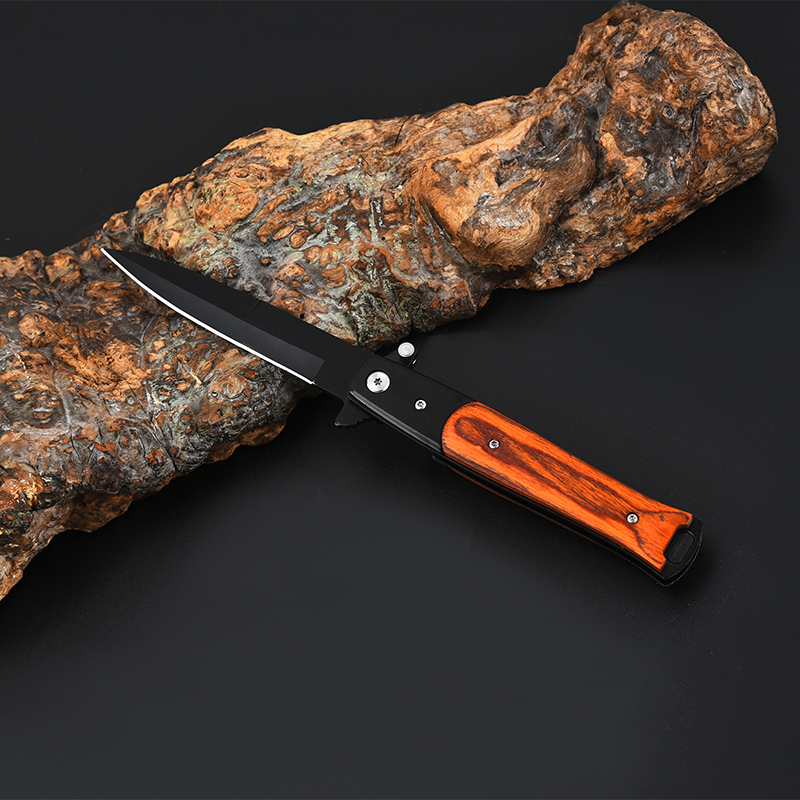
In broad industry usage, a gravity knife is a knife with a blade that can be released from the handle or sheath by the force of gravity, inertia, or a related manual movement. Once deployed, the blade is typically held in place by a lock, latch, lever, or other retention mechanism.
The practical definition is more nuanced than simply asking whether a blade can move when the handle is flicked. Many ordinary folding knives can be opened quickly by an experienced user. However, they may still be designed primarily for thumb-stud, thumb-hole, flipper, nail-nick, or manual opening.
A purpose-built gravity knife generally has several recognizable characteristics:
- A blade path designed for gravity or inertial deployment
- A release, latch, frame, button, or locking component
- A handle construction that guides blade movement
- A mechanism intended to retain the blade in closed and open positions
- A design that can often be operated with one hand
- A controlled action rather than uncontrolled blade swing
For product developers, the key question is not only, "Can it open by gravity?" A more useful question is:
> Does the mechanism provide a repeatable, secure, and user-controlled opening-and-closing experience?
That distinction determines whether a design feels like a practical cutting tool or an unreliable mechanism.
Knife terminology is often inconsistent across markets. Buyers should understand the differences before selecting a mechanism for a private-label project, outdoor brand, retail program, or professional-tool collection.
| Knife type | Primary opening method | Typical mechanism | Buyer consideration |
|---|---|---|---|
| Traditional folding knife | Manual opening | Nail nick, thumb stud, thumb hole, flipper | Familiar, versatile, and widely used |
| Gravity knife | Gravity or inertial movement | Sliding blade, swinging frame, latch or lock | Distinctive action and mechanism-focused appeal |
| Gravity-assisted folding knife | Manual release plus gravity-assisted blade movement | Button lock, pivot system, free-swinging blade | Can combine familiar folding-knife form with fast operation |
| Automatic knife | Automatic deployment after activation | Spring-driven blade movement | Often subject to different compliance requirements |
| OTF knife | Blade travels in and out through handle front | Manual, spring-assisted, or automatic slider | Compact and mechanically complex |
| Utility knife | Blade is extended manually or by a sliding mechanism | Replaceable blade, slider, lock | Practical choice for packaging, construction, and industrial work |
A gravity knife should not automatically be treated as an automatic knife. The operating principle matters. An automatic knife typically uses stored spring force to drive the blade open after the user activates a button or other control. A gravity knife relies more directly on gravitational force, inertia, user movement, or a released blade path.
This difference matters in product development because spring-powered mechanisms, blade deployment speed, locking methods, and legal classifications may all affect the target market.
The most frequently cited historical example is the German Flieger-Kappmesser, often translated as an aviator's cutting knife. This type of tool was developed for aircrew use and combined a folding cutting blade with additional functional elements, including a marlinspike in certain versions.
The original design logic was practical. Aircrew and parachutists needed a compact cutting tool that could be operated with limited dexterity, potentially with one hand, while wearing gloves or working in confined conditions. A knife that folded into the handle was easier to carry than a fixed blade, while gravity-assisted deployment could reduce the need for two-handed manipulation.
Over time, the gravity-knife concept moved beyond aviation and emergency use. It became relevant to:
- Collectible military-style tools
- Outdoor and field equipment
- Everyday-carry folding knives
- Mechanism-driven enthusiast products
- Specialty tactical-style designs
- Custom promotional and private-label knife programs
Today's market includes both historically inspired designs and modern reinterpretations. Some use sliding blades. Others use pivoting frames, button locks, split-handle mechanisms, or free-swinging blades. The common thread is the user's interaction with a blade that moves through controlled gravity or inertia rather than solely through a conventional thumb-opening system.
A gravity knife is not the universal answer for every cutting task. However, the category continues to attract buyers because it offers a combination of usability, tactile appeal, and visual differentiation.
In real work and outdoor situations, users may have only one hand available. They may be holding rope, packaging, a fishing line, a flashlight, a strap, or another tool. A gravity-based opening action can make blade access more convenient when properly designed.
For example, a user opening cartons in a warehouse may prefer a compact folding utility knife with a secure release mechanism over a tool that requires two hands to open. An outdoor user may value a glove-friendly design when cutting cordage, tape, food packaging, or lightweight material at camp.
Many gravity-inspired designs reduce dependence on strong opening springs. This can create a more direct relationship between the user, the release mechanism, the blade path, and the locking system.
From a manufacturing perspective, fewer high-tension components may simplify some aspects of assembly. However, this does not mean gravity knives are automatically easier to produce. Precision remains essential. Small variations in tolerances can affect blade travel, lock engagement, friction, alignment, and user confidence.
For brands operating in a crowded folding-knife market, a familiar liner-lock folder may be commercially safe but visually difficult to differentiate. A well-executed gravity or gravity-assisted mechanism can give a product a memorable identity.
It can also support product storytelling around:
- Mechanical craftsmanship
- Outdoor readiness
- Field-inspired functionality
- One-hand usability
- Modern industrial design
- Historical utility-tool inspiration
- Collectible mechanism appeal
For OEM/ODM buyers, this differentiation can be especially valuable when launching a new product line under a proprietary brand.
Although specific designs vary, most gravity knives include four functional systems: blade movement, closed retention, open locking, and user control.
The blade may move through a handle channel, pivot from a frame, or swing freely after a latch is released. The design must allow smooth movement while preventing excessive side-to-side play.
A well-engineered blade path should offer:
- Consistent action
- Minimal blade rubbing
- Stable alignment
- Predictable deployment
- Reduced risk of accidental contact with the edge
- Reliable closure after use
A blade must remain secure when the knife is carried. This can be achieved through a latch, detent, locking frame, cover, button, friction system, or another retention feature.
Closed retention is one of the most important safety factors. If the blade moves too freely while inside the handle, it may create an unpleasant or unsafe carry experience. If retention is too strong, the knife may become difficult to operate.
The best balance is usually secure enough for confident carry, yet accessible enough for controlled deployment.
Once the blade reaches its working position, it must be held securely. Common approaches include:
- Button locks
- Frame locks
- Liner locks
- Lockback systems
- Lever-operated locks
- Rotating or sliding frame locks
- Crossbar-style locking systems
The lock should engage fully and consistently. It should also be positioned to reduce the risk of accidental disengagement during ordinary cutting tasks.
A gravity knife should provide the user with intentional control. The user should be able to understand:
- How to release the blade
- Where the blade will travel
- When the lock has engaged
- How to close the knife safely
- Which fingers must stay clear of the blade path
This is why handle ergonomics matter. The mechanism may be visually impressive, but the product succeeds only when the user can operate it confidently and consistently.
A gravity knife can be safe when it is properly designed, correctly manufactured, maintained, and used responsibly. Its safety depends less on the category name and more on the quality of the engineering.
A responsible manufacturer should evaluate safety across the entire product cycle: concept design, prototype testing, material selection, assembly, inspection, packaging, instructions, and quality control.
When sourcing a gravity knife or developing a custom model, assess the following areas carefully:
- Closed-blade retention: The blade should remain secure during normal carry.
- Positive lock engagement: The lock should hold the blade in the open position during intended use.
- Controlled blade travel: The blade should not bind, wobble excessively, or move unpredictably.
- Finger-safe handle geometry: The design should reduce exposure to the blade path during opening and closing.
- Reliable release component: Buttons, levers, or latches should operate smoothly without unintentional activation.
- Appropriate blade thickness: Blade geometry should match the intended use rather than prioritize appearance alone.
- Secure fasteners and pivots: Screws, pins, pivots, and lock components require consistent assembly standards.
- Clear user instructions: Safe opening, closing, storage, and maintenance instructions should accompany the product.
A knife is a cutting tool, not a toy. Users should avoid attempting rapid opening techniques until they understand the design, lock operation, and safe finger placement.
For brands selling gravity knives or gravity-assisted models, clear user guidance can reduce confusion and improve customer satisfaction. The following process is appropriate for many folding designs, although product-specific instructions should always take priority.
1. Read the operating instructions before attempting to open the knife.
2. Inspect the knife for shipping damage, loose screws, misalignment, or debris.
3. Confirm the blade is fully closed and that the retention mechanism is engaged.
4. Hold the handle firmly with fingers away from the blade path.
5. Release the mechanism slowly during the first few uses to understand blade movement.
6. Check that the lock has fully engaged before cutting.
7. Use controlled cutting motions and cut away from the body whenever possible.
8. Close the knife only after clearing the cutting area and keeping fingers away from the blade path.
9. Clean and lubricate the pivot or moving surfaces according to the manufacturer's recommendations.
10. Stop using the knife if the lock, latch, pivot, or blade movement becomes unreliable.
These steps are straightforward, but they are commercially important. A product with good instructions, clear warnings, and a logical mechanism is more likely to earn positive user feedback and reduce avoidable returns.

The performance of a gravity knife is shaped by more than its opening mechanism. Blade steel, handle material, heat treatment, surface finish, and internal components all influence usability and perceived value.
Different steels suit different price levels and end-use requirements.
| Material category | Typical advantage | Typical use |
|---|---|---|
| Stainless steel | Corrosion resistance and accessible maintenance | Everyday carry, outdoor use, promotional projects |
| High-carbon steel | Strong cutting performance and easy sharpening | Work-oriented and traditional-style tools |
| Tool steel | Toughness and wear resistance | Heavy-duty applications |
| Powder metallurgy steel | High edge retention and premium performance | High-end enthusiast or collector products |
| Replaceable utility blade | Fast blade replacement and practical cutting | Box cutters, industrial utility knives |
For a commercial knife project, the ideal steel is not necessarily the most expensive steel. It is the steel that matches the product's intended use, price point, maintenance expectations, target customer, and brand positioning.
Handle materials also affect grip, durability, appearance, weight, and manufacturing cost.
Common choices include:
- Aluminum: Lightweight, machinable, and suitable for anodized color options.
- Stainless steel: Durable, strong, and appropriate for all-metal designs.
- G10: Textured, durable, and popular for outdoor-focused handles.
- Micarta: Warm grip feel with a classic, premium appearance.
- FRN or reinforced nylon: Lightweight and cost-effective for high-volume products.
- Wood: Traditional visual appeal for lifestyle or gift-oriented collections.
- Titanium: Lightweight, corrosion resistant, and often positioned for premium products.
A practical OEM recommendation is to build a material ladder. For example, a brand could launch the same mechanism in a basic stainless-steel/FRN version, a mid-tier G10 version, and a premium titanium or Micarta edition. This creates visual continuity while serving different price levels.
For a gravity knife manufacturer, mechanism consistency is often more important than decorative complexity. An attractive knife that opens inconsistently, has poor lock engagement, or develops blade play will quickly lose customer trust.
At Yangjiang Holin Industrial Co., Ltd., an effective development process for folding knives, pocket knives, utility knives, and outdoor tools should include structured checks from design confirmation through batch production.
A robust quality-control process should evaluate:
- Blade centering in the closed position
- Smoothness of opening and closing
- Lock engagement and lock release
- Blade play in the open position
- Pivot tension consistency
- Screw and hardware security
- Edge finishing and sharpening consistency
- Handle surface quality
- Coating adhesion and corrosion resistance
- Logo placement and branding accuracy
- Packaging completeness
- Product-function consistency across the production batch
For custom projects, the sampling stage is particularly important. Before mass production, buyers should review a pre-production sample that reflects the confirmed materials, finish, blade shape, handle construction, lock type, logo method, packaging, and performance requirements.
This avoids a common sourcing problem: approving an early prototype that does not fully represent the final production specification.
A custom knife program can range from a simple logo application to a fully new mechanism and product identity. The most efficient path depends on the buyer's budget, target market, order quantity, and desired level of differentiation.
OEM is generally suitable when a buyer wants to use an existing product platform with customized branding or selected modifications.
Typical OEM options include:
- Laser-engraved logo
- Printed logo
- Custom blade finish
- Custom handle color
- Private-label packaging
- Custom sheath or pouch
- Modified clip design
- Retail-ready gift box
- Barcode, warning label, and instruction-card customization
This approach can reduce development time because the core structure already exists.
ODM is more suitable when a buyer wants a customized or newly developed product based on specific functional, visual, or commercial requirements.
ODM development can include:
- New blade profile
- New handle shape
- Proprietary opening or locking concept
- Custom material combination
- Exclusive colorway
- New pocket clip design
- Specialized outdoor-tool function
- Custom packaging system
- 3D design and prototype development
- Production tooling and mass manufacturing
For example, an outdoor brand may request a compact gravity-assisted folding knife with a blunt-tipped rescue-oriented blade, high-visibility handle scales, a lanyard hole, glove-friendly release control, and customized packaging for emergency kits. That project requires more than logo application; it requires integrated product design.
Knife rules vary significantly by jurisdiction. Laws may distinguish among gravity knives, automatic knives, folding knives, fixed blades, assisted-opening knives, and utility knives. They may also regulate blade length, concealment, visible carry, transport, intended use, sales channels, import documentation, and restricted locations.
For example, New York repealed its statewide prohibition on the mere possession of gravity knives in 2019. However, this does not create a universal rule for every knife type, every location, or every manner of carry. Other restrictions and location-specific rules may still apply. The American Knife & Tool Institute notes that knife laws differ substantially among U.S. states and that the same knife may have very different legal consequences depending on where and how it is carried.
For importers, distributors, and online sellers, the safest commercial approach is to establish a compliance review process before launch.
Before placing a gravity-knife order, confirm:
- The target country and local sales region
- Product classification in the destination market
- Blade length and blade style restrictions
- Opening and locking mechanism restrictions
- Import and customs documentation needs
- Product-labeling requirements
- Age-verification requirements for online sales
- Restrictions for schools, transport systems, public venues, and workplaces
- Packaging warning requirements
- Product-liability insurance expectations
A manufacturer can provide product specifications and documentation support, but buyers should obtain qualified local guidance for legal interpretations and market-entry decisions.
Choosing a knife supplier is not only about receiving a competitive quotation. It is about finding a manufacturing partner that can translate product requirements into stable, scalable production.
Yangjiang Holin Industrial Co., Ltd. focuses on folding knives, pocket knives, utility knives, and outdoor tools. With an in-house research and development team and production capability, we support customers who need dependable OEM/ODM development from initial concept through mass production.
Our one-stop customization support can help buyers develop products with:
- Customized blade designs
- Folding and gravity-inspired mechanisms
- Private-label branding
- Material and finish selection
- Handle color and texture options
- Outdoor-oriented functional features
- Packaging customization
- Prototype confirmation
- Batch-production planning
- Consistent quality inspection
Whether you are building a new outdoor brand, expanding a tactical-style tool category, sourcing promotional pocket knives, or developing utility cutting tools for professional users, the most successful projects begin with clear specifications and early technical communication.
A gravity knife can become more than a mechanism-driven product. With the right design, materials, safety features, brand identity, and manufacturing control, it can become a distinctive part of an outdoor, EDC, utility, or tool collection.
Contact Yangjiang Holin Industrial Co., Ltd. to discuss your folding knife, pocket knife, utility knife, or outdoor-tool project. Share your target market, reference images, preferred materials, blade size, branding requirements, packaging expectations, and estimated order quantity. Our team can help evaluate the most practical OEM or ODM route for your custom product.

A standard folding knife is usually opened manually through a thumb stud, flipper, thumb hole, or nail nick. A gravity knife is designed so that gravity, inertia, or gravity-assisted movement plays a primary role in blade deployment after a release mechanism is disengaged.
No. Automatic knives generally use spring force to deploy the blade after the user activates a button or other control. Gravity knives depend primarily on gravity, inertia, or a released blade path. However, legal definitions differ by location, so product classification should be checked in the destination market.
The best materials depend on the target price and use case. Stainless steel and FRN may suit cost-effective everyday products. G10, Micarta, aluminum, titanium, premium steels, and specialized coatings may be better for higher-end outdoor, collector, or performance-focused models.
They can be used for suitable outdoor cutting tasks, such as cutting cord, tape, food packaging, lightweight materials, fishing line, and general camp utility. Users should select a blade profile, steel, handle material, and lock type that match the intended activity.
Learn the specific operating method before use, keep fingers clear of the blade path, verify that the lock is fully engaged, avoid rapid opening attempts until familiar with the mechanism, maintain the knife, and stop using it if the lock or pivot becomes unreliable.
Yes. OEM customization can include laser engraving, printed logos, blade finishes, handle colors, clips, boxes, instruction cards, warning labels, and other private-label packaging elements. The available options depend on the chosen product platform and order requirements.
Provide your target market, intended use, blade size, blade shape, preferred steel, handle material, opening mechanism, lock preference, logo files, packaging requirements, expected order quantity, reference images, and target price range. These details help the development team evaluate feasibility and prepare a more accurate proposal.
Check blade centering, opening action, closing action, lock engagement, blade play, handle finish, sharpness, hardware security, logo accuracy, packaging, and consistency with the approved product specification. A pre-production sample should reflect the final materials and processes as closely as possible.
1. [Blade HQ — Everything You Need to Know About Gravity Knives]
2. [American Knife & Tool Institute — What Is a Gravity Knife?]
3. [American Knife & Tool Institute — State Knife Laws]
4. [New York Police Department — Knives Frequently Asked Questions]
5. [New York State Senate — Bill S4769, Relating to the Definition of a Gravity Knife]
6. [CUNY Academic Works — A Case Study of Gravity Knife Legislation in New York City]
7. [American Knife & Tool Institute — New York State Knife Laws]


