


Views: 258 Author: Holin Knife Publish Time: 2026-10-15 Origin: Site


Content Menu
● Titanium EDC Knife vs Stainless Steel EDC Knife: What Are You Comparing?
>> Titanium Handles and Titanium Blades Are Different Products
>> Handle Steel Is Not Automatically Blade Steel
● Titanium vs Stainless Steel EDC Knife Comparison Table
● Weight and Carry Comfort: Titanium's Clearest Advantage
>> Why Titanium Handles Can Reduce Pocket Weight
>> Balance Matters as Much as Total Mass
● Blade Performance: Why Titanium Does Not Automatically Cut Better
>> Edge Retention Comes from the Blade System
>> Match the Blade to the Everyday Task
● Corrosion Resistance: Evaluate the Entire Knife
>> Titanium Handles Offer a Useful Advantage
>> Practical Care for Humid and Coastal Conditions
● Durability, Stiffness, and Lock Reliability
>> Stronger and Stiffer Are Not the Same
>> Why Titanium Frame Locks May Have Steel Inserts
● Grip, Finish, and Everyday Appearance
>> Surface Design Matters More Than Material Alone
>> Premium Finishes Require Clear Expectations
● Price and Manufacturing: Compare More Than Raw Material
>> Why Titanium EDC Knives Often Cost More
>> Compare Complete Specifications
● Three Practical Ways to Improve Your Buying Decision
>> 1. Run a Controlled Sample Comparison
>> 2. Build a Component-Level Purchasing Specification
>> 3. Separate Product Positioning from Performance Claims
● Which EDC Knife Material Should You Choose?
>> 1. Is a Titanium EDC Knife Better Than a Stainless Steel EDC Knife?
>> 2. Does a Titanium Pocket Knife Have a Titanium Blade?
>> 3. Will Titanium Handles Improve Edge Retention?
>> 4. Can a Stainless Steel EDC Knife Rust?
>> 5. Are Titanium EDC Knives Always Lighter?
>> 6. What Should an OEM Buyer Specify First?
A titanium EDC knife usually offers lighter handles and a premium appearance, while a stainless steel EDC knife often provides a lower-cost route to a durable everyday tool. However, the most important distinction is construction: these names may describe the handle material, not the blade. A titanium-handled pocket knife can still have a stainless steel cutting blade.
When comparing a titanium EDC knife vs stainless steel EDC knife, I would start with three questions: What cuts the material? What supports the mechanism? What makes the knife comfortable to carry?
For individual users, those questions prevent an expensive mismatch. For brands and distributors, they help turn material preferences into practical product specifications.
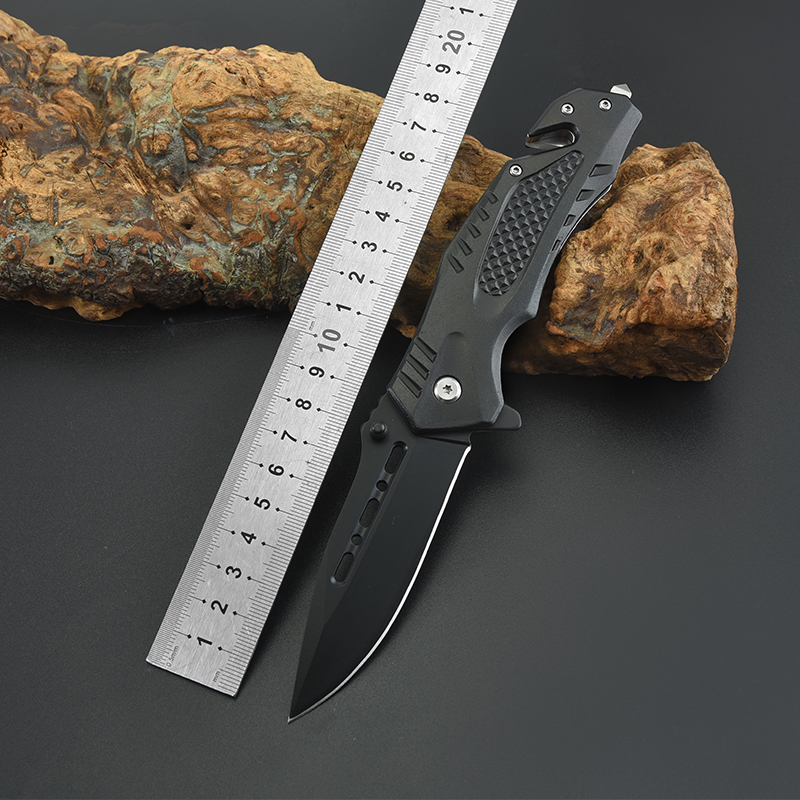
"Titanium EDC knife" commonly refers to a folding knife with titanium handle scales or a titanium frame. Its blade may be made from a completely different alloy.
A titanium blade is a separate proposition. Conventional titanium alloys do not deliver the same cutting-edge performance as properly selected and heat-treated knife steels. Specialized blade designs require individual evaluation.
Likewise, "stainless steel EDC knife" may describe:
- A knife with a stainless steel blade.
- A folding knife with stainless steel handles.
- A predominantly stainless construction with different grades for different components.
This article primarily compares titanium and stainless steel handles, while explaining how blade selection affects the finished knife.
Stainless steel is a family of alloys, not one material.
Austenitic grades such as 304 and 316 are relevant to corrosion-resistant components, but they are not conventional choices for hardened cutting blades. Knife blades commonly use hardenable martensitic stainless steels.
A useful specification therefore identifies the blade, handles, liners, lock components, screws, and pocket clip separately.
| Comparison point | Titanium-handled EDC knife | Stainless steel-handled EDC knife |
|---|---|---|
| Material density | Grade 5 titanium: approximately 4.43 g/cm³ | Many stainless grades: approximately 7.8–8.0 g/cm³ |
| Carry weight | Lower at equal component volume | Higher at equal component volume |
| Cutting performance | Depends primarily on the blade | Depends primarily on the blade |
| Corrosion resistance | Strong option for many chloride-exposed applications | Varies with grade, finish, and environment |
| Structural stiffness | Lower elastic modulus than steel | Generally stiffer at equivalent geometry |
| Frame-lock interface | May use a hardened steel lockbar insert | Depends on steel grade and treatment |
| Appearance | Anodized colors, machining, blasted or stonewashed finishes | Polished, brushed, blasted, or stonewashed finishes |
| Manufacturing cost | Often higher material and machining costs | Often more economical; design still matters |
| Best fit | Lightweight, premium-positioned products | Value-focused or weight-tolerant products |
These are material-level tendencies, not guarantees about a particular finished knife.
Grade 5 titanium has approximately 55–57% of the density of many stainless steels. At identical volume, the titanium component therefore weighs roughly 43–45% less.
That does not mean an entire titanium folding knife weighs 45% less.
The blade, pivot, bearings, screws, and clip may remain unchanged. Handle thickness, internal milling, and additional liners also affect the result.
Consider an illustrative design:
- Stainless handle components: 80 grams.
- All remaining components: 70 grams.
- Original total: 150 grams.
Replacing only those handles with equal-volume titanium components would bring the estimated total to about 115 grams—a reduction of roughly 23%, not 45%.
This is a design calculation, not a tested product claim.
A lighter knife can feel better in thin trousers or during extended walking. However, removing handle weight also changes balance.
My preference would be to evaluate pocket comfort and cutting control separately. A knife can carry comfortably yet feel awkward during sustained work.
Compare clip pressure, handle thickness, closed dimensions, and balance alongside the scale reading.
Handle material does not determine edge retention.
Blade alloy, hardness, carbide structure, heat treatment, and geometry all influence cutting performance. Two knives with different handles can cut similarly when their blades and edge geometries are equivalent.
Conversely, two titanium-handled knives can perform very differently.
For a meaningful comparison, request:
1. Exact blade steel designation.
2. Target hardness range.
3. Blade thickness and grind.
4. Edge angle.
5. Relevant cutting-test results.
A premium handle cannot compensate for an unsuitable blade specification.
Package opening rewards efficient slicing geometry. Outdoor cutting may require a different balance of toughness, corrosion resistance, and sharpening practicality.
High wear resistance can improve edge retention, but it may also make sharpening more demanding. Extremely thin geometry cuts efficiently but needs appropriate use.
For repetitive abrasive cutting, a replaceable-blade utility knife may be more practical than either folding-knife option.
The right comparison starts with the task, not the material's reputation.
Titanium's protective oxide film contributes to its strong corrosion resistance in many everyday and marine environments.
Stainless steel also relies on a passive surface film. However, chloride exposure can cause localized attack, including pitting and crevice corrosion. Grade selection matters.
Neither statement justifies calling the complete knife corrosion-proof.
A titanium frame can surround a steel blade, steel bearings, and steel fasteners. Moisture or salt trapped around those components can still create problems.
A sensible maintenance routine includes:
- Removing salt and contamination according to the manufacturer's instructions.
- Drying the blade, handle recesses, and pivot area.
- Inspecting fasteners and concealed surfaces.
- Using only recommended lubricants.
- Avoiding storage while wet.
For buyers serving coastal markets, specify the corrosion expectations for the entire assembly rather than advertising only the handle material.
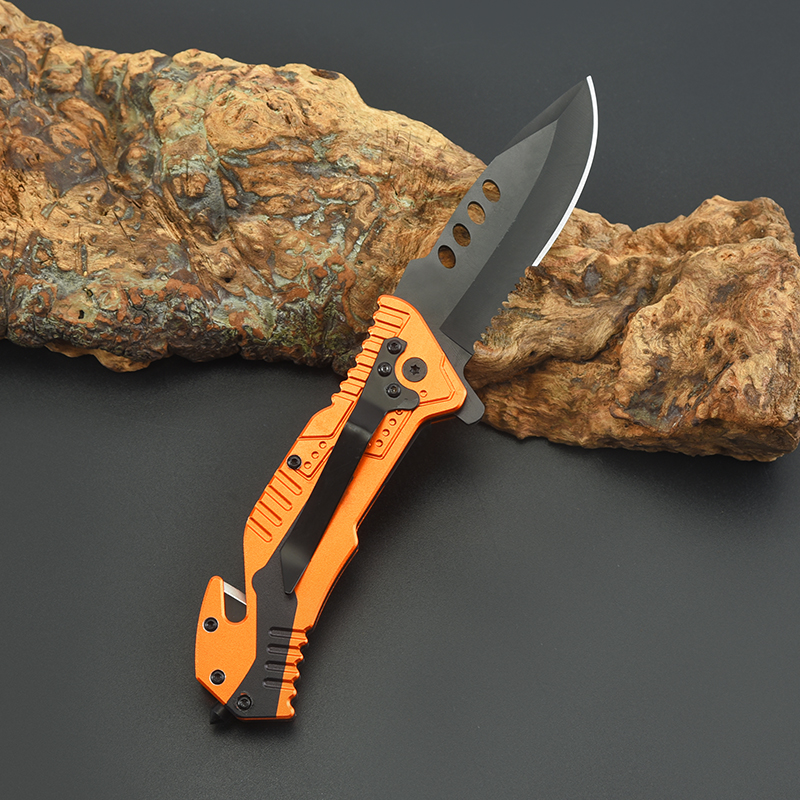
Strength describes resistance to permanent deformation or failure. Stiffness describes resistance to elastic deflection.
Titanium can offer attractive strength relative to weight, but its elastic modulus is lower than steel's. Equal-shaped titanium parts generally deflect more under the same load.
Designers can compensate through thickness, geometry, and support.
Therefore, "titanium is stronger" is not a sufficient engineering specification. The alloy, material condition, dimensions, and load case must be identified.
A titanium frame lock may use a hardened steel insert where the lockbar contacts the blade tang.
This places a more wear-resistant contact surface at an important interface and can help address lock sticking. Some designs also incorporate overtravel control.
The insert does not make every titanium lock superior. Engagement geometry, tolerances, assembly, and inspection remain important.
Never treat a lock as permission to pry, hammer, or perform destructive impact tests.
A smooth titanium handle and a polished stainless steel handle can both feel slippery.
Practical grip depends on:
- Handle contour and usable length.
- Surface texture.
- Edge chamfers.
- Clip placement.
- Finger clearance around the lock.
For a lightweight titanium EDC knife, consider whether the machining pattern improves grip or merely adds decoration.
For stainless steel handles, examine whether weight and contour support comfortable control rather than creating pressure points.
Titanium anodizing can produce distinctive colors through controlled oxide-layer thickness. It should not be confused with a painted coating or a guarantee of scratch resistance.
Both materials can show wear. A textured or stonewashed finish may make some marks less noticeable, but appearance depends on the actual finish.
Approve a physical sample whenever color and surface consistency are commercially important.
Titanium's purchase cost is only part of the difference.
Its low thermal conductivity concentrates heat near the cutting zone during machining. Tool selection, process control, cycle time, and finishing can increase manufacturing demands.
However, there is no reliable universal price multiplier.
A complex stainless handle may cost more to produce than a simple titanium component. Order quantity, tooling, tolerances, and assembly requirements all influence the quotation.
For an OEM EDC knife project, ask suppliers to quote the same:
- Blade and heat-treatment requirements.
- Lock architecture.
- Dimensions and weight targets.
- Finish and branding.
- Inspection criteria.
- Packaging and order quantity.
Otherwise, the apparent "material premium" may actually reflect differences elsewhere in the product.
Compare matched designs wherever possible.
1. Weigh each assembled knife.
2. Measure handle thickness and closed dimensions.
3. Assess pocket comfort in the same clothing.
4. Compare controlled cutting tasks using equivalent blades.
5. Check clip pressure and hand comfort.
6. Record operation and lock behavior through an agreed cycle sequence.
Keep fingers outside the closing path and avoid improvised impact testing.
This is a suggested evaluation workflow, not evidence that either material has passed a particular test.
"Titanium knife" is too vague for a purchase order.
Specify the titanium grade and the components that must use it. Identify blade steel, clip material, fasteners, and any steel lockbar insert separately.
Also define acceptable finish variation, blade centering, operation, and agreed dimensional tolerances.
For critical materials, request appropriate traceability documentation. A visual inspection alone cannot reliably verify every alloy.
An illustrative product range might use:
| Product position | Possible construction | Development priority |
|---|---|---|
| Value-oriented everyday folder | Stainless handles and suitable stainless blade | Cost, grip, assembly consistency |
| Lightweight premium folder | Titanium handles and suitable stainless blade | Weight, balance, finish quality |
| Coastal-use folder | Titanium handles with carefully selected remaining components | Whole-assembly corrosion performance |
These are planning examples, not market-share findings.
The commercial lesson is straightforward: material should support the intended user experience, not substitute for it.
Choose titanium handles when reduced component weight, premium presentation, and corrosion-resistant handle construction justify the added cost.
Choose stainless steel handles when purchase price, stiffness at comparable geometry, and a substantial feel fit the product brief.
For frequent cutting, prioritize the blade and ergonomics first. For a private-label range, prioritize consistent specifications and repeatable manufacturing.
At Yangjiang Holin Industrial Co., Ltd., our in-house development team and production factory support folding knives, pocket knives, utility knives, and outdoor tools, with OEM/ODM services from design and development through batch production.
To discuss a custom EDC knife, send your target market, preferred construction, blade requirements, weight target, finish, expected quantity, and budget. Ask our team to review material feasibility and sample-development requirements before finalizing the specification.
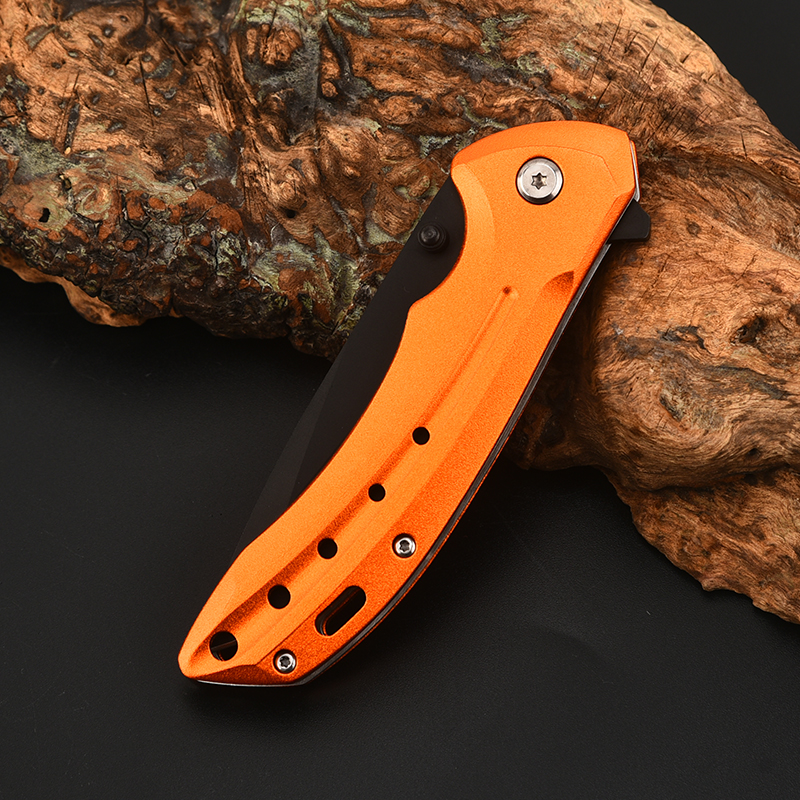
Not universally. Titanium handles offer lower density, while stainless steel handles can offer a more economical and stiffer construction. Blade performance, ergonomics, and assembly quality determine whether either knife suits the user.
Not necessarily. Many titanium pocket knives use titanium handles with steel blades. Check the component specifications rather than relying on the product name.
No. Handles do not directly improve edge retention. Blade alloy, heat treatment, hardness, and edge geometry are the relevant factors.
Yes. Stainless steel resists corrosion but is not immune. Chlorides, trapped moisture, material grade, and maintenance influence the risk.
No. Titanium is less dense, but finished weight also depends on dimensions, liners, blade size, and internal milling. Compare measured assembled weights.
Start with intended use, target price, blade requirements, lock design, dimensions, and weight. Then select handle materials and finishes that meet those requirements.
1. MachineMFG. "Grade 5 Titanium vs. Stainless Steel: What's the Difference?" May 10, 2025. Material-property comparison supporting the approximate density and stiffness discussion. These values describe alloys, not finished knives. [shop.machinemfg]
2. Larrin Thomas, Knife Steel Nerds. "Knife Steels Rated by a Metallurgist—Toughness, Edge Retention, and Corrosion Resistance." October 19, 2021. Metallurgical basis for the blade-performance discussion, including hardness and carbide effects. [knifesteelnerds]
3. Outokumpu. "Stainless Steel Types." Manufacturer guidance on stainless steel families, physical properties, and the distinction between corrosion resistance and corrosion immunity. [outokumpu]
4. Outokumpu. "What Makes Stainless Steel Corrosion Resistant?" Technical explanation of passive films, chloride exposure, pitting, and crevice corrosion. [outokumpu]
5. Sandvik Coromant. "Troublesome Titanium—Tips on Machining This Tough Material." August 14, 2014. Manufacturing guidance explaining heat concentration and cutting-tool challenges when machining titanium. [sandvik.coromant]
6. Knivesandtools. "What Is a Lockbar Insert?" December 7, 2018. Explanation of steel inserts in titanium frame locks and their role at the blade-contact interface. Its broad statement about titanium blade suitability is not adopted as a universal rule here. [knivesandtools]


