


Views: 210 Author: Holin Knife Publish Time: 2026-10-06 Origin: Site


Content Menu
● Pocket Knife Supplier vs Factory
>> What Is a Pocket Knife Supplier?
>> What Is a Pocket Knife Factory?
>> Compare Capabilities, Not Labels
● Evaluate Total Purchasing Value
>> Illustrative Cost Comparison
>> Consider MOQ and Inventory Exposure
>> Judge Quality Through Evidence
>> Evaluate Steel and Manufacturing Together
>> Compare Customization Depth
● Choose and Verify Your Partner
>> When a Supplier Offers Better Value
>> When a Factory Offers Better Value
>> Use a Five-Step Verification Process
>> Build a Practical Buyer Scorecard
>> Clarify Ownership and Market Requirements
● Develop Your Project With Holin
>> 1. Is a Factory Always Cheaper?
>> 2. Can a Supplier Provide OEM Knives?
>> 3. What Should Buyers Check First?
>> 4. Which Option Suits a Startup Brand?
>> 5. How Can Repeat Orders Stay Consistent?
>> 6. What Should an Inquiry Include?
A pocket knife supplier can offer better value for smaller, mixed-product orders and ready-to-ship inventory. A pocket knife factory is often the stronger choice for custom designs, repeat production, and direct technical collaboration. The right answer depends on your order size, product requirements, and the responsibilities each partner actually handles.
For brands, importers, and distributors, value means more than a low unit price. It includes consistent quality, manageable inventory, reliable delivery, and products that customers want to buy.
Our manufacturing perspective at Yangjiang Holin Industrial Co., Ltd. is straightforward: compare the complete sourcing arrangement, not simply the label on a company's website. A capable intermediary can justify its margin. A capable factory can strengthen your product development and long-term supply.
This guide explains how to evaluate both options before committing to a wholesale or private-label pocket knife program.

A supplier is any business that supplies pocket knives. It may be a manufacturer, trading company, distributor, or sourcing agent.
In this comparison, "pocket knife supplier" refers primarily to an intermediary that purchases or coordinates products from manufacturers and sells them to buyers.
Its value may include product selection, order consolidation, communication, inventory availability, and export coordination.
For example, a distributor building a mixed outdoor assortment might prefer one partner that supplies folding knives, utility knives, multitools, and accessories. Managing one consolidated order can be easier than coordinating several production facilities.
However, buyers should establish whether the supplier holds inventory, orders on demand, or relies on another intermediary.
A pocket knife factory manufactures knives rather than primarily reselling them. Its production scope may include blade processing, handle manufacturing, finishing, assembly, inspection, and packaging.
Do not assume every process happens in-house. A manufacturer may outsource selected operations while controlling specifications and final acceptance.
The important question is who manages production and takes responsibility when something changes.
For custom pocket knife manufacturing, direct access to the production team can simplify discussions about dimensions, materials, mechanisms, and assembly tolerances.
A factory can also be your supplier. Meanwhile, an experienced trading company may provide stronger project management than a poorly organized manufacturer.
Use the following table as a starting point, not a universal ranking.
| Buying factor | Intermediary pocket knife supplier | Direct pocket knife factory |
|---|---|---|
| Product selection | May combine several manufacturers | Usually focused on its production capabilities |
| Small mixed orders | Attractive when stock is available | Depends on existing models and production minimums |
| Custom development | Depends on access to manufacturing teams | Can support direct technical discussions |
| Pricing | May include sourcing and service margins | May remove intermediary margins, but adds buyer responsibilities |
| Quality visibility | Depends on inspection access and documentation | Can provide closer production visibility |
| Delivery | Stocked products may ship quickly | Custom orders require development and production scheduling |
| Best fit | Assortment testing and consolidated purchasing | Proprietary products and repeat manufacturing |
The practical distinction is control: how much control you need, and how much responsibility you can manage.
A factory quotation is not automatically the cheapest complete solution. Likewise, a supplier's higher price is not automatically poor value.
Compare both offers using identical specifications, quantities, packaging, delivery terms, and inspection requirements.
A useful purchasing model is:
Total purchasing cost = goods + development + logistics + inspection + inventory costs + expected quality losses.
Include tooling, samples, freight, duties, brokerage, storage, financing, and reasonable allowances for rework or returns.
Also identify costs already included in the quotation. Otherwise, you may count them twice.
Delivery terms matter because they allocate transportation tasks, costs, and risks differently. An EXW quotation and a delivered quotation are not directly comparable without adjustment.
Consider a hypothetical order of 2,000 identical pocket knives. These figures are planning assumptions, not actual quotations, industry averages, or Holin pricing.
| Cost category | Supplier option | Factory option |
|---|---|---|
| Goods | $11,600 | $10,200 |
| Development and setup | $200 | $700 |
| Freight and import expenses | $1,300 | $1,300 |
| Inspection and coordination | $200 | $500 |
| Total before inventory and quality losses | $13,300 | $12,700 |
| Cost per ordered knife | $6.65 | $6.35 |
The factory option saves $600 in this example. Yet additional coordination, unsold inventory, or quality losses could erase that difference.
The lesson is comparison, not a guaranteed saving. Request comparable quotations and test the assumptions against your actual business.
Minimum order quantity influences cash flow as much as price.
A wholesale pocket knife supplier with existing inventory may accommodate a smaller trial order. A factory may need a larger commitment for custom handles, finishes, packaging, or components.
Ask what the MOQ applies to:
- The overall order
- Each knife model
- Each handle color or material
- Each blade finish
- Each packaging version
A 1,000-piece order split across five models may not meet a 1,000-piece minimum per model.
For uncertain demand, paying more per unit can be sensible if it reduces excess inventory. For established repeat demand, larger production runs may offer a better commercial balance.
Neither sourcing model guarantees quality. A supplier can manage rigorous inspection, while a factory can produce inconsistent results if specifications and process controls are weak.
For folding knives, define acceptance requirements before approving production.
Useful inspection points include:
- Blade centering and clearance
- Opening and closing operation
- Lock engagement, where applicable
- Blade play and pivot adjustment
- Handle fit, surface finish, and exposed burrs
- Pocket clip alignment and retention
- Packaging accuracy and product identification
Requirements should reflect the knife's mechanism and intended use. A slip joint, liner lock, and replaceable-blade utility knife need different functional evaluations.
Acceptance sampling can support shipment decisions, but it does not prove every unit is defect-free. Agree on defect categories, sampling procedures, and rejection criteria in advance.
Safety-related characteristics may require additional controls beyond routine sample inspection.
A recognizable steel grade does not, by itself, establish knife performance.
Heat treatment and edge geometry can substantially influence cutting behavior. Toughness, corrosion resistance, and edge retention also involve trade-offs.
Ask for a documented specification covering steel grade, target hardness, blade thickness, edge geometry, and finish.
Then connect those requirements to the intended customer.
An everyday carton-opening knife and an outdoor folding knife may need different design priorities. Avoid choosing a premium steel solely because its name looks attractive on packaging.
Consistency between approved samples and production matters more than impressive but unsupported material claims.
For an OEM pocket knife project, buyers typically provide product requirements or a design for manufacturing. For an ODM project, the manufacturer contributes an existing platform or development input. Because businesses use these terms differently, define the actual responsibilities.
A pocket knife factory may offer closer collaboration on:
- Blade profile and dimensions
- Handle construction and ergonomics
- Opening method and locking mechanism
- Clip position and carry configuration
- Branding, finishing, and retail packaging
A supplier can still coordinate these changes effectively. The concern is whether instructions reach the responsible engineers accurately.
Distinguish cosmetic customization from structural development. Adding a logo is not equivalent to developing a new locking mechanism.
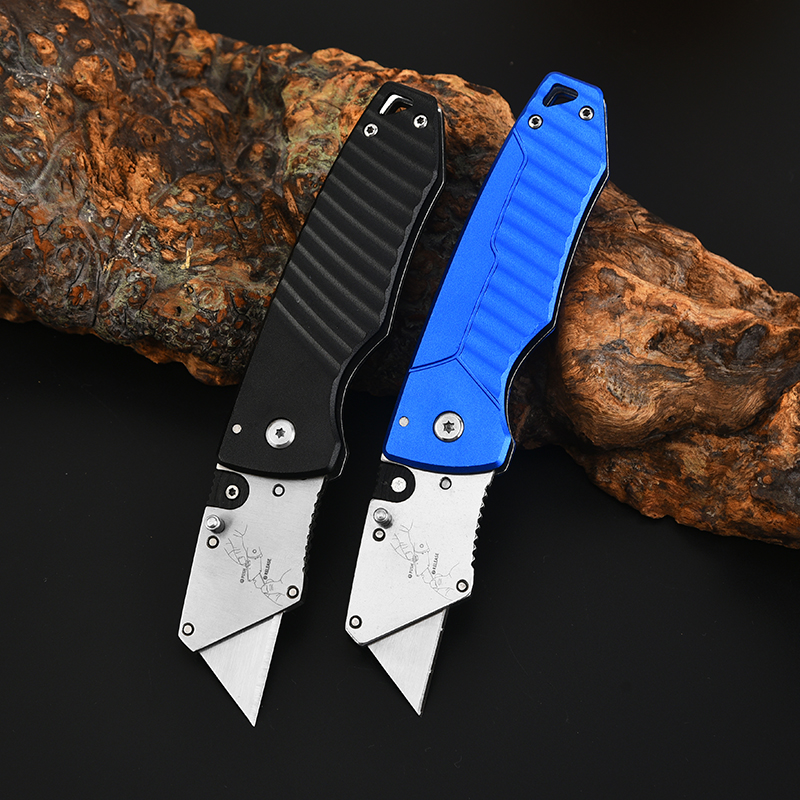
An intermediary can be the better choice when your priority is purchasing flexibility rather than proprietary development.
Consider this route when you need a mixed assortment, a limited market test, or available inventory.
Its service margin may be worthwhile if it reduces coordination work, consolidates shipments, or provides dependable local support.
Before proceeding, confirm stock availability and replenishment arrangements. "Available products" can mean a catalog selection rather than physical inventory.
Also establish who handles complaints and whether replacement products will match the original batch.
Direct manufacturing becomes more attractive when you have defined specifications, repeat demand, and a product roadmap.
A custom pocket knife factory can help connect design decisions with production feasibility. Direct discussions may make it easier to resolve dimensional conflicts, revise components, or maintain approved specifications.
This route is especially relevant for private-label pocket knives that need a distinctive identity.
However, buyers must manage development approvals, inspection arrangements, shipping coordination, and contractual details unless the factory expressly includes those services.
Direct access creates an opportunity for better control—not an automatic guarantee of better results.
1. Verify the business identity. Check registration details, contracting entity, manufacturing address, and payment beneficiary.
2. Request production evidence. Review relevant facilities, equipment, process responsibilities, and outsourced operations.
3. Send one specification package. Give every candidate the same drawings, quantities, materials, packaging requirements, and delivery destination.
4. Approve representative samples. Document measurable requirements and request a pilot batch when development risk justifies it.
5. Agree on remedies. Define inspection rights, change approval, rejected-product handling, warranty responsibilities, and dispute procedures.
A showroom video or polished catalog alone cannot establish manufacturing capability.
For substantial commitments, independent verification and a clearly documented purchasing agreement can provide stronger evidence than sales claims.
Price should be one part of your decision, not the entire decision.
Here is an illustrative weighting model for a custom knife program:
| Evaluation area | Suggested weight |
|---|---|
| Quality controls and production consistency | 30% |
| Total purchasing cost | 25% |
| Development and customization capability | 20% |
| Delivery and capacity planning | 15% |
| Communication and after-sales support | 10% |
Score each area from one to five using evidence. Apply the weights consistently.
Adjust the model to your project: an inventory-based supplier may score better for a rapid trial launch, while a factory may score better for proprietary development.
Treat essential requirements as gates. An unresolved safety issue or unverified business identity should not be offset by a low price.
Before funding development, establish ownership and permitted use of drawings, tooling, packaging artwork, and custom components.
Ask whether tooling can be transferred, how it will be maintained, and whether exclusivity applies to your specific design.
Market suitability also needs early attention. Knife restrictions can differ by jurisdiction, mechanism, blade characteristics, sale conditions, and carry circumstances.
Manufacturing capability does not establish that a product can legally enter or be sold in every market. Confirm applicable requirements with qualified advisers before approving the design.
Avoid treating a generic "compliant" statement as sufficient evidence.
Yangjiang Holin Industrial Co., Ltd. specializes in folding knives, pocket knives, utility knives, and outdoor tools. With our own research and development team and production factory, we support product design, development, and batch manufacturing through one-stop OEM/ODM services.
Our proposed starting point is a clear product brief rather than a price-only inquiry.
Send your target market, intended use, estimated quantity, preferred materials, branding requirements, and launch schedule. Include drawings or reference products where available.
Contact Holin to discuss manufacturing feasibility, sample development, customization scope, and a quotation based on defined requirements.

No. Direct manufacturing may reduce intermediary margins, but development, logistics, inspection, and larger order commitments can change the result. Compare total purchasing cost using equivalent specifications and delivery terms.
Yes. A supplier may coordinate OEM work with a manufacturing partner. Confirm who handles engineering, production approvals, inspection, and corrective action. Access to the responsible technical team is particularly important for structural changes.
Start with business identity, actual production responsibilities, and product suitability. Then evaluate samples, specifications, quality records, commercial terms, and delivery planning. Do not approve a bulk order solely because the quotation is attractive.
A stocked supplier may suit a small assortment test. A factory may suit a startup with a defined custom product and sufficient development budget. Choose according to demand certainty, differentiation needs, and available purchasing resources.
Maintain approved specifications, reference samples, packaging files, and inspection requirements. Require written approval before material or component substitutions. Keep revision records so later orders do not silently drift from the accepted product.
Provide intended use, destination market, quantity, blade and handle requirements, mechanism, branding, packaging, and delivery expectations. Separate mandatory requirements from preferences. This helps partners prepare comparable proposals and identify development constraints early.
- International Chamber of Commerce — [Incoterms® Rules]. Authoritative background for the discussion of delivery obligations, costs, and risk allocation. [iccwbo]
- U.S. International Trade Administration — [Know Your Incoterms]. Practical guidance supporting the recommendation to compare quotations on equivalent delivery terms. [trade]
- American Society for Quality — [ANSI/ASQ Z1.4 and Z1.9 Standards]. Basis for the discussion of acceptance sampling, specified quality limits, and inspection procedures. [asq]
- American Society for Quality — [Attribute and Variable Sampling]. Supports the explanation that sampling plans use defined sample sizes and acceptance or rejection criteria. [asq]
- Larrin Thomas, Knife Steel Nerds — [Knife Steels Rated by a Metallurgist: Toughness, Edge Retention, and Corrosion Resistance], October 19, 2021. Technical basis for the discussion of steel trade-offs, heat treatment, and edge geometry. [knifesteelnerds]
- American Knife and Tool Institute — [State Knife Laws]. Supports the discussion of jurisdiction-specific restrictions; this resource covers U.S. state laws rather than worldwide requirements. [akti]


