


Views: 288 Author: Holin Knife Publish Time: 2026-09-21 Origin: Site


Content Menu
● Why Source Carpet Cutters From China?
● How These Manufacturers Were Selected
● Top 10 Carpet Cutter Manufacturers in China
>> 1. Yangjiang Holin Industrial Co., Ltd.
>> 2. Yangjiang Jiancheng Industrial Co., Ltd.
>> 3. Yangjiang Bangchubao Industry and Trade Co., Ltd.
>> 4. Svega Industrial Co., Ltd.
>> 5. Yongkang Shi Pengcheng Abrasive & Apparatus Co., Ltd.
>> 6. Shang Qiu Feng Li Measuring Tools Co., Ltd.
>> 7. Yiwu Haohang Stationery Co., Ltd.
>> 8. Yangjiang Wins Industries and Trades Co., Ltd.
>> 9. Yangjiang Jiangcheng Jialinda Hardware & Plastic Products Factory
>> 10. China-Based OEM Cutter Suppliers Through Verified Manufacturing Platforms
● Manufacturer Comparison Table
● Technical Details That Matter in a Carpet Cutter
>> Blade Material and Edge Performance
>> Handle Material and Ergonomics
>> Locking and Blade Retention
>> Packaging and Safety Information
● Common Carpet Cutter Sourcing Problems
>> Problem 1: Quoted Steel Grade Does Not Match Production Material
>> Problem 2: Sample Quality Is Better Than Mass Production
>> Problem 3: Low MOQ Is Promised but Hidden Costs Appear Later
>> Problem 4: Certification Claims Are Not Relevant to the Product
>> Problem 5: Incorrect Customs Classification or Incomplete Shipping Documents
● The Overlooked Insider Check
● Buyer's Guide: From Inquiry to Shipment
>> Step 1: Prepare a Clear Product Brief
>> Step 2: Shortlist Three to Five Suppliers
>> Step 3: Request Samples Before Negotiating Final Price
>> Step 4: Use a Written Quality Standard
>> Step 5: Plan Logistics Early
>> 1. How can I verify whether a factory's ISO certificate is still valid?
>> 2. What MOQ should I expect for customized carpet cutters?
>> 3. Is a RoHS report necessary for a manual carpet cutter?
>> 4. How can I prevent the supplier from changing the blade material after sample approval?
>> 5. Should I purchase replacement blades from the same supplier as the carpet cutter?
China remains one of the most practical sourcing locations for carpet cutters, utility knives, snap-off cutters, hook-blade knives, and related flooring-installation tools. For procurement teams, the advantage is not simply a lower unit cost: it is the ability to combine blade supply, plastic or metal handle production, tooling, packaging, assembly, and export support within a mature manufacturing ecosystem.
For carpet cutter sourcing in particular, Yangjiang, Guangdong deserves close attention. The city is widely recognized as China's knives-and-scissors manufacturing center, with a long-established industrial chain spanning steel processing, blade grinding, handle production, packaging, and export-oriented manufacturing. Official local sources report that Yangjiang has more than 1,500 knife and scissors manufacturers, with the sector representing a major share of China's national production and exports. A Guangdong government source also describes the city as having more than 1,400 years of knife-and-scissors manufacturing history and a large-scale, integrated industry cluster.
For buyers developing private-label flooring tools, carpet-cutting knives, professional utility cutters, or compact retractable cutters, the most suitable supplier is rarely the company with the lowest quotation. The better long-term choice is usually the factory that can provide stable material specifications, repeatable blade performance, controlled assembly, realistic delivery planning, responsive communication, and traceable quality documentation.

Carpet cutters are deceptively simple products. A typical tool may include a metal blade holder, retractable or folding mechanism, polymer or aluminum handle, locking system, replacement blades, safety packaging, and printed instructions. Yet failure in any one of these components can create customer complaints, retailer returns, safety incidents, or brand damage.
China's advantage is its ability to manufacture these components at different price levels while offering multiple customization routes:
- Standard catalog models with custom logos and packaging.
- Modified existing models with color, handle texture, blade configuration, or packaging changes.
- Semi-custom products using adjusted tooling, mechanisms, or materials.
- Fully custom OEM/ODM programs involving industrial design, prototype development, mold production, testing, and batch manufacturing.
- Retail-ready sets with replacement blades, hanging cards, blister packaging, display boxes, and multilingual instructions.
The broader hand-tool market also continues to support long-term demand for cutting tools. One 2025 market estimate valued the global hand-tools market at USD 27.6 billion, with projected growth to USD 38.1 billion by 2034; the category includes utility knives and cutters used in construction, renovation, industrial work, and DIY applications. China's tool manufacturing base remains significant in global trade: OEC data reported Chinese hand-tool exports of approximately USD 1.14 billion in 2025.
For carpet cutter buyers, the key question is not whether China can produce the product. It can. The key question is whether a prospective supplier can manufacture the exact version required by the end market, at a predictable quality level and with evidence to support its claims.
This list is designed for professional buyers looking for a long-term carpet cutter supplier rather than a one-time trading contact. The companies below were considered based on publicly available manufacturing positioning, product relevance, location within relevant industrial clusters, apparent OEM/ODM capability, export orientation, and ability to serve distinct buyer profiles.
The evaluation framework includes the following practical sourcing criteria.
| Evaluation Area | What Professional Buyers Should Verify | Why It Matters |
|---|---|---|
| Product relevance | Carpet cutters, utility knives, retractable knives, snap-off cutters, folding knives, replacement blades, flooring tools | A kitchen-knife factory may not understand blade locking, blade-loading systems, or flooring-tool packaging requirements |
| Manufacturing capability | Machinery, assembly lines, blade grinding, injection molding access, tooling capability, workforce, production planning | Determines whether samples can be repeated consistently in mass production |
| R&D and customization | In-house designers, engineering staff, prototype support, mold development, packaging design | Important for private-label and differentiated products |
| Quality control | Incoming material inspection, blade hardness checks, lock-function tests, edge inspection, pull-force testing, AQL inspection | Prevents failures such as loose locks, uneven blades, or poor cutting performance |
| Export readiness | Experience with destination-market packaging, documentation, carton markings, barcode handling, shipping coordination | Reduces customs, compliance, and retail-delivery problems |
| Commercial flexibility | MOQ, sample policy, payment terms, communication speed, willingness to support small and medium brands | Especially important for emerging brands and product-launch testing |
| Compliance support | Material declarations, test reports where applicable, packaging documentation, product labeling support | Helps buyers manage retailer, importer, and regional-market requirements |
A critical clarification: CE marking and RoHS are not automatic requirements for every manual carpet cutter. RoHS primarily concerns electrical and electronic equipment, while CE marking applies only when a product falls under applicable EU harmonized legislation. A manually operated carpet knife normally should not be presented as CE-compliant unless a specific applicable legal basis exists. Buyers should instead focus on product safety, accurate labeling, chemical restrictions where relevant, packaging requirements, and documentation appropriate to the destination market. EU guidance confirms that RoHS and CE documentation requirements apply to equipment within the directive's scope, rather than to every consumer product.
The following companies represent different sourcing profiles. Buyers should conduct their own factory audits, sample evaluations, certification verification, and contractual review before placing production orders.
Location: Yangjiang, Guangdong, China
Established: 2010
Core Products: Carpet cutters, utility knives, folding knives, pocket knives, outdoor tools, daggers, and customized cutting tools
Suitable For: Small and medium brands, importers, distributors, promotional-tool buyers, and private-label projects requiring flexible OEM/ODM support
Yangjiang Holin Industrial Co., Ltd. is a practical option for buyers seeking a balance between customization flexibility, responsive project communication, and scalable production. The company focuses on folding knives, pocket knives, utility knives, carpet cutters, and outdoor tools, making it relevant for buyers building broader cutting-tool assortments rather than sourcing a single low-cost cutter model.
According to the company's published profile, Holin has operated in Yangjiang for more than 20 years in the knife and tool sector and reports a 2,000 m² factory, more than 60 machines, and 80 skilled workers. Its team includes five designers and 12 technical specialists supporting product development and production projects.
For carpet cutter procurement, Holin's value lies in its ability to support a product from concept through volume production. This can include:
- Product-shape and handle-design development.
- Material and finish selection.
- Brand logo placement through laser engraving, printing, embossing, or packaging.
- Customized blade configurations and replacement-blade sets.
- Retail packaging development, including color boxes, blister cards, and private-label instructions.
- Support for folding, retractable, or utility-knife-style product concepts.
- Communication suitable for smaller brands that may need more iteration before finalizing a production specification.
Rather than positioning itself only as a high-volume catalog supplier, Holin is particularly relevant to buyers who need a manufacturer willing to discuss practical details: handle feel, lock style, blade replacement method, product positioning, retail presentation, and target price range. The company also states that it provides 24/7 response support and one-stop OEM/ODM solutions from product design through production.
Typical procurement fit: A flooring-tool distributor launching a private-label retractable carpet cutter, a hardware brand adding a knife category, or an online seller developing custom retail packaging with moderate order volumes.
Location: Yangjiang, Guangdong, China
Established: 1999
Core Products: Knives, scissors, cutlery, multi-tools, stainless-steel tools
Suitable For: Buyers requiring long-standing knife-manufacturing experience and custom design support
Yangjiang Jiancheng Industrial Co., Ltd. is positioned as an established Yangjiang manufacturer with a long operational history. Public supplier information identifies the company as a manufacturer of stainless-steel knives, scissors, cutlery, and multi-tools, with a factory footprint of approximately 1,500 m².
Although its public-facing product positioning is broader than carpet cutters alone, the company may be relevant for sourcing projects that combine cutting tools with kitchen, multi-tool, or promotional hardware categories. Buyers should specifically verify whether the supplier produces retractable carpet cutters, hook-blade cutters, snap-off cutter bodies, or compatible replacement blades in-house.
Potential strengths include:
- Experience in metal cutting-tool manufacturing.
- Ability to support customized designs.
- Export-market familiarity.
- Product development potential for buyers seeking a broader knife or tool collection.
Buyer note: Request a sample set that includes the exact intended blade type and locking mechanism. A factory experienced in stainless-steel cutlery may still need to prove competence in utility-knife safety mechanisms.
Location: Yangjiang, Guangdong, China
Core Products: Kitchen knives, chef knives, fruit knives, carving knives, scissors, hardware knives
Suitable For: Buyers seeking a supplier with knife-category coverage and possible private-label support
Yangjiang Bangchubao Industry and Trade Co., Ltd. appears in manufacturing directories as an OEM/ODM supplier associated with knife and scissors production in Yangjiang, including ISO 9001:2015 listed capability. Its primary product focus is broader kitchen and household cutting tools, but it may be useful for buyers evaluating a supplier capable of supporting basic utility-knife or carpet-cutter extensions.
This supplier may be more suitable when:
- The buyer wants to bundle carpet cutters with other home, DIY, or cutting-tool products.
- The project requires basic logo, color, and packaging customization.
- A buyer is comparing several Yangjiang factories for price and production options.
Buyer note: Do not rely solely on directory-listed ISO claims. Ask for the full certificate, certificate number, issuing body, scope statement, expiry date, and audit report or verification path.
Location: Yangjiang, Guangdong, China
Core Products: Folding knives, mini multi-tools, scissors, outdoor tools
Suitable For: Outdoor, EDC, multi-tool, and compact cutter brands
Svega Industrial is listed as a Yangjiang-based manufacturer and trading company offering folding knives, mini multi-tools, scissors, and OEM/ODM services. This profile may make the company more relevant for buyers seeking compact folding carpet cutters, pocket-sized utility tools, or outdoor-inspired cutting tools rather than basic low-cost construction cutters.
Potential applications include:
- Compact folding carpet knives.
- EDC-style utility cutters.
- Multi-tool kits with cutter functions.
- Outdoor and hardware-store private-label products.
Buyer note: For folding carpet cutters, test not only the blade sharpness but also lock engagement, lateral blade play, opening/closing cycle life, and resistance to carpet fibers or adhesive residue entering the pivot area.
Location: Yongkang, Zhejiang, China
Core Products: Abrasives, apparatus, knife-related products, hardware tools
Suitable For: Buyers looking for a Zhejiang hardware-cluster option
Yongkang is one of China's most recognized hardware and tool-production areas. While Yangjiang is especially strong in knives and scissors, Yongkang offers access to broader hardware ecosystems, including tool components, abrasive products, metalworking, and industrial consumer goods.
Yongkang Shi Pengcheng Abrasive & Apparatus Co., Ltd. is listed in manufacturing directories among suppliers connected to knife and tool categories. It may be worth considering for projects involving utility cutters bundled with abrasives, flooring accessories, or general hardware assortments.
Potential strengths:
- Proximity to Zhejiang's broader hardware-manufacturing supply base.
- Potential sourcing synergies for tool sets and related accessory categories.
- Possible suitability for buyers requiring multiple hardware SKUs from one region.
Buyer note: Confirm which components are produced internally and which are outsourced. A manufacturer's ability to make a handle or assemble a cutter does not necessarily mean it controls blade grinding, heat treatment, or blade coating.
Location: Shangqiu, Henan, China
Core Products: Measuring tapes, utility knives, DIY tools
Suitable For: Hardware distributors, DIY brands, and buyers sourcing bundled measuring-and-cutting tool sets
Shang Qiu Feng Li Measuring Tools is listed as a manufacturer and trading company offering utility knives and OEM/ODM services, with product categories connected to measuring tools and DIY hardware. This makes it potentially relevant for buyers selling carpet cutters alongside tape measures, marking tools, or basic installation accessories.
A supplier in this category can be useful for:
- Carpet-installation starter kits.
- Retail DIY tool bundles.
- Utility knife and measuring tape combinations.
- Promotional hardware sets.
Buyer note: Buyers should define whether the product will be sold as a general utility knife or marketed specifically as a carpet cutter. Carpet-cutting use requires clearer performance validation because dense carpet backing, underlay, and adhesive-contaminated materials can stress blade edges and locking components differently from paperboard cutting.
Location: Yiwu, Zhejiang, China
Core Products: Mini cutters, student scissors, stationery cutting tools
Suitable For: Lightweight utility cutters, craft cutters, promotional products, and entry-level retail programs
Yiwu Haohang Stationery is listed as a manufacturer and trading company offering mini cutters, scissors, and OEM/ODM services. Its positioning is more suitable for stationery, craft, household, and light-duty cutters than for professional flooring installation tools.
This supplier type may fit:
- Small household carpet cutters.
- Compact package-opening knives.
- Craft and DIY cutters.
- Low-duty utility cutters for discount retail or promotional channels.
Buyer note: This profile may not be appropriate for heavy-duty commercial carpet installation tools. If the end user will cut commercial carpet tiles, woven backing, thick underlay, or roofing-style materials, request evidence of blade thickness, locking strength, and operational cycle testing.
Location: Yangjiang, Guangdong, China
Core Products: Pocket knives, multi-function tools, stainless-steel products, household goods
Suitable For: Export buyers sourcing multi-category knife and tool ranges
Yangjiang Wins Industries and Trades Co., Ltd. is described as an exporter of stainless-steel products, including kitchen knives, pocket knives, multi-function tools, manicure tools, and related household items. Its broader export portfolio may appeal to importers managing several small-tool categories from one supplier base.
Potential value for buyers:
- Access to a variety of knife and tool forms.
- Export-oriented product mix.
- Possible support for bundled seasonal, gift, hardware, or general-merchandise programs.
- Useful benchmark supplier when comparing Yangjiang pricing and product breadth.
Buyer note: When working with companies that combine manufacturing and trading functions, ask for transparency on the actual manufacturing site, production-control responsibilities, source of blades, and who is responsible for final inspection.
Location: Yangjiang, Guangdong, China
Core Products: Hardware and plastic products, knife-related manufacturing
Suitable For: Buyers needing plastic-handle, mixed-material, or cost-focused cutter designs
Yangjiang Jiangcheng Jialinda Hardware & Plastic Products Factory is listed among Yangjiang suppliers connected to hardware and plastic products. For carpet cutters, plastic components are not secondary. Handle resin, texture, wall thickness, insert-fit accuracy, and resistance to cracking all affect the product's safety and perceived quality.
A factory with competence in both hardware and plastic production may be relevant for:
- Plastic-handle utility knives.
- Rubberized or dual-material grip designs.
- Injection-molded safety cutters.
- High-volume, cost-sensitive carpet cutter programs.
- Custom color matching and brand-specific housing development.
Buyer note: For plastic handles, specify resin grade rather than merely asking for "ABS" or "PP." Require confirmation of virgin versus recycled material use, color masterbatch stability, and drop-test performance at low temperatures if the products will be sold in cold climates.
Location: Multiple clusters, including Yangjiang, Zhejiang, Yiwu, Ningbo, and other hardware regions
Core Products: Utility knives, replacement blades, retractable cutters, snap-off knives, household cutters
Suitable For: Buyers building a qualified supplier pipeline before final factory selection
A practical sourcing strategy should not rely on one directory listing or one supplier quotation. Manufacturing platforms can help buyers identify a broad range of potential utility-knife and cutter suppliers, including companies in Yangjiang, Zhejiang, and other industrial centers. Listings on Made-in-China, for example, show numerous manufacturers offering utility knives, OEM/ODM programs, and different production locations.
However, an online platform should be treated as the start of supplier discovery, not as evidence of manufacturing quality.
Use platforms to:
- Build a long list of potential suppliers.
- Compare catalog breadth and initial responsiveness.
- Identify factories offering the required cutter type.
- Collect early pricing ranges.
- Request sample quotations and development timelines.
- Screen for product-market fit before arranging video audits or onsite inspections.
Buyer note: A supplier that appears on a platform may be a factory, a trading company, or a hybrid. Ask directly: "Which product processes are completed at your own site?" This single question often reveals whether the supplier truly controls the critical steps.
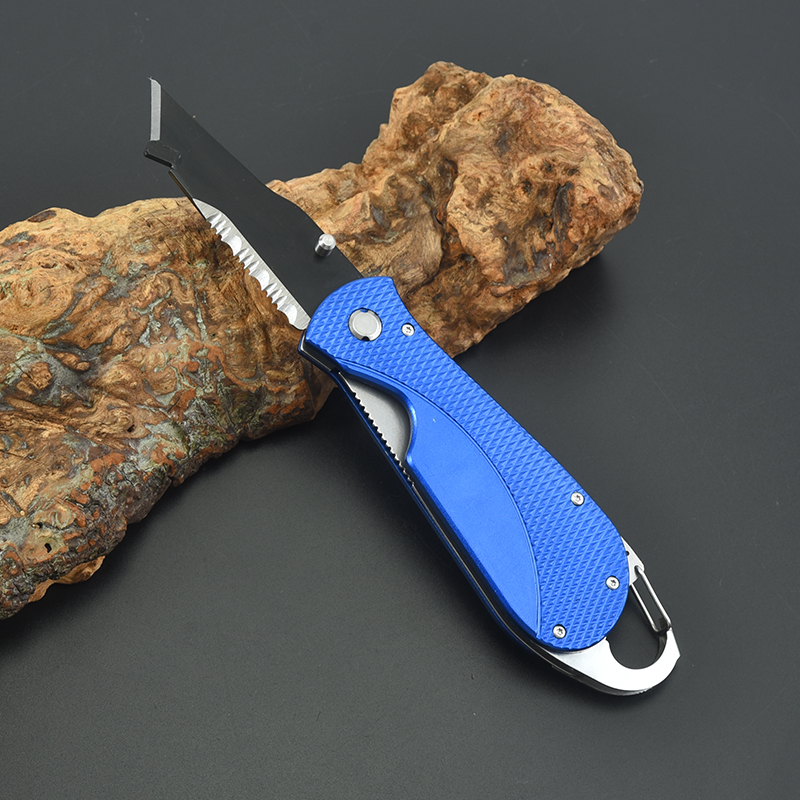
The figures below should be treated as buyer-verification points rather than guaranteed contractual specifications. Production capacity, MOQ, certification scope, and delivery lead times vary by model, customization level, raw-material conditions, and order season.
| Manufacturer / Supplier Type | Main Strength | Typical Buyer Profile | Estimated MOQ Approach | Production Capacity Signal | Certifications / Documentation to Verify |
|---|---|---|---|---|---|
| Yangjiang Holin Industrial Co., Ltd. | Flexible OEM/ODM support, R&D participation, knife and outdoor-tool specialization | Small and medium brands, importers, private-label projects | Often negotiable by model and customization level | 2,000 m² facility, 60+ machines, 80 workers reported | Factory audit records, material declarations, product test plan, packaging compliance files |
| Yangjiang Jiancheng Industrial Co., Ltd. | Long operating history and stainless-steel knife experience | Buyers seeking knife-category sourcing | Depends on product and customization | Approximately 1,500 m² factory reported | ISO status if claimed, blade material records, export documentation |
| Yangjiang Bangchubao Industry and Trade Co., Ltd. | OEM/ODM and knife/scissors category coverage | General knife and hardware buyers | Usually model-dependent | Directory-listed manufacturing capability | ISO 9001:2015 certificate validity and scope |
| Svega Industrial Co., Ltd. | Folding knives and multi-tools | Outdoor, EDC, compact cutter brands | Usually moderate MOQ for custom programs | Directory-listed OEM/ODM capability | Lock-function testing, blade material declaration, packaging test records |
| Yongkang Shi Pengcheng Abrasive & Apparatus Co., Ltd. | Zhejiang hardware ecosystem | Tool-kit and hardware buyers | Depends on tool-set complexity | Hardware-cluster sourcing potential | Component sourcing records, blade heat-treatment evidence |
| Shang Qiu Feng Li Measuring Tools Co., Ltd. | Measuring and cutting tool combinations | DIY, retail, installation-kit buyers | Often suitable for bundled products | Product-category relevance | Utility knife performance tests, packaging and label files |
| Yiwu Haohang Stationery Co., Ltd. | Light-duty mini cutters and stationery products | Craft, household, promotional buyers | Lower MOQs may be possible for standard items | Stationery-oriented production | Material safety files, edge protection, retail packaging records |
| Yangjiang Wins Industries and Trades Co., Ltd. | Export-oriented multi-category portfolio | Importers buying multiple small-tool categories | Depends on whether models are stocked | Broad export product coverage | Manufacturing-site verification, inspection responsibility agreement |
| Yangjiang Jiangcheng Jialinda Hardware & Plastic Products Factory | Hardware-plus-plastic component focus | Plastic-handle or cost-sensitive cutter programs | Mold and color requirements may affect MOQ | Hardware/plastic category relevance | Resin-grade evidence, mold ownership agreement, drop-test records |
| Verified platform suppliers | Broad supplier discovery | Buyers creating a qualified shortlist | Varies widely | Must be independently audited | Business license, audit, sample results, third-party inspection reports |
A carpet cutter should be specified as an engineered product, not as a generic knife. Before requesting quotations, buyers should create a product specification sheet covering the following areas.
Common blade materials may include carbon steel, SK-series steel, stainless steel, and higher-grade alloy steels. The best choice depends on target use, corrosion expectations, cost target, and blade-replacement model.
For professional carpet cutting, buyers should evaluate:
- Blade thickness and consistency.
- Edge angle and sharpening quality.
- Blade hardness and brittleness balance.
- Coating or oil protection against corrosion.
- Compatibility with standard replacement blades.
- Edge retention when cutting carpet backing, textile fibers, cardboard, rubber, vinyl, or underlay.
A blade that is extremely hard may retain its edge but can become more brittle. A softer blade may resist breakage but lose sharpness too quickly. The right specification depends on the cutting task, not on the highest hardness number.
Common handle options include:
- Zinc alloy for weight and perceived durability.
- Aluminum alloy for lighter premium products.
- Stainless steel for corrosion resistance and structural strength.
- ABS for economical molded handles.
- PP for lightweight, chemical-resistant applications.
- TPR or rubberized overmolding for grip comfort.
- Nylon reinforced with glass fiber for higher stiffness.
For a carpet cutter, handle ergonomics influence safety. A buyer should consider whether the user will make repeated pulls over long seams, cut overhead, wear gloves, or operate in dusty conditions.
For folding or retractable carpet cutters, the locking mechanism is often more important than the handle's appearance.
Test points should include:
- Blade movement under cutting load.
- Lock engagement consistency.
- Lock disengagement force.
- Side-to-side blade play.
- Blade-loading reliability.
- Spring performance after repeated use.
- Resistance to dust, carpet fiber, and adhesive contamination.
A practical test is to operate multiple samples through repeated opening, closing, locking, and blade-changing cycles. One polished sample proves little. Buyers should test samples from different production batches whenever possible.
The cutter itself may pass inspection while the retail package fails. Common requirements may include:
- Blade-protection covers or sealed blade positions.
- Warning labels appropriate to the destination market.
- Clear blade-replacement instructions.
- Age-grade or retailer-required warnings where applicable.
- Barcode placement and carton markings.
- Drop-tested retail packaging.
- Moisture protection for carbon-steel blades.
- Correct country-of-origin marking.
A supplier may quote a recognized steel grade but use a lower-cost alternative for mass production. In some cases, the blade looks acceptable at first inspection but dulls quickly, rusts during storage, or breaks under load.
How to reduce the risk:
- Include the steel grade in the purchase contract.
- Request a material certificate or supplier declaration for the blade material.
- Keep approved "golden samples."
- Require pre-shipment inspection against approved samples.
- Conduct random material or hardness checks for high-volume programs.
- Define an acceptable blade-performance test before production begins.
This is one of the most common procurement failures. A supplier may use extra care for samples but substitute materials, reduce inspection time, or alter assembly parameters after the order is confirmed.
How to reduce the risk:
- Approve a pre-production sample, not only an initial development sample.
- Match the pre-production sample to the approved packaging, blade, handle material, and accessories.
- Use an inspection checklist with measurable requirements.
- Inspect at least one production batch before final balance payment.
- Require the supplier to retain a sealed reference sample from the approved batch.
A factory may accept a low MOQ but then add charges for color changes, logo printing, tooling, blade changes, custom packaging, export cartons, or separate assembly steps.
How to reduce the risk:
Ask for a full quotation breakdown covering:
- Unit price.
- Tooling or mold cost.
- Logo method and charge.
- Color-change cost.
- Packaging cost.
- Replacement-blade cost.
- Testing cost.
- Sample cost.
- Export carton specification.
- Shipping terms.
- Payment conditions.
- Lead time for samples and mass production.
Buyers often see statements such as "CE certified," "RoHS approved," or "ISO factory" and assume that all product risks are covered. In reality, a factory-level ISO certificate, a material test report, and a product-level compliance document are different things.
How to reduce the risk:
- Ask what legal requirement the certificate supports.
- Request the full document, not a cropped image.
- Check the certificate scope and expiry date.
- Confirm the legal entity name matches the supplier's invoice entity.
- Verify whether the certificate applies to the actual product or only to a different factory process.
- Consult an importer-of-record, testing laboratory, or local compliance adviser for destination-market requirements.
Carpet cutters and replacement blades may be classified differently depending on product construction and destination-market rules. A cutter set, folding knife, replacement blade pack, and industrial blade can fall under different tariff classifications.
A U.S. Customs ruling involving cutter sets illustrates that utility knife blades and associated cutter products can require distinct Harmonized Tariff Schedule classifications.
How to reduce the risk:
- Confirm the classification with your customs broker before production.
- Provide detailed product descriptions, photos, materials, and intended use.
- Ensure invoice descriptions match the actual product.
- Confirm whether blades are packed inside the cutter, separately, or both.
- Check destination-market restrictions on folding knives, locking knives, and replacement blades.
One of the least discussed issues in carpet cutter sourcing is blade-holder alignment after final assembly.
Many buyers focus on blade material, logo quality, and handle appearance. However, the blade channel or metal holder can be slightly misaligned during assembly. The blade may still slide in and lock, but it can sit at a small angle relative to the handle. When cutting thick carpet or backing materials, this misalignment can cause the knife to drag, cut unevenly, wear the blade edge faster, or feel unstable in the user's hand.
This problem is easy to miss in a casual sample check because the cutter may work well on paper or thin cardboard.
To identify it:
1. Insert a standard production blade into several units from different cartons.
2. Cut a consistent test material, such as thick corrugated board, carpet offcuts, vinyl flooring, or dense textile backing.
3. Observe whether the blade tracks straight or tends to pull sideways.
4. Compare blade exposure and alignment across multiple units.
5. Check the blade channel, locking button, and handle halves for variation.
6. Include a blade-alignment and cutting-path check in your final inspection checklist.
This detail becomes especially important when sourcing low-cost plastic-handle cutters or products with a metal blade rail inserted into an injection-molded housing.
A good inquiry should contain more than a product photo. Include:
- Product type: retractable carpet cutter, hook-blade knife, folding cutter, snap-off knife, or safety cutter.
- Target user: professional installer, DIY customer, warehouse worker, or retail consumer.
- Handle material and preferred dimensions.
- Blade type, thickness, and replacement method.
- Required lock or safety mechanism.
- Branding method.
- Packaging format.
- Target market.
- Estimated annual purchase volume.
- Required compliance or retailer documentation.
- Target delivery date.
The more precise the brief, the more comparable supplier quotations will be.
Avoid selecting a supplier based on the first fast reply. Compare at least three qualified candidates.
A useful shortlist should include:
- One factory strong in flexible OEM/ODM development.
- One factory optimized for high-volume, cost-sensitive production.
- One supplier with broader hardware or tool-set capability if you plan cross-selling.
- One backup supplier for supply-chain resilience.
Do not finalize a purchase order based only on catalog images. Request samples and assess:
- Cutting smoothness.
- Blade sharpness.
- Blade retention.
- Lock reliability.
- Handle comfort.
- Surface finish.
- Logo quality.
- Packaging protection.
- Replacement-blade operation.
- Consistency across multiple samples.
If the product will be sold under your brand, request samples with your intended logo and packaging before mass production whenever possible.
Your purchase order should define measurable requirements. For example:
| Inspection Item | Example Requirement |
|---|---|
| Blade material | As agreed in approved specification and supplier declaration |
| Blade movement | No unacceptable lateral movement during normal cutting use |
| Lock operation | Must engage securely and release consistently |
| Handle finish | No sharp flash, cracks, discoloration, or visible sink marks |
| Logo | Correct artwork, location, color, and adhesion |
| Packaging | Correct barcode, warnings, language, and carton markings |
| Functional testing | Cutter must pass agreed cutting and cycle tests |
| AQL inspection | Define inspection level and defect classifications before production |
For most export orders, buyers should decide whether the shipment will move under EXW, FOB, CIF, DDP, or another Incoterm before mass production begins.
Key checks include:
- Port of loading.
- Carton dimensions and gross weight.
- Pallet requirements.
- Container utilization.
- Cargo insurance responsibility.
- Import duty and tariff exposure.
- Customs classification.
- Blade-related shipping restrictions.
- Destination-country product labeling.
- Delivery deadline for retailer or warehouse appointments.
For blade-containing products, ensure cartons are strong enough to prevent damage or exposed blade edges during transit. Carbon-steel blades may also require anti-rust treatment or moisture-resistant packaging for sea freight.
China offers a strong sourcing base for carpet cutters because buyers can access specialized knife manufacturing in Yangjiang, broader hardware ecosystems in Zhejiang and other regions, and a wide range of OEM/ODM options. But the supplier-selection process must go beyond catalogs and quotation sheets.
The right factory should understand the difference between a basic utility knife and a carpet cutter designed for repeated professional use. It should be able to explain its blade material, locking structure, assembly process, inspection method, packaging capability, and delivery plan in clear commercial terms.
For buyers seeking a manufacturer with flexibility for customized carpet cutters, folding knives, pocket knives, utility knives, and outdoor tools, Yangjiang Holin Industrial Co., Ltd. is a relevant supplier to include in the evaluation process. Its Yangjiang location, product-development resources, reported factory scale, and one-stop OEM/ODM support make it especially suitable for small and medium brands that require practical communication and customization support from concept to batch production.
Before placing your next order, prepare a detailed specification sheet, request multi-unit samples, verify key documents, inspect production quality, and treat blade performance and locking reliability as non-negotiable requirements. A well-managed supplier qualification process will help turn a standard carpet cutter into a stable, repeatable, brand-ready product line.

Ask for the complete certificate rather than a screenshot. Check the legal company name, facility address, certification scope, certificate number, issuing certification body, issue date, and expiry date. Then verify the certificate with the issuing body or its online database when available. Also confirm that the certificate applies to the manufacturing location producing your carpet cutters, not a separate affiliate or trading company.
MOQ depends on the level of customization. Standard catalog products with a logo and simple packaging may have relatively accessible MOQs. Custom colors, new handle molds, special blade shapes, retail blister packs, and unique safety mechanisms usually require higher volumes because of mold, setup, and material-purchase requirements. Ask suppliers to quote separately for standard, semi-custom, and fully custom options.
Not automatically. RoHS concerns electrical and electronic equipment within its scope. A manual carpet cutter generally requires a different compliance review focused on its materials, safety, labeling, chemical restrictions where applicable, and destination-market rules. Do not request RoHS or CE documents as generic "proof of quality." Instead, ask your importer, testing lab, or compliance adviser what documentation applies to your exact product and market.
Make blade material part of the signed technical specification. Keep approved golden samples, request material declarations, define cutting-performance requirements, and arrange a pre-shipment inspection. For high-volume or premium projects, consider third-party testing of random production samples for hardness, composition, coating, or corrosion performance.
In many cases, yes, because the supplier can control fit between the blade holder and replacement blade. However, you should still verify compatibility, blade thickness tolerance, edge quality, rust protection, and packaging. If you plan to source blades separately, require samples from both sources and conduct fit and performance testing before committing to bulk purchases.
- Yangjiang government information on the city's knives-and-scissors industry and industrial-chain development: [Yangjiang's knife-and-scissors industry base]. [yangjiang.gov]
- Official Guangdong-related overview of Yangjiang's knife-and-scissors cluster and export importance: [Yangjiang eyes BRI, RCEP to improve status]. [en.gdfao.gov]
- China hand-tool trade data: [The Observatory of Economic Complexity—China hand tools trade profile]. [oec]
- EU RoHS guidance and applicability context: [European Commission RoHS 2 FAQ]. [environment.ec.europa]
- Global hand-tools market context: [IMARC hand tools market report]. [imarcgroup]


