


Views: 298 Author: Holin Knife Publish Time: 2026-09-28 Origin: Site


Content Menu
● How the Suppliers Were Selected
>> 1. Yangjiang Holin Industrial Co., Ltd.
>> 3. Svega Industrial Co., Ltd.
>> 4. Yangjiang Honglin Industrial Co., Ltd.
>> 5. LeeKnives
>> 8. QSP Knife
>> 9. Yangjiang Grand Harvest Industrial Co., Ltd.
>> 10. Yangjiang Sanbao Knives Co., Ltd.
● Buyer's Guide: Specify, Verify, Inspect
>> Put the specification in writing
>> Run a controlled sample process
>> The easily missed production trap
>> Keep compliance claims product-specific
● FAQs
>> 1. How do I check whether a supplier's ISO 9001 certificate has expired or been suspended?
>> 2. Can I use one steel certificate for every repeat order?
>> 3. Does a sample approval guarantee the bulk order will match?
>> 4. How should I compare two very different MOQ quotes?
>> 5. What if the factory says the knife is legal because another customer imports it?
A dagger sourcing project calls for more scrutiny than an ordinary knife purchase. The buyer must define the product precisely, confirm whether it can be imported and sold in the destination market, and determine whether a supplier can repeat the approved sample across a production run.
China offers a broad knife-manufacturing base, with Yangjiang in Guangdong as a particularly important cluster. Its advantage is not simply the number of factories: blade production, finishing, handles, packaging, and export services can be coordinated within a concentrated supply chain. That can help buyers develop several specifications, compare samples, and scale an established design. It does not, however, mean every knife factory is experienced with a true dagger or that every supplier controls every production step.
The available industry figures illustrate both the opportunity and a limitation. Xinhua reported that Yangjiang exported RMB 1.33 billion of knives and scissors in January–April 2025, up 8% year over year. China's customs data put all 2025 exports in HS Chapter 82—which covers tools and cutlery well beyond knives—at US$24.53 billion. Neither figure measures dagger exports specifically.
This guide is a procurement shortlist, not a verified ranking by dagger sales or factory capacity. It includes companies with an identifiable dagger product, as well as broader fixed-blade and knife manufacturers worth approaching for a custom project. The first entry, Yangjiang Holin Industrial Co., Ltd., is the company behind this article; its position should not be read as an independent endorsement.

A credible shortlist begins with questions a factory can answer and documents a buyer can check. For a long-term dagger program, five dimensions matter more than a catalog photograph:
1. Relevant production: Does the supplier show a dagger, double-edge design, or related fixed-blade work? A folding-knife specialist may still be capable of the project, but should not be described as a proven dagger producer without model-level evidence.
2. Development capability: Can its team turn a drawing into a controlled specification, identify manufacturing constraints, and manage sample revisions? Ask who owns the drawings and tooling.
3. Quality control: Can the supplier trace steel batches, document heat treatment, inspect finished geometry, and retain an approved reference sample?
4. Capacity and delivery: What monthly quantity can it commit to *this SKU*, which operations are subcontracted, and how will it reserve capacity for repeat orders? Factory floor area is not an output figure.
5. Commercial and legal readiness: Can the supplier establish the correct contracting entity, provide applicable records, and work with the buyer and freight provider on accurate product descriptions?
The comparison below separates public claims from information that requires an RFQ or audit. "Not publicly disclosed" is intentional; an unsupported MOQ, certificate, or production number would make the table less useful.
| Supplier | Most relevant public product focus | Capacity evidence | Dagger MOQ | Certification status for the proposed SKU |
|---|---|---|---|---|
| Yangjiang Holin Industrial Co., Ltd. | Listed dagger category; folding, pocket, and outdoor knives | Company reports a 2,000 m² factory, 60+ machines, and 80 workers; dagger-specific monthly output not published | Obtain quotation | Obtain current, applicable documents |
| WE Knife Co., Ltd. | Listed OSS fixed-blade dagger; OEM knife background | Dagger-specific capacity not published | Obtain quotation | Verify directly |
| Svega Industrial Co., Ltd. | Daggers, fixed blades, and outdoor tools | SKU-specific capacity not published | Obtain quotation | Verify directly |
| Yangjiang Honglin Industrial Co., Ltd. | Fixed blades and a broad knife range | Company reports 20,000 m² of factory area; dagger output not published | Obtain quotation | Verify directly |
| LeeKnives | Fixed-blade wholesale and knife customization | SKU-specific capacity not published | Obtain quotation | Verify directly |
| World Backyard | Outdoor, tactical-style, and collectible fixed blades | SKU-specific capacity not published | Obtain quotation | Verify directly |
| Kubey Knife | Fixed blades and knife development | SKU-specific capacity not published | Obtain quotation | Verify directly |
| QSP Knife | Retail fixed-blade and neck-knife lines | Custom-project capacity not published | Obtain quotation | Verify directly |
| Yangjiang Grand Harvest Industrial Co., Ltd. | Pocket knives, survival knives, and multitools | Dagger-specific capacity not published | Obtain quotation | Verify directly |
| Yangjiang Sanbao Knives Co., Ltd. | Established Yangjiang knife manufacturer | Historical company profile reports 300+ personnel; current dagger capacity unverified | Obtain quotation | Verify directly |
The figures in this table are not directly comparable: a machine count, factory area, and historical employee count measure different things. Do not use them as proxies for available production slots. Supplier product ranges and company-reported figures are documented in the linked company profiles; MOQ and applicable certificates need fresh confirmation against an exact design.
Best fit: A developing or mid-sized brand that wants close design communication and an OEM/ODM partner across dagger, pocket-knife, folding-knife, and outdoor-tool categories.
Holin's company profile states that it has a 2,000 m² factory, more than 60 machines, 80 skilled workers, five designers, and 12 technical experts. It describes one-stop OEM/ODM support from development through production, while its site has a dedicated dagger category. These are useful starting points for a buyer seeking a custom line rather than a logo applied to a stock item. They remain company-published claims, not independently audited dagger-output figures.
Established: The site's history places company setup in 2010, while other wording refers to more than 20 years of experience. A procurement team should request the Chinese business licence and clarify which date refers to the registered entity and which to team or industry experience. Markets: The site indicates overseas exports but does not give a verified market-by-market breakdown. OEM/ODM scope: Reported design, development, customization, and mass-production support; confirm the exact operations and subcontractors for the proposed dagger.
Holin's practical appeal is the possibility of working directly with a defined design and technical team at a factory of stated moderate size. That could suit a small or medium brand seeking responsive revisions without assuming that a low MOQ is guaranteed. Ask Holin for a project-specific quantity ladder, sample timetable, tooling terms, and evidence of comparable finished work before evaluating price. The company advertises a fast response and cost-effective manufacturing, but those benefits should be tested during the RFQ rather than treated as established performance.
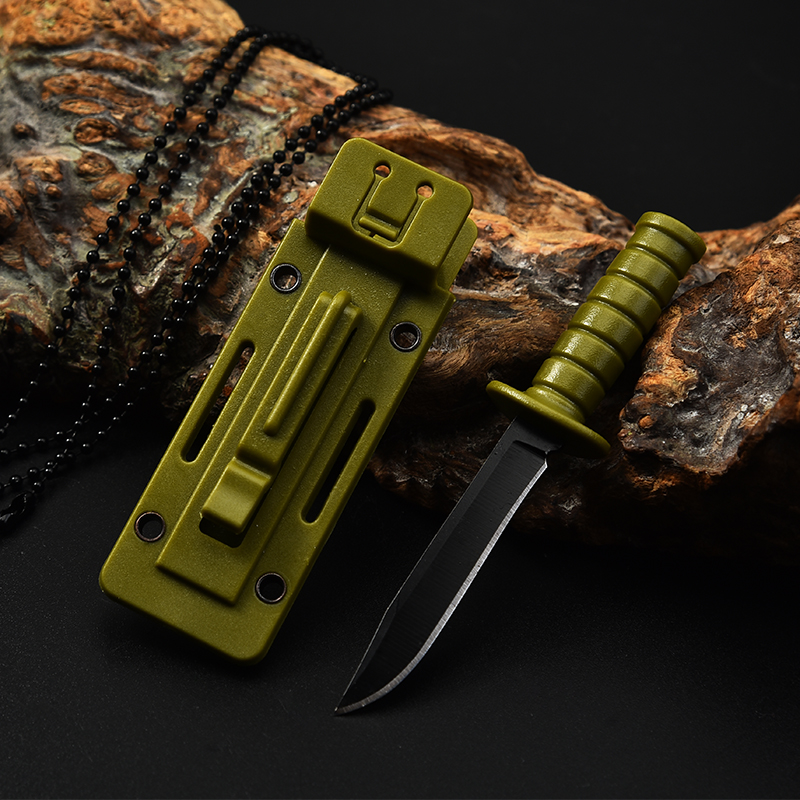
Best fit: Buyers benchmarking a documented dagger model and seeking a manufacturer with an established OEM history.
WE states that it began OEM manufacturing in 2000 and launched its own branded knife line in 2016. Its published catalog includes an OSS fixed-blade dagger, making the link to this article's product category clearer than for many general knife suppliers. The company also describes in-house research and development and collaborative design.
Established: 2000, according to WE. Markets: Its public-facing brand and support operation has an international reach, but a buyer should request destination-specific experience relevant to the project. OEM/ODM scope: Historical OEM manufacture and design collaboration are documented; current availability for a new private-label dagger must be confirmed directly. A retail catalog item is evidence of a product type, not an offer to reproduce that model for another brand.
Best fit: Buyers considering a dagger alongside a wider range of fixed blades and outdoor tools.
Svega says it was founded in 2002 in Yangjiang and markets folding knives, daggers, axes, and other outdoor products. It also presents itself as an OEM/ODM supplier. This breadth makes it a reasonable RFQ candidate when a buyer wants related products under one sourcing relationship.
Established: 2002, according to the company. Markets: Svega describes service to global brands and specialty retailers, without a sufficiently specific destination breakdown for this shortlist. OEM/ODM scope: Outdoor-knife and tool customization is promoted; confirm which dagger processes occur in-house, the minimum order per finish, and whether the supplier accepts buyer-owned drawings and tooling. Its public references to flexible MOQ are not a quote for a particular design.
Best fit: Buyers seeking to evaluate a larger stated facility and a company active across several knife formats.
Honglin describes a 20,000 m² facility and teams covering research and development, sales, and quality control. Its company profile lists OEM/ODM, design, and customization services; another supplier profile lists fixed-blade knives among its principal products. Those facts support an inquiry, but not an assumption that every fixed-blade pattern has already been made at commercial dagger volumes.
Established: A specific registration year was not confirmed in the reviewed company profile; it states more than 10 years of knife-manufacturing experience. Markets: A supplier listing names North America, South America, Europe, Asia, Africa, Oceania, and the Middle East; request recent shipment references for the destination that matters to you. OEM/ODM scope: Design and customization are advertised. For a fixed blade with a sheath, ask Honglin which entity makes the sheath and conducts final assembly.
Best fit: Buyers who want to compare fixed-blade options and discuss private-label or custom knife development through a Yangjiang-based supplier.
LeeKnives presents fixed-blade products as well as OEM knife manufacturing, packaging, and shipping services. Its broader knife range may make it useful for buyers consolidating multiple categories, although the reviewed fixed-blade pages do not establish dedicated dagger capacity.
Established: The company's own material traces its operation to 1993; confirm the legal entity and factory history during diligence. Markets: LeeKnives markets international fulfillment, but request evidence for your particular import market. OEM/ODM scope: It promotes customization and private-label services; ask for a written account of whether LeeKnives manufactures, coordinates partner factories, or does both for the proposed SKU. That distinction affects inspection rights and accountability.
Best fit: Buyers developing outdoor or collectible fixed-blade lines who need to discuss drawing revisions and sampling.
World Backyard describes design and drawing support, material selection, prototyping, and mass production for OEM/ODM knives. Its product range includes outdoor, tactical-style, and collectible blades. These are relevant capabilities to examine for a dagger project, though the buyer must validate any exact double-edge specification through a sample.
Established: A founding year was not clearly verifiable from the reviewed company page. Markets: The company says it serves buyers in North America, Europe, Australia, the Middle East, and Asia. OEM/ODM scope: It lays out a development-to-production workflow, but public page counters did not provide dependable numerical capacity evidence. Ask for dated production records rather than copying animated website figures into an approval file.
Best fit: Buyers studying branded fixed-blade development who want to ask about possible contract manufacturing.
Kubey says its brand was registered in 2014 and that a knife-manufacturing factory followed in 2017. It describes design, development, production, and trade, and lists fixed blades among its categories. Its existing designs can inform a capability discussion, but they do not establish that Kubey currently accepts outside dagger OEM work.
Established: Brand registration in 2014; stated factory establishment in 2017. Markets: Confirm target-market supply experience directly. OEM/ODM scope: Development and production are described publicly, while availability, design ownership, MOQ, and exclusivity for an outside brand require direct confirmation.
Best fit: A benchmark for fixed-blade materials and finish quality; treat it as a potential custom-project contact only after confirming that service is available.
QSP's public catalog includes fixed-blade and neck-knife collections as well as named fixed-blade models. For a purchasing team, that makes it useful for reviewing the level of product documentation a supplier can provide. A consumer-facing catalog, however, is not proof of an open OEM program.
Established: A founding year was not verified from the reviewed official page. Markets: Its website sells internationally, but current manufacturing or OEM destination markets should be confirmed. OEM/ODM scope: Not established by the reviewed catalog. Include QSP in outreach only if it confirms it accepts external development projects and can identify the legal contracting and manufacturing entities.
Best fit: Buyers whose range may extend beyond daggers to survival knives, pocket knives, and multitools.
Grand Harvest describes more than 30 years of knife and tool activity and lists OEM/ODM experience on its product pages. The categories demonstrate broader knife-manufacturing relevance, but the reviewed material does not independently verify a current dagger line.
Established: A 1993 founding date appears in public company material; confirm it against registration documents. Markets: The company refers to customers worldwide without a detailed breakdown. OEM/ODM scope: It states that it provides these services for knives and tools. Request a comparable fixed-blade sample and a process map before treating that experience as transferable to a dagger design.
Best fit: Buyers willing to conduct direct diligence with an established Yangjiang knife company rather than rely on a current online dagger catalog.
A public company listing describes Sanbao as established in 1994 and historically employing more than 300 people. Those points merit an inquiry, but they do not verify today's workforce, output, dagger specialization, export destinations, or availability for a new OEM order.
Established: 1994, according to the listing. Markets: Not reliably established from the reviewed source. OEM/ODM scope: Not sufficiently documented for this article; request a current capability deck, relevant samples, customer-market references, and an on-site or independent audit. Sanbao is the least substantiated dagger candidate here and should remain on the shortlist only if it answers those requests satisfactorily.
The strongest RFQ starts with a lawful, clearly defined product. In ordinary use, *dagger* can describe a fixed blade with two sharpened edges, but product names alone cannot determine legal classification. Before commissioning samples, have a qualified importer or customs adviser review the exact blade configuration, intended market, sales channel, and local restrictions. UK border guidance identifies several prohibited or restricted knife types; U.S. Customs and Border Protection also flags restrictions on switchblades and other spring-loaded knives. Neither authority's guidance should be replaced by a supplier's assurance that a parcel is "easy to ship."
Send every shortlisted supplier the same revision-controlled RFQ. It should define the intended use and destination, drawings, steel grade, finish, handle and sheath materials, packaging, inspection criteria, annual forecast, initial order quantity, and requested Incoterm. This prevents a low headline price from masking a different steel, finish, or inspection scope.
For materials, ask for the steel's specified grade or standard—not simply "high carbon," "stainless," or "Damascus." Match the mill paperwork to the purchased batch, and agree in advance on how an independent laboratory will resolve a disputed grade. Specify hardness as an agreed measurement range and test location rather than accepting one attractive number on a sample card. A report should identify the test method, measured pieces, batch, and date.
For workmanship, define acceptable variations in blade symmetry, point alignment, surface finish, handle fit, sheath retention, marking, and packaging. Record measurements and photographs on the approved sample. A sample that looks right but lacks measurable acceptance criteria is a weak reference for production.
1. Confirm identity and scope. Obtain the Chinese legal name, business licence, factory address, and name of the contracting and invoicing entity. China's National Enterprise Credit Information Publicity System is an official route for checking registered-company information.
2. Review feasibility before tooling. Ask the factory to identify processes it will perform, processes it will outsource, drawing changes it recommends, and any cost or schedule consequences.
3. Approve a documented prototype. Record the drawing revision, actual materials, finish, measurements, and test results. Pay particular attention to differences between hand-finished samples and the proposed production process.
4. Approve a pre-production reference. Have both parties identify and retain a matching reference after tooling and production methods are settled.
5. Inspect the order. Agree on the sampling plan, critical defects, corrective-action process, and release authority *before* production starts. For an initial order, an independent pre-shipment inspection is a sensible contractual option.
6. Control changes and shipment. Prohibit material substitutions or outsourced-process changes without written approval. Confirm the product description, classification, packing method, destination rules, and carrier acceptance with the importer and freight provider before dispatch.
A polished prototype may be produced with individual attention, while the bulk order is processed on different fixtures, by another finishing team, or with a substituted sheath supplier. The result can be a run whose parts each appear acceptable but no longer fit together consistently. This is a procurement risk to test, not an allegation about any company in this list.
Avoid it by approving a *production-method* sample, not just an appearance sample. Identify which operations may be subcontracted; require a first-piece review after any fixture, material lot, or subcontractor change; and inspect assembled knife-and-sheath pairs drawn from the actual order. Tie the contractual acceptance standard to the retained pre-production reference and its written tolerances.
Do not request a generic "CE certificate for daggers." The European Commission says CE marking is mandatory only for products covered by the relevant EU rules and must not be affixed to other products. Likewise, EU RoHS addresses electrical and electronic equipment; it is not a universal approval for a conventional, non-electrical steel knife. Ask which exact requirement applies to the finished SKU and destination market, then request the corresponding evidence. Consumer-product safety, packaging, chemical-content, and local knife restrictions should be assessed separately where applicable.
For commercial planning, request separate quotations for an existing design with private labeling, an altered existing design, and a new design. The MOQ for each can differ substantially because of tooling, material purchase quantities, finish changes, and packaging. Ask for lead times measured from *approved sample and deposit*, not from the date of the first inquiry. Treat any quoted capacity as a dated commitment for the intended SKU, not a general statement about factory size.
The right dagger manufacturer is the one that can make a lawful, documented, repeatable product at the quantity your business actually needs. Use these ten companies as an outreach list, not as a substitute for checking the legal entity, reviewing a comparable sample, confirming the production route, and inspecting the first bulk order.
For a new private-label or OEM/ODM program, is a relevant first conversation: it lists dagger products and reports its own design, technical, and production resources. Send a drawing or product brief, destination market, expected order volume, and required delivery date to request a project-specific feasibility review and quotation. Compare its written response with other qualified suppliers on the same specification before placing an order.

Request the certificate number, exact legal entity, covered site, scope, issuer, and validity dates. Search IAF CertSearch where applicable, then contact the issuing certification body if the record is absent or unclear. A genuine certificate held by an associated trading company is not automatically evidence that the factory making your order is covered.
Not without establishing batch traceability. Ask how incoming material is identified and linked to finished production lots; specify what documents and independent tests will be supplied for each order. An old certificate, even for the right grade, does not identify the steel in a later shipment.
No. Approve a sample made with the intended production process, define tolerances, retain reference units, and give the factory a written change-control procedure. Inspect production pieces rather than relying solely on pre-shipment photographs.
Ask each supplier to quote the same drawing revision and separate tooling, samples, unit price, packaging, inspection, and freight terms. Then request prices at several annual and per-order volumes. A lower MOQ may carry a higher unit price, and a lower unit price may require buying more inventory than the brand can sell.
Do not rely on that answer. A different blade, opening mechanism, destination, importer, or sales channel can change the result. Obtain destination-specific advice on the exact SKU before paying for production or booking freight; confirm carrier acceptance and accurate customs documentation as separate steps.
- [China's General Administration of Customs: 2025 HS-section export data]. Chapter 82 provides broad trade context, not a dagger market total. [english.customs.gov]
- [Xinhua: Yangjiang knife and scissors exports, January–April 2025]. [english.news]
- [IndexBox: China knives, scissors and blades market analysis]. Its published export figures concern a wider product group, not daggers alone. [indexbox]
- [European Commission: CE marking rules] and [RoHS scope]. [single-market-economy.ec.europa]
- [ISO: How to verify accredited certification] and [IAF CertSearch]. [iso]
- [UK guidance on import controls for offensive weapons] and [U.S. CBP knife-import guidance]. [gov]
- [European Commission guidance on checking Chinese company information]. [intellectual-property-helpdesk.ec.europa]


